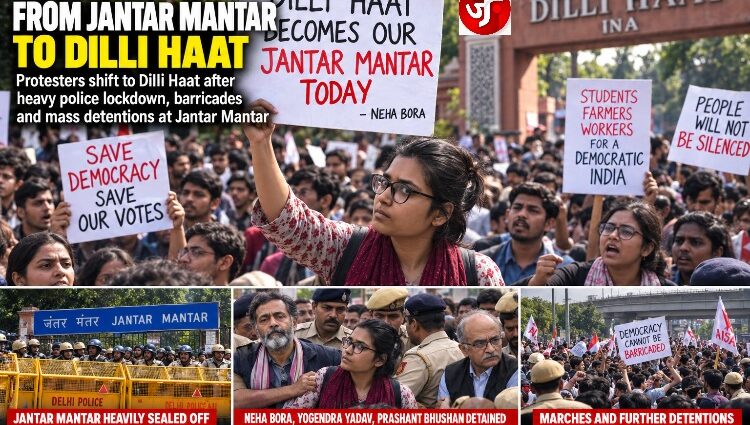
Neha Bora, Yogendra Yadav And Prashant Bhushan Detained As Dissent Meets A Wall Of Barricades
October 10, 2026: Jantar Mantar was the intended destination. Dilli Haat became the rallying cry. And as barricades, heavy police deployment and mass detentions shut down access to the original protest site, demonstrators sought another way to make their voices heard.
“Dilli Haat becomes our Jantar Mantar today,” declared AISA leader Neha Bora, urging people to assemble at Dilli Haat in INA after restrictions around Jantar Mantar prevented protesters from gathering there as intended.
The change of venue was not simply a logistical adjustment but an on-the-ground response to a city centre transformed by police restrictions, with demonstrators attempting to reach the very place where they had planned to protest.
Reports on October 10 said activists, including Neha Bora, farmer leader and political activist Yogendra Yadav, and senior advocate Prashant Bhushan, were detained as they marched from or near Dilli Haat towards Jantar Mantar. Further detentions and clashes were reported during the afternoon, including near Safdarjung Flyover, as protesters attempted to move towards the original gathering point.
Jantar Mantar remained heavily sealed off. The protest, however, did not simply disappear, it rather shifted. Jantar Mantar has long been associated with public demonstrations, political dissent and citizens demanding accountability. On October 10, the restrictions around the site became central to the story itself.
With access blocked by barricades and police personnel, organisers and demonstrators redirected their efforts to Dilli Haat. What followed, according to reports, was a series of attempts to march towards Jantar Mantar, accompanied by further detentions and confrontations.
Neha Bora’s declaration captured the defiance of a protest struggling to find physical space in the national capital. If one public gathering point was inaccessible, another would have to serve. The location could change; the demands driving the demonstration would not automatically disappear with it.
The episode raises a fundamental question for any democracy: what does the right to peaceful protest mean when people cannot reach the place where they intend to assemble?
Public order is a legitimate responsibility of the authorities. But restrictions on demonstrations, detentions of activists and the sealing off of protest sites also demand public scrutiny. The crucial issues are whether the restrictions are lawful and proportionate, whether peaceful assembly is being facilitated wherever possible, and whether those detained are being treated in accordance with the law.
The reported detention of Neha Bora, Yogendra Yadav and Prashant Bhushan brought renewed attention to the police action surrounding the gathering.
Their detention was particularly significant because the march was an attempt to move towards the original protest site after the restrictions had already forced demonstrators to assemble elsewhere.
Further reports of detentions and clashes, including near Safdarjung Flyover, suggested that the confrontation extended beyond the immediate perimeter of Jantar Mantar.
The sequence matters: the planned gathering encountered restrictions, organisers redirected protesters to Dilli Haat, and activists then attempted to march towards Jantar Mantar. The resulting police action became another flashpoint in the wider dispute over access to public protest spaces.
For a movement centred on democratic accountability, the manner in which the state responds to peaceful dissent is not a side issue, but reinforced the central question – detaining peaceful people signals the death of democracy.
JANPATH NEWS NETWORK (JNN)
Independent. Fearless. On the People’s Path.