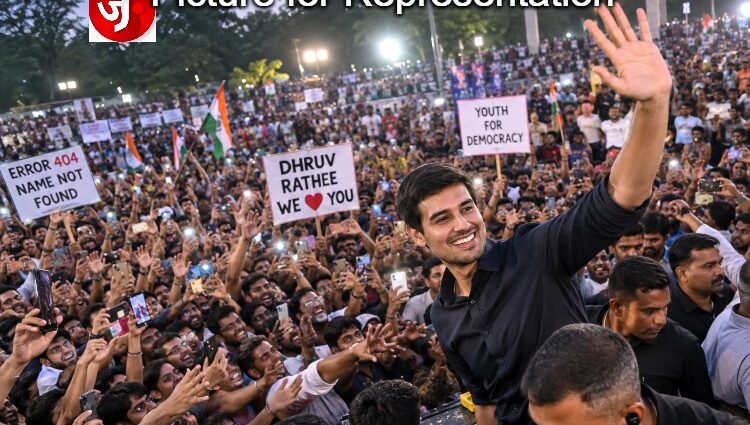
At Bengaluru’s Freedom Park, the digital world met the streets as Dhruv Rathee joined a protest over electoral transparency. His presence drew attention, his words challenged political loyalties, and the crowd offered a glimpse of how India’s new generation of digital influencers is reshaping public debate.
October 9, 2026: The man millions of Indians know through a screen stepped into the middle of a political storm, and suddenly, the story was no longer just about YouTube.
Dhruv Rathee’s appearance at Bengaluru’s Freedom Park sent a powerful message about his growing popularity as a crowd-puller. The YouTuber, whose political videos command millions of views, brought the excitement of the digital world into a real-life political gathering, where supporters and curious onlookers came together amid roaring slogans and palpable energy. For many, seeing a familiar face they had followed on their screens was an entirely different experience. His presence alongside Prakash Raj and CJP founder Abhijeet Dipke amplified the event’s visibility, demonstrating how digital influence can spill onto the streets and turn an online personality into a powerful presence in public life.
The atmosphere at Freedom Park was punctuated by slogans that blended political anger with the irreverent language of the internet.
“Vote Chor, Gaddi Chhod” echoed through the gathering. Placards carried messages such as “Error 404 – Name Not Found” and “Gyanesh, it’s done bro, resign sir”, turning concerns about electoral rolls into slogans that were instantly recognisable to a generation raised on digital culture.
The language was cheeky. The underlying concern was not.
The People’s Tribunal heard accounts from people who alleged that they had been affected by the electoral-roll revision. Among the issues raised were claims of names being removed and difficulties faced by people who lacked formal documentation. These accounts gave the protest a human dimension beyond the speeches of prominent personalities.
For someone like Rathee, whose public identity rests on explaining complicated issues to a mass audience, this was a particularly significant setting. Electoral rules can sound technical and remote. The possibility of an eligible citizen losing the ability to vote makes the consequences immediate.
The distinction between an allegation and an established fact remains crucial. Yet the people who raised concerns were asking a question that democratic institutions must be able to answer: if an eligible voter is wrongly removed, what effective and transparent process exists to correct the mistake?
Rathee did not begin his speech by pretending the controversy surrounding his participation did not exist.
He addressed claims that he had come to India to bring about regime change and rejected suggestions that Elon Musk or George Soros had funded his appearance.
Some of the statements he made were:
“There is no transparency. Zero transparency and zero accountability.”
His criticism of the Election Commission’s handling of electoral-roll revision.
ON VOTING RIGHTS
“Whether you vote for the BJP, whether you vote for the Congress, or whether you support any other party, this is an issue that concerns every citizen of the country.”
His appeal to move the debate beyond party loyalties.
ON ALLEGED VOTER DELETIONS
“Names are being added at will, names are being removed at will.”
An allegation he made while questioning the procedures used to revise electoral rolls
ON THE DEMAND FOR RESIGNATION
“Gyanesh has to resign.”
His demand concerning Chief Election Commissioner Gyanesh Kumar.
HIS CALL TO CITIZENS
“If you believe that every citizen in this country should have the right to vote, then you too should support our cause, and you should also come and join the protest.”
“I have not come here for regime change,” he said, according to reports of his address, adding that he had travelled using his own money.
It was a revealing moment. Before he could argue about electoral transparency, he was confronting questions about his own legitimacy as a participant in the debate.
His response was direct, but it also exposed a larger problem in modern political discourse. Arguments about the messenger can sometimes overshadow the message. Questioning a speaker’s motives is legitimate; using speculation about those motives as a substitute for examining the evidence is not.
Rathee’s own political positions deserve scrutiny, just as the claims made by the protesters and the responses of the Election Commission deserve scrutiny. None should be exempt from evidence-based examination.
Why Rathee’s popularity matters now
Rathee’s importance is not that he is automatically right, nor that a large audience makes an argument true. It is that he can bring questions about public institutions to an audience far beyond the people standing in front of a stage.
His appearance in Bengaluru illustrated three changes in Indian politics.
First, political communication has become less dependent on traditional gatekeepers. A digital creator can establish a national audience without owning a newspaper or hosting a television programme.
Second, online audiences can become a source of visibility for physical movements. A protest that might otherwise remain a local event can attract wider attention when a well-known creator participates.
Third, political influence is becoming increasingly personal. Audiences often feel that they know a creator through repeated exposure to their videos. That familiarity can make a message more compelling, although it can also encourage viewers to accept claims without sufficient verification.
The challenge for journalism is to recognise this influence without confusing popularity with proof.
The controversy that followed
Rathee’s appearance also attracted criticism. Former Bengaluru police commissioner Bhaskar Rao subsequently called for an examination of Rathee’s citizenship and immigration status.
That request introduced a new controversy around the protest. However, a demand for an investigation is not evidence of a violation, and questions about legal status should be resolved through the relevant facts and applicable law rather than speculation.
The episode demonstrated how quickly a political appearance can generate competing narratives. For supporters, Rathee’s participation represented a willingness to question authority. For critics, it raised questions about his political motives and his role in a domestic demonstration.
Both the criticism and the defence deserve to be assessed on their merits. The larger issue raised at Freedom Park, electoral transparency, should not disappear beneath a debate about one individual.
Beyond one man, one rally and one day
It would be premature to declare that Rathee’s appearance has transformed the anti-SIR movement. A single rally cannot establish the durability of a political campaign, and a crowd’s enthusiasm does not necessarily translate into policy change.
But October 8 offered a striking picture of India’s changing political landscape.
A digital commentator stood alongside an actor-activist and a youth-led political movement. Citizens brought their grievances to a public tribunal. Students and protesters raised questions about electoral procedures. Slogans designed for an internet generation rang out in a physical public space.
Rathee was an important part of that picture, but the citizens whose voting rights were at issue were its central subject.
That distinction matters. Political movements become stronger when they are built around verifiable public concerns rather than the fame of any single personality.
The real test of the Bengaluru protest will not be how loudly the crowd shouted, how widely the videos circulated or how many people recognised Dhruv Rathee. It will be whether the questions raised at Freedom Park receive credible answers, whether eligible voters can exercise their rights, and whether institutions respond with the transparency that public trust demands.
Dhruv Rathee arrived at Bengaluru’s Freedom Park with the weight of millions of online followers behind his name. But his message was directed at people beyond his digital audience, including those who vote for the very party he frequently criticises. His challenge was straightforward: electoral rights should not become a matter of political allegiance. In a country where political loyalties can divide families, communities and entire newsrooms, that was the central argument he placed before the crowd.
JANPATH NEWS NETWORK (JNN)
Independent. Fearless. On the People’s Path.