










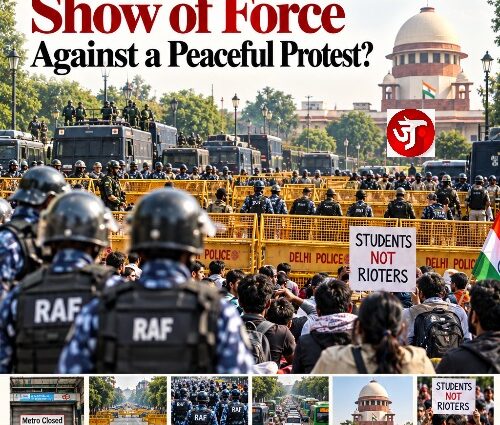
Rahul Gandhi and India Bloc will march to the Supreme Court at 1:30 PM, but ahead of this, Delhi turning into a fort-like zone exposes a troubling question: why must an entire city pay the price when citizens seek a peaceful march?
October 12, 2026: Delhi looks less like a capital preparing for a peaceful democratic demonstration and more like a city bracing for a battle. Barricades choke major roads, key access points are sealed, Metro stations are shut, traffic is diverted, and police and Rapid Action Force (RAF) personnel are deployed in overwhelming numbers. The sheer scale of the security operation raises an uncomfortable question: what image of India is the government projecting to the citizens of India and the world? Is it suggesting that citizens exercising their democratic rights are dangerous rioters who must be contained by a paramilitary force?
On October 9th, the Supreme Court itself expressed concern on October 9 about excessive restrictions imposed ahead of an earlier protest, invoking the principle of proportionality and warning against using a “hammer to kill a fly.” It is important to note that the government has heeded to a part of the Supreme Court’s orders by not cutting Internet, and closing only six entry point, not over 40 such as during the last protests.
Section 163 is imposed in designated areas, including around Jantar Mantar, which the Supreme Court had also directed authorities to remove the notice imposing Section 163.
Congress workers already gathered early near Mandi House have encountered barricades, while security has been intensified around the Supreme Court and other parts of central Delhi. The authorities cite security concerns, but the scale of the restrictions raises a fundamental question: is this proportionate security, or an excessive response to a political demonstration?
The six Metro stations affected are Patel Chowk, Janpath, Rajiv Chowk, Mandi House, Central Secretariat and Barakhamba Road. Entry and exit were restricted from 6 am to 4 pm, although interchange facilities remained operational.
The question is not whether the police should maintain order, which is important, but it is whether such extensive restrictions are necessary when a protest can potentially be managed through targeted security, negotiated routes and reasonable safeguards.
The Constitution guarantees citizens the right to assemble peacefully and without arms under Article 19(1)(b), subject to reasonable restrictions. The right to protest does not override public safety, but neither should public safety become a blanket justification for making peaceful dissent extraordinarily difficult.
There is also an important development concerning the Chief Justice of India, Justice Surya Kant. Rahul Gandhi and Congress president Mallikarjun Kharge had sought a meeting to submit a memorandum concerning alleged electoral irregularities, the Special Intensive Revision (SIR) of electoral rolls and demands for action against Chief Election Commissioner Gyanesh Kumar. The CJI declined the request. According to reports, his response cited the separation of powers, the fact that related issues were already before the Court, and the need to pursue grievances through formal judicial proceedings. He indicated that a petition could be filed for consideration by the Court.
The INDIA Bloc says it is marching to raise concerns about electoral integrity and democratic accountability, but Delhi is being turned into a fortress!
The irony is difficult to ignore. Many among the protesters are students, young people and ordinary citizens angry about alleged paper leaks and alleged electoral irregularities and demanding a cleaner, more accountable government. They are citizens seeking answers, not enemies invading their own capital.
When a peaceful protest is surrounded by the imagery of a war zone, who benefits from that spectacle? Does it reassure the public, or does it intimidate citizens and risk portraying democratic dissent as a threat to national stability?
A government confident in its democratic mandate should be able to face criticism without making its capital look like a city under siege. The world is watching, and so are India’s citizens. The real test of democracy is not how effectively a government can barricade its streets, but how willingly it allows people to question those in power.
Delhi’s extraordinary security arrangements raise a separate but equally important issue: how can the authorities protect public order without imposing disproportionate restrictions on peaceful protest and the daily lives of ordinary citizens?
JANPATH NEWS NETWORK (JNN)
Independent. Fearless. On the People’s Path.