










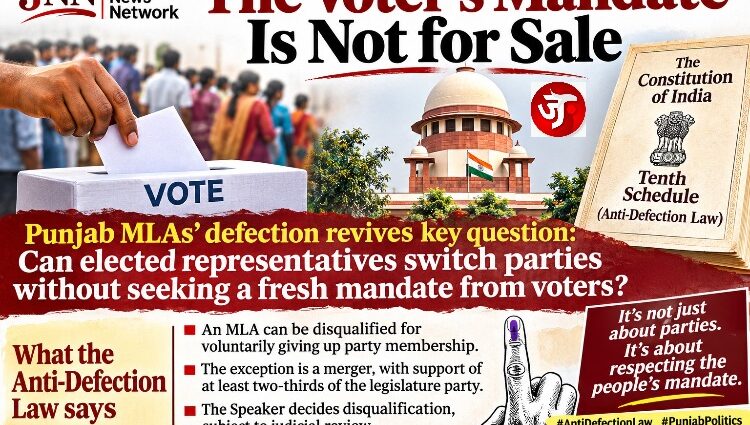
Punjab’s AAP defections revive questions over India’s Anti-Defection Law allowing legislators to switch parties without seeking voters mandate
NEW DELHI – NOVEMBER 2, 2026
Two Aam Aadmi Party (AAP) legislators in Punjab have resigned from the party and announced their intention to join the Bharatiya Janata Party (BJP), triggering fresh questions about the effectiveness of India’s Anti-Defection Law and whether elected representatives can change political allegiance without seeking a renewed mandate from voters.
Harmeet Singh Pathanmajra, MLA from Sanaur, and Chetan Singh Jouramajra, MLA from Samana, announced their departure from AAP on November 1, a day after the party released its first list of 40 candidates for the 2027 Punjab Assembly elections. Both are expected to be formally inducted into the BJP.
The political development has once again brought India’s constitutional provisions against defection into focus. The central question is straightforward: When voters elect a candidate on the ticket of a particular political party, should that legislator be allowed to switch to another party midway through the Assembly’s term without seeking the people’s approval?
India has a law designed precisely to prevent such political manoeuvring. Yet, more than four decades after its introduction, the Anti-Defection Law continues to face questions about its enforcement, effectiveness and ability to protect the electoral mandate.
The Constitution’s answer: The Tenth Schedule
The Anti-Defection Law was introduced through the 52nd Constitutional Amendment in 1985 and incorporated into the Constitution as the Tenth Schedule.
It was intended to curb the widespread practice of elected legislators switching political parties for political advantage, ministerial positions or other inducements.
Under Paragraph 2 of the Tenth Schedule, an elected legislator can be disqualified if they voluntarily give up membership of the political party on whose ticket they were elected.
A legislator can also face disqualification for voting or abstaining from voting contrary to the directions issued by their political party, without prior permission, unless the party condones the action within 15 days.
Importantly, the law does not require a formal resignation letter from the party. The Supreme Court has clarified that a legislator’s conduct can establish that they have voluntarily given up party membership.
Therefore, an MLA who announces a departure from AAP and joins the BJP while continuing to occupy an Assembly seat could face disqualification proceedings under the Tenth Schedule.
The two-thirds exception: A provision frequently misunderstood
One of the most misunderstood provisions of the Anti-Defection Law concerns the two-thirds merger exception.
Under Paragraph 4 of the Tenth Schedule, legislators are protected from disqualification if their original political party merges with another political party and at least two-thirds of the members of its legislature party agree to the merger.
This is not a general permission for two-thirds of MLAs to abandon their party and join another political organisation.
The original political party must itself merge. Simply assembling two-thirds of legislators and announcing a change of allegiance does not satisfy the constitutional requirement.
The distinction became particularly important after the 91st Constitutional Amendment in 2003 abolished the earlier provision that protected legislators forming a separate faction with at least one-third of the legislature party.
In other words, the Constitution no longer recognises an ordinary legislative split as a defence against disqualification.
The resignation route: Where the political and constitutional questions become complicated
There is another route through which the political consequences of defection can unfold.
An MLA may resign from the Legislative Assembly before joining another political party.
Under Article 190(3)(b) of the Constitution, a legislator’s resignation becomes effective only when it is accepted by the Speaker. The Speaker must also be satisfied that the resignation is voluntary and genuine.
If an MLA’s Assembly resignation is accepted, the seat becomes vacant. The individual is no longer a sitting legislator and the ordinary disqualification process under the Tenth Schedule cannot simply remove them from a seat they no longer occupy.
They may subsequently join another party, but they cannot continue as an MLA in the vacated seat. They would have to seek election again to return to the Assembly.
This distinction is central to the present debate. Resigning from a political party and resigning from the Assembly are two different legal acts with different constitutional consequences.
The question, therefore, is whether legislators should be able to circumvent the spirit of the Anti-Defection Law by surrendering their party membership, resigning their seats and subsequently returning to electoral politics under another party’s banner.
The Constitution permits resignation, but it also requires the Speaker to examine whether it is genuine and voluntary. The larger question of political accountability remains.
What happens if an MLA is disqualified?
Disqualification under the Tenth Schedule carries significant consequences.
An MLA loses membership of the Assembly and cannot continue exercising the rights of an elected legislator.
Article 164(1B) also restricts a disqualified state legislator from being appointed a minister for the constitutionally prescribed period.
Article 361B further prevents a legislator disqualified under the Tenth Schedule from holding a remunerative political post for the applicable period.
However, the law does not prescribe automatic imprisonment or a criminal fine merely for changing political parties. Its principal penalty is constitutional disqualification.
A disqualified legislator is not permanently barred from electoral politics. They can contest an election and, if elected, regain legislative membership.
Who decides whether an MLA has defected?
Under Paragraph 6 of the Tenth Schedule, the Speaker of the Legislative Assembly decides questions of disqualification arising from defection.
In Punjab, this responsibility rests with the Speaker of the Punjab Legislative Assembly.
However, the Speaker’s decision is not beyond judicial scrutiny. The Supreme Court has established that decisions under the Tenth Schedule are subject to judicial review on constitutional grounds.
In its landmark May 2023 judgment in Subhash Desai v. Principal Secretary, Governor of Maharashtra, the Supreme Court examined the relationship between political parties and their legislative parties, the merger exception and the constitutional consequences of defection.
The judgment also reaffirmed that a faction cannot simply claim to represent the original political party as a defence against disqualification.
The court described the Tenth Schedule as a constitutional response to the destabilising practice of legislators shifting political allegiance after being elected.
The democratic dilemma: Whose mandate does an MLA carry?
Beyond the legal provisions lies a more fundamental democratic question.
When voters elect an AAP candidate in Punjab, they are not merely electing an individual. They are also making a political choice based on the party’s manifesto, leadership, promises and programme of governance.
If that legislator subsequently joins the BJP, the political identity under which the mandate was secured changes.
The voters who supported one political platform may find their representative aligned with another without their having been consulted.
The same question applies irrespective of which political parties are involved. The principle must be consistent whether the defection is from AAP to BJP, BJP to Congress, Congress to another party or between any other political formations.
The Anti-Defection Law attempts to protect the stability of elected governments and the integrity of party-based electoral mandates. But the continued use of resignations, political realignments and delayed disqualification proceedings has kept the debate alive.
Does India need stronger anti-defection provisions?
The recurring controversy has prompted calls for reforms to make the law more effective.
Among the proposals debated by constitutional experts and political observers are:
- Transferring the power to decide disqualification petitions from the Speaker to an independent constitutional authority.
- Establishing strict and enforceable timelines for deciding defection cases.
- Strengthening safeguards against resignations that are used to engineer changes in legislative strength.
- Requiring greater transparency when elected representatives change political allegiance.
- Encouraging legislators who wish to abandon the political platform on which they were elected to seek a fresh mandate from their constituencies.
There is also a need to balance party discipline with the legitimate freedom of legislators to express disagreement, especially when questions of public interest and constitutional responsibility arise.
The voters must not become spectators in their own democracy
The Punjab developments are another reminder that India’s democratic accountability cannot end on polling day.
An elected representative receives a mandate from voters, but that mandate also carries a responsibility to honour the political commitments under which the election was contested.
The right to resign from a political party or leave public office is not the issue. The question is whether political realignments should be allowed to alter the composition of an elected legislature without adequate constitutional scrutiny and public accountability.
India’s Anti-Defection Law was enacted to prevent the manipulation of electoral mandates through political switching. Its effectiveness must therefore be judged not merely by the existence of constitutional provisions but by how consistently and promptly they are enforced.
A voter casts a ballot to choose a representative and a political direction. That mandate should not become a transferable political asset, passed from one party to another without accountability to the people.
The larger question for Parliament and the country is whether the Anti-Defection Law, in its present form, is sufficient to protect that democratic principle.
JANPATH NEWS NETWORK (JNN)
Independent. Fearless. On the People’s Path.