





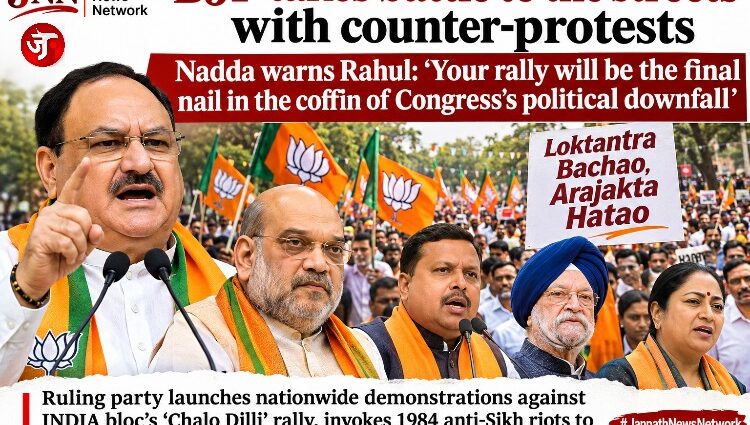
BJP takes battle to the streets with counter-protests: Nadda warns Rahul, ‘Your rally will be the final nail in Congress’s coffin’
Ruling party launches nationwide counter-mobilisation against INDIA bloc’s ‘Chalo Dilli’ rally; invokes 1984 anti-Sikh violence to attack Congress over timing
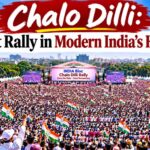
NEW DELHI, November 2, 2026: As thousands gathered in Delhi for the INDIA bloc’s ‘Chalo Dilli’ mobilisation against alleged electoral irregularities and the functioning of the Election Commission, the BJP mounted a parallel political offensive, taking its counter-campaign to the streets in several states.
Led by senior leaders, including BJP president Nitin Nabin, the ruling party organised demonstrations and padyatras under the slogan ‘Loktantra Bachao, Arajakta Hatao’ (Save Democracy, Remove Anarchy), accusing the Opposition of attempting to destabilise democratic institutions after repeated electoral defeats.
The BJP’s counter-mobilisation sought to challenge the INDIA bloc’s narrative on alleged ‘vote chori’, while shifting the political spotlight towards Congress’s historical accountability for the 1984 anti-Sikh violence.
Union Minister J.P. Nadda launched a particularly sharp attack on Rahul Gandhi, questioning the decision to hold the Opposition rally on November 1, the anniversary of the violence that followed the assassination of former Prime Minister Indira Gandhi.
” This rally of yours will prove to be the final nail in the coffin of the Congress party’s political downfall,” Nadda declared, describing the INDIA bloc’s mobilisation as an orchestrated political drama by parties rejected by voters.
He accused Rahul Gandhi of exploiting democratic institutions for political gain and said the country would be governed by the Constitution and the people’s mandate, not what he called ‘riot-based politics’.
BJP brings 1984 riots into the political confrontation
The BJP’s most visible counter-demonstration took place in West Delhi, where party leaders marched alongside families of victims of the 1984 anti-Sikh violence.
Delhi Chief Minister Rekha Gupta and Union Minister Hardeep Singh Puri participated in the march, which sought to commemorate the victims and demand accountability from the Congress.
Puri accused Congress leaders of having encouraged and facilitated violence against innocent Sikh men and women. He said the suffering of the victims and their families remained unresolved.
The BJP argued that holding a political celebration or mass mobilisation on the anniversary of the killings was insensitive to the Sikh community.
The Congress-led INDIA bloc, however, had organised its rally around a separate issue: alleged manipulation and irregularities in electoral rolls and its demand for accountability from Chief Election Commissioner Gyanesh Kumar.
The two campaigns thus brought competing political narratives onto the streets of the capital on the same day.
Nitin Nabin leads BJP’s counter-offensive in Haryana
BJP president Nitin Nabin led a ‘Loktantra Bachao, Arajakta Hatao’ padyatra in Rohtak, Haryana, where he accused the Congress and its allies of targeting constitutional institutions out of frustration over electoral defeats.
Former Union minister Dharmendra Pradhan also participated in a similar padyatra in Faridabad.
Nabin accused the Congress of failing to acknowledge its responsibility for the 1984 violence and argued that the Opposition should have sought forgiveness rather than organised a protest on its anniversary.
The BJP’s message was that questioning the Election Commission and challenging electoral outcomes amounted to an attempt to undermine democratic institutions.
Amit Shah joins the attack
Union Home Minister Amit Shah also targeted Rahul Gandhi, accusing him of organising a political gathering on a day associated with one of the darkest episodes in independent India’s history.
Speaking in Chandigarh, Shah criticised the Congress leadership and said the 1984 killings could not be forgotten.
He also mocked Rahul Gandhi’s political ambitions, arguing that the Opposition’s campaign was an attempt to regain power through street mobilisation rather than electoral victories.
Two competing narratives, one political battleground
The BJP’s counter-protests underline how the controversy surrounding electoral rolls has evolved into a wider political confrontation between the ruling party and the INDIA bloc.
While Rahul Gandhi and Opposition leaders are seeking to make electoral transparency, voter rights and the Election Commission’s accountability central national issues, the BJP is countering with allegations of political opportunism, anarchy and Congress’s historical record.
The invocation of 1984 has added another emotionally charged dimension to the confrontation, particularly for Sikh families who continue to seek justice for the violence.
The November 1 mobilisation was therefore not merely a contest of crowds. It became a contest over competing claims to democratic legitimacy, institutional accountability and political history.
As both sides seek to consolidate their positions ahead of the 2029 general election, the battle over electoral integrity is increasingly being fought beyond Parliament and courtrooms, on the streets of India’s cities.
JANPATH NEWS NETWORK (JNN)
Independent. Fearless. On the People’s Path.