









INDIA bloc demands answers from CEC Gyanesh Kumar over alleged unilateral decisions, voter deletions and the controversial SIR.
TUESDAY, NOVEMBER 17, 2026: India’s electoral watchdog is facing an increasingly serious constitutional challenge.
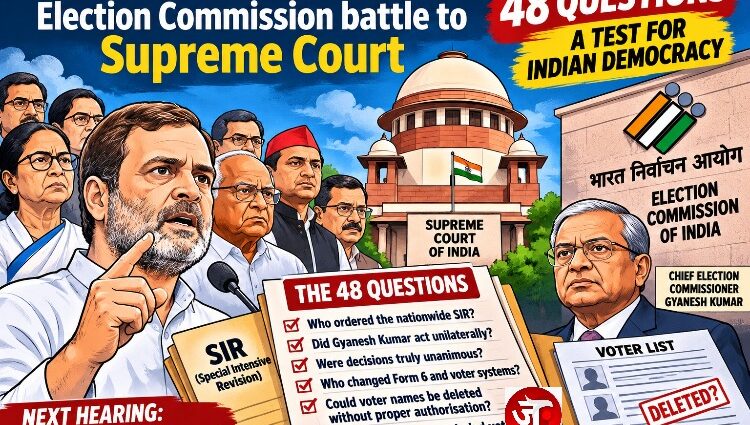
Leader of Opposition Rahul Gandhi, joined by INDIA bloc leaders, has approached the Supreme Court with 48 pointed questions for the Election Commission of India (ECI), demanding accountability over the way electoral decisions are being made, how voter lists are being altered and whether Chief Election Commissioner Gyanesh Kumar has been taking crucial decisions without the concurrence of his fellow Election Commissioners.
This is no longer merely a political confrontation between the Opposition and the ruling establishment. It raises a much larger question: Who holds the Election Commission accountable when questions arise about the integrity of the electoral process itself?
The application, filed on November 16, seeks the Supreme Court’s permission to put formal written questions, known as interrogatories, to the Chief Election Commissioner, the two Election Commissioners and senior officials responsible for the Commission’s information technology systems.
The Opposition wants answers supported by official records and sworn affidavits, not simply assurances that everything was done according to procedure.
SUPREME COURT’S LATEST DEVELOPMENT: DECEMBER 9 HEARING
There has been an important development today, November 17. A Supreme Court bench headed by Chief Justice Surya Kant, comprising Justices Joymalya Bagchi and V. Mohana, has allowed the Election Commission to file its objections to the Opposition’s application seeking permission to serve the 48 interrogatories. The matter has been listed for December 9.
The Court has not yet granted permission for the 48 questions to be formally served. Nor has it ruled on the Opposition’s allegations.
The original constitutional challenge remains before the Court.
At the centre of the controversy is the Special Intensive Revision (SIR), the extensive exercise to revise electoral rolls. The Opposition has repeatedly raised concerns about voter exclusions, unexplained changes to electoral records and the decision-making process behind the nationwide exercise.
The 48 questions seek to establish several things:
1. Who actually ordered the nationwide SIR?
The petitioners want the original decision, the date it was taken, the relevant file numbers and the official records establishing whether all three Election Commissioners approved it.
2. Did Gyanesh Kumar act unilaterally?
The questions seek to establish whether Election Commissioners Sukhbir Singh Sandhu and Vivek Joshi recorded objections, disagreements or reservations over decisions concerning SIR, ECINET, Form 6 and related matters.
3. Were decisions genuinely unanimous?
The Election Commission has maintained that important SIR decisions were unanimously approved by all three members. The Opposition wants the dates, meeting records, file notings and electronic communications that substantiate this assertion.
4. Who changed the voter registration system?
The application raises questions about changes to online Form 6, used by people applying for inclusion in electoral rolls, and whether additional declarations were introduced with proper authorisation.
5. Could voter names be deleted without proper authorisation?
The petitioners want information about whether entries were added, deleted or modified through bulk operations or database-level changes without individual orders from Electoral Registration Officers.
They have also questioned whether deleted entries could be restored through the ECINET system.
6. What happened to excluded voters?
The questions seek state-wise information about voters missing from electoral rolls, the reasons for their exclusion and the number of applications rejected, delayed or left unprocessed.
These are not peripheral administrative questions. They concern the machinery through which citizens exercise their most fundamental democratic right.
THE BIGGEST QUESTION: WERE THE DECISIONS REALLY UNANIMOUS?
One of the most significant aspects of the case concerns the Election Commission’s own internal functioning. In its counter-affidavit filed on October 26, the ECI maintained that the three members had unanimously approved the key SIR decisions.
But the Opposition argues that the Commission has not produced sufficient supporting documentation, including dates, file numbers, minutes and records of individual approvals.
The petitioners have also drawn attention to an earlier RTI response from the Commission’s First Appellate Authority, which reportedly stated that no decision had been taken to initiate a nationwide SIR in 2025.
That apparent discrepancy is now a major part of the legal challenge. If the decisions were unanimous, the Opposition wants to know where the documentary evidence is. If there were disagreements, it wants those disagreements disclosed.
And if changes were made to electoral databases, it wants to know who authorised them. December 9th remains a crucial date for this.
JANPATH NEWS NETWORK (JNN)
Independent. Fearless. On the People’s Path.