









A country sitting on the world’s second-largest proven natural gas reserves is struggling to keep its own homes warm.
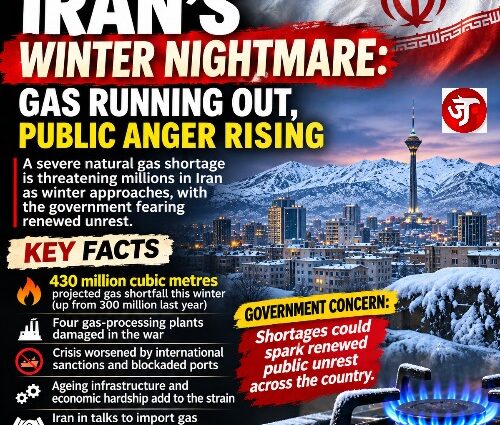
TUESDAY, NOVEMBER 17, 2026: Iran is heading into winter with a deepening energy crisis, and this time the government’s greatest concern may not be just the shortage of gas, but the public anger it could unleash. Millions of Iranians could face the consequences of a severe natural gas supply deficit as temperatures fall, with authorities warning that shortages could lead to supply cuts across the country, including the capital, Tehran.
According to Reuters, Iran is anticipating a winter gas shortfall of approximately 430 million cubic metres, significantly higher than the estimated 300 million cubic metres last year. The figure reflects the projected supply gap during periods of peak winter demand, not a total annual shortage.
The crisis has been intensified by damage to four gas-processing plants during the war with the United States and Israel. The attacks initially knocked out approximately 230 million cubic metres of daily processing capacity. Although around 100 million cubic metres has reportedly been restored, a substantial portion remains unavailable. The consequences could be felt far beyond the energy sector.
A gas-rich nation unable to meet its own needs
Iran possesses the world’s second-largest proven natural gas reserves, after Russia. Yet its enormous energy wealth has not translated into reliable supplies for its population.
Years of underinvestment, international sanctions, ageing industrial equipment and inefficient infrastructure have left the country’s energy system increasingly vulnerable. The war has now compounded those longstanding weaknesses.
The United States’ blockade of Iranian ports has added further pressure, while repairing damaged facilities and restoring lost production capacity remain formidable challenges.
The National Iranian Gas Company has warned that 11 of Iran’s 31 provinces could experience supply difficulties this winter. Among the particularly vulnerable regions are Mazandaran, Golestan and North Khorasan.
Government spokesperson Fatemeh Mohajerani has warned that if consumption remains high, gas cuts could occur nationwide, including in Tehran.
Russia becomes a possible energy lifeline
With domestic production under pressure, Tehran is reportedly discussing the possibility of importing natural gas from Russia. For a country that possesses extraordinary natural gas reserves, the prospect of turning to Moscow to help meet domestic demand highlights the severity of its predicament.
However, negotiations do not guarantee that sufficient supplies will arrive in time to ease the coming winter crisis. Authorities are also considering other emergency measures, including restricting gas supplies to industries to protect household consumption.
Parliament Speaker Mohammad Baqer Qalibaf has urged Iranians to reduce their gas consumption by 10 per cent. First Vice President Mohammad Reza Aref has also warned that excessive consumption amid constrained supplies could lead to higher gas prices.
The political danger: A cold winter and an angry population
The energy crisis comes at a particularly sensitive moment for Iran. The country is already grappling with inflation, rising living costs, damaged infrastructure, economic disruption and the consequences of war. For ordinary families, the possibility of losing reliable heating during winter adds another burden to an already punishing economic reality.
Reuters reports that Iranian leaders are increasingly concerned that gas shortages could fuel renewed public unrest. Security agencies are reportedly monitoring signs of opposition, with the authorities acutely aware that shortages of essential services can become a powerful source of public anger.
The fear is not simply that factories could slow down or households could struggle to keep warm. It is that another failure in the delivery of basic necessities could deepen the growing disconnect between the government and an increasingly frustrated population.
Iran has weathered sanctions, economic isolation and years of political turmoil. But a winter in which people struggle to heat their homes could test the country’s already strained social and political stability.
For Tehran, the coming winter is becoming more than an energy challenge. It is a test of whether the government can protect its people from the consequences of a crisis that has been years in the making and dramatically worsened by war.
JANPATH NEWS NETWORK (JNN)
Independent. Fearless. On the People’s Path.
Sources: Reuters, November 11 and November 16, 2026; Al Jazeera, November 16, 2026