










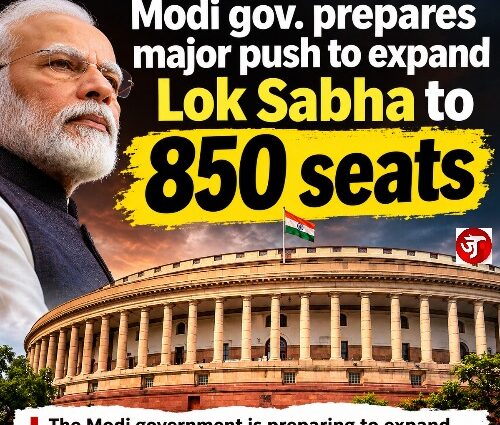
The Modi government is preparing to expand the Lok Sabha through a nationwide delimitation that could reshape India’s political landscape
Wednesday, November 18, 2026: The Narendra Modi government is preparing a renewed parliamentary push to expand the strength of the Lok Sabha from its present 543 seats to a maximum of 850, through a nationwide delimitation exercise that could fundamentally reshape India’s political landscape.
The proposed legislative package is linked to the implementation of the 33 per cent reservation for women in the Lok Sabha and state legislative assemblies, a constitutional commitment passed by Parliament in 2023 but yet to be operationalised.
According to reports, the Centre is considering convening a special session of Parliament ahead of the Winter Session to secure the passage of the necessary constitutional amendments. No official dates have been announced so far.
The proposed expansion would involve redrawing parliamentary and assembly constituencies, potentially changing the distribution of political representation across states.
Why the proposal has become controversial
Delimitation is the process of redrawing electoral constituency boundaries and determining the allocation of seats based on population. India’s parliamentary seat allocation has remained frozen on the basis of the 1971 Census, with the freeze extended until the first Census conducted after 2026.
The government’s earlier proposal sought to use the 2011 Census as the basis for the exercise, while increasing the maximum strength of the Lok Sabha to 850.
This has raised concerns, particularly among southern states, which fear that states with faster population growth could gain a greater share of parliamentary representation at their expense.
Tamil Nadu, Kerala and other southern states have argued that their success in population stabilisation should not translate into reduced political influence in Parliament.
The government has reportedly explored a formula that would increase seats across states while maintaining their existing relative shares. However, the precise formula has not been finalised.
A two-thirds majority hurdle
The proposed constitutional amendment requires a special majority in both Houses of Parliament: a majority of the total membership and at least two-thirds of members present and voting.
The government suffered a significant setback on April 17, when its Constitution (131st Amendment) Bill, 2026, failed to secure the required majority in the Lok Sabha. The legislation received 298 votes in favour and 230 against.
The Opposition had argued that the government was linking women’s reservation to a contentious delimitation exercise that could alter the country’s political balance.
The Centre, however, maintains that expanding parliamentary representation and implementing women’s reservation are necessary steps towards strengthening democratic participation.
Government sources have now expressed confidence that the renewed proposal could secure the required numbers, reportedly anticipating a margin of 15 to 18 votes.
Regional parties could hold the key
The position of regional parties, particularly the DMK in Tamil Nadu and the Samajwadi Party in Uttar Pradesh, could prove significant in the renewed parliamentary contest.
The DMK has been among the strongest critics of delimitation based on population figures that could disadvantage southern states.
The Samajwadi Party, meanwhile, has raised concerns over the broader political implications of the proposed changes and the implementation of women’s reservation.
For the Opposition, the central question is not simply how many additional seats Parliament should have, but how those seats will be distributed and whether the exercise will preserve the federal balance between India’s states.
Why this matters
Delimitation is far more consequential than a routine parliamentary reform. It could determine the political weight of individual states for decades, influence future electoral outcomes and alter the balance of power between northern and southern India.
At the heart of the controversy lies a difficult constitutional question: how can India expand democratic representation without penalising states that have successfully controlled population growth?
With the government preparing another attempt to secure parliamentary approval, the coming weeks could witness a major confrontation between the Centre and the Opposition over the future shape of Indian democracy.
JANPATH NEWS NETWORK (JNN)
Independent. Fearless. On the People’s Path.