









Elon Musk is back in the diplomatic spotlight. He heads to China as Trump brings the world’s richest man into high-level diplomacy.
Elon Musk is travelling to China this week, where US President Donald Trump is scheduled to meet Chinese President Xi Jinping in Shenzhen. His involvement highlights how closely America’s technology, space and electric-vehicle industries are now tied to its geopolitical relationship with Beijing.
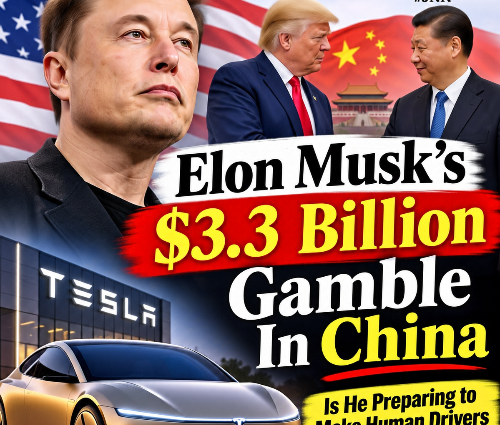
But there is an even stronger business angle emerging from Musk. On November 16, Tesla announced a €3-billion ($3.3-billion) expansion of its German factory near Berlin. The proposed facility is designed to produce up to one million Cybercabs annually. The construction is expected to begin in the first half of 2027, with production is targeted for 2029. The expansion could create several hundred initial jobs.
There is a catch: the driverless taxi business has yet to prove its long-term commercial viability at this scale.
This move could reshape the global taxi industry. Musk is determined to move Tesla beyond conventional electric vehicles and establish it as a major player in autonomous mobility. At the centre of this ambitious vision is Tesla’s Cybercab, a futuristic two-seater electric vehicle designed specifically for autonomous transportation.
Unlike conventional cars, the Cybercab is designed without a steering wheel or pedals. Passengers would simply enter their destination and allow the vehicle’s autonomous driving system to take over.
Musk’s larger ambition is to build a network of driverless taxis that could operate on demand, potentially transforming urban transportation. Instead of employing human drivers, Tesla envisages fleets of autonomous vehicles providing transport services around the clock.
The commercial appeal is obvious: lower operating costs, greater vehicle utilisation and the possibility of generating revenue even when individual owners are not using their cars.
But the technology still faces significant challenges, particularly around road safety, regulatory approval and the ability of autonomous systems to deal with unpredictable traffic conditions.
A billion-dollar bet on the future
For Musk, the German expansion is about more than manufacturing capacity. It represents a strategic investment in what he believes could become one of the world’s biggest transportation markets.
If autonomous taxis become commercially viable on a large scale, the implications could extend far beyond Tesla. Traditional taxi operators, ride-hailing companies, automobile manufacturers and millions of professional drivers could face unprecedented disruption.
However, producing a million vehicles is not the same as putting a million safe, commercially successful driverless taxis on the road. Regulatory restrictions and public confidence will determine how quickly that ambition can become reality.
Musk’s involvement in the wider US-China business relationship reflects the increasingly important role played by technology billionaires in global economic diplomacy.
Tesla’s manufacturing presence in China, its dependence on international supply chains and SpaceX’s position in the global space industry place Musk at the intersection of commerce, technology and geopolitics.
As Washington and Beijing navigate their complex relationship, companies led by influential American entrepreneurs are increasingly exposed to decisions made far beyond corporate boardrooms.
Can Musk actually make human drivers obsolete?
That remains the billion-dollar question. Autonomous transportation promises convenience and potentially cheaper mobility, but it also raises difficult questions about employment, accountability and public safety.
For millions of people who earn their living driving taxis, cabs, delivery vehicles and commercial transport, the arrival of reliable driverless technology could represent a serious economic threat.
Musk has repeatedly presented autonomy as the future of transportation. His latest investment suggests he is prepared to put substantial capital behind that conviction.
But the road to a driverless future may be considerably more complicated than the billionaire imagines.
For Tesla, the stakes are enormous. If Musk succeeds, he could help redefine how the world moves. If he fails, the $3.3-billion gamble could become another expensive reminder that technological ambition and commercial reality do not always travel in the same vehicle.
JANPATH NEWS NETWORK (JNN)
Independent. Fearless. On the People’s Path.