










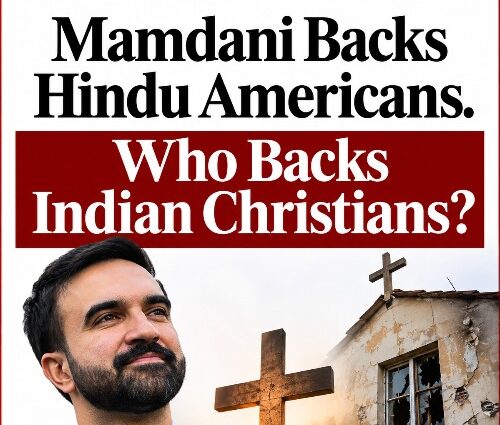
A striking contradiction: Mamdani backs Hindu Americans’ right to worship without fear, Indian Christians face attacks with little protection
Mamdani’s November 18 remarks at a Diwali celebration were unequivocal. Condemning hostility towards Hindu and Sikh communities, he said that Hindu Americans must be able to practise their religion safely and peacefully. He also warned against hatred moving from the political margins into mainstream electoral campaigns. His message was simple: religious freedom is not negotiable, and political leaders have a responsibility to defend it.
He said:
“We all have the responsibility to ensure that Hindu-Americans can live here in safety and in peace and can worship their religion as is their right.”
Now consider what is happening in India to Christians.
The Christian community in India is increasingly taking its grievances to the streets, with thousands of Christians gathering in Kolkata on November 5, 2026, for a six-kilometre prayer march to protest alleged mob attacks, harassment and vandalism targeting churches and prayer meetings across West Bengal. Organised by the Bangiya Christiya Pariseba and the All India Christian Council, the demonstration brought together three processions from Sealdah, the Birla Planetarium and Howrah, converging at Esplanade’s Rani Rashmoni Road, with delegations from 11 states joining the protest.
Similar demonstrations in Kohima, Arunachal Pradesh and Raipur point to a wider concern among Christian communities over religious freedom, the safety of places of worship and the right to practise their faith without intimidation. What is emerging is not merely a series of local protests, but a growing public demand from Christians across India for protection, accountability and equal treatment under the law.
Christians constitute just 2.3 per cent of India’s population, according to the 2011 Census, the latest officially released religion-wise census figures. Yet the scale of reported hostility against this small minority is deeply disturbing.
The Evangelical Fellowship of India’s Religious Liberty Commission documented 747 incidents affecting Christians in 2025, following verification of reports received from across the country. These included 112 incidents of physical violence, 110 disruptions of church services and prayer meetings, 98 cases involving false accusations or legal complaints, 86 arrests, 24 incidents of vandalism and seven church burnings.
The situation has not improved in 2026. The United Christian Forum reported receiving 474 complaints of violence against Christians between January and the end of October. These included assaults, intimidation, damage to religious properties and disruption of worship services. Going to church on a Sunday morning can be quite challenging for Christians, something they would not have imagined a decade back.
West Bengal offers a particularly troubling illustration. In September, two house churches were attacked during Sunday worship. On October 31, a mob allegedly assaulted pastors, women and children during a church inauguration in South 24 Parganas and vandalised the premises. On November 1, another Sunday prayer gathering in Burdwan was reportedly attacked. The Bengal Christian Council has subsequently raised concerns about attacks and disruptions at nine locations across the state. Christians
There have been voices of protest. Rajya Sabha MP Sagarika Ghose led a Trinamool Congress fact-finding delegation to investigate allegations of intimidation, church vandalism and denial of burial rights. Journalist Rajdeep Sardesai has also spoken out against the attacks. Trinamool leader Kunal Ghosh has urged the West Bengal government to intervene. These interventions matter, but they cannot substitute for a sustained response from the country’s highest political leadership.
And this is where the political contradiction becomes impossible to ignore. Why should the protection of religious minorities become a matter of political convenience? Why is religious freedom invoked so forcefully when Indians face discrimination abroad, but treated with such limited urgency when vulnerable communities face intimidation at home?
The question is not whether Hindu Americans deserve protection. They absolutely do. The question is why Christian Indians should have to fight so hard for the same assurance.
There is also a deeper political calculation at work. Attacks on small religious communities can become normalised when perpetrators believe that the consequences will be negligible, when allegations of conversion are used to disrupt ordinary worship, and when political leaders remain reluctant to condemn intimidation unequivocally. Silence, in such circumstances, is not neutral. It can create an atmosphere in which impunity flourishes.
India’s Constitution guarantees every citizen the freedom of conscience and the right to profess, practise and propagate religion under Article 25. A Sunday prayer meeting is not a provocation, a church is not a political battleground. and a pastor is not a criminal simply because he leads a congregation.
Mamdani has understood something that India’s political leadership needs to remember: defending religious freedom is not an act of generosity towards a minority. It is an obligation of democracy.
If Hindu Americans deserve to worship without fear in America, Christian Indians deserve precisely the same freedom in India. Religious liberty cannot be a principle we demand abroad and abandon at home.
JANPATH NEWS NETWORK (JNN)
Independent. Fearless. On the People’s Path.