









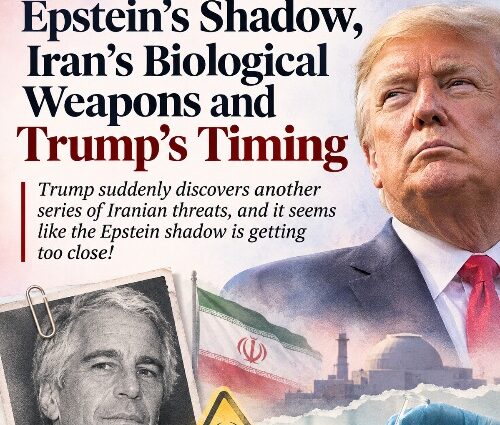
Trump suddenly discovers another series of Iranian threats, and it seems like the Epstein shadow is getting too close!
November 20, 2026
From nuclear ambitions to chemical weapons, biological warfare and dirty bombs, Donald Trump has a new warning about Iran. But with no evidence presented publicly, questions over the timing, the intelligence and the political usefulness of yet another threat deserve as much attention as the allegation itself.
Donald Trump has a peculiar way of keeping the world on edge. Just when one international controversy begins to settle, another warning emerges from the White House. Iran is back in the crosshairs, this time not merely for its nuclear ambitions but for allegedly exploring chemical and biological weapons. The language is ominous, the threats are sweeping, and the evidence offered to the public is conspicuously thin.
In an interview with Fox News correspondent Jacqui Heinrich in Shenzhen, China, on November 18, Trump announced that Iran was looking at alternative weapons because, according to him, American and Israeli action had made its nuclear programme more difficult to pursue.
He said:
“There is indication that Iran is looking at gases, looking at bio, because we’ve shut them out with the nuclear. Nuclear is much harder.”
He went on to describe biological weapons as “not nice” and added a threat that has become almost routine in his public vocabulary:
“Look, if it does happen, we wipe them out.”
There was no detailed intelligence briefing, no publicly identified evidence, no scientific assessment and no explanation of what precisely the alleged Iranian programme involved. The President of the United States had made an extraordinarily serious allegation, but the world was being asked to take his word for it.
Intelligence agencies may possess information that cannot immediately be made public. But there is a considerable difference between an intelligence assessment, an unverified possibility and an established weapons programme. Trump’s choice of words blurred those distinctions.
Even the reporting surrounding the alleged dirty bomb threat against Washington has carried important qualifications. ABC News reported that American intelligence had picked up chatter about a possible attack targeting senior administration officials, but sources cautioned that the credibility of the underlying intelligence had not been verified. American and Israeli officials have also reportedly differed over the extent of Iran’s chemical weapons capabilities and intentions.
And then there is the timing.
The latest Iran warning comes as the Epstein scandal continues to generate uncomfortable questions on both sides of the Atlantic. The investigation into Jeffrey Epstein’s network is no longer simply about the disgraced financier and his convicted associate Ghislaine Maxwell. It is increasingly about the powerful people who crossed his path, the institutions that protected their reputations and the possibility that the full story has yet to emerge.
On November 19, Police Scotland’s Chief Constable Jo Farrell confirmed to Sky News that officers were examining information concerning allegations that women were trafficked to Balmoral, the King’s private Scottish estate, during visits involving Epstein, Maxwell and then-Prince Andrew, now Andrew Mountbatten-Windsor.
Farrell said the police would examine the information and determine what action was required.
While, an examination of allegations is not proof that trafficking took place at Balmoral, nor does it establish wrongdoing by King Charles. But the development has brought the Epstein affair into an extraordinarily sensitive corner of the British establishment.
The juxtaposition is striking. While British police are examining allegations connected to Epstein’s visits to a royal estate, the American President is once again commanding headlines with a frightening new account of what Iran might be planning.
Is Trump deliberately trying to change the subject?
There is no evidence establishing that his Iran remarks were designed to divert attention from the Epstein files, but the political usefulness of such a diversion is difficult to ignore.
Trump understands television politics. He understands the power of a dramatic announcement, the value of a frightening headline and the extraordinary capacity of a security crisis to displace almost every other conversation. A President discussing chemical and biological warfare immediately commands attention. A discussion about accountability, powerful associates and uncomfortable historical connections is pushed further down the news cycle.
For a politician who thrives on controlling the public conversation, that shift is politically convenient.
There is another familiar feature of Trump’s approach to Iran: the constant escalation of rhetoric. One day the nuclear programme is the central threat. Another day the discussion moves to chemical weapons, then biological weapons, then a possible dirty bomb in Washington. Each new allegation raises the stakes, even when the underlying evidence remains unclear.
His latest interview also contained an interesting qualification. Trump said that Washington would see what happened after January 1, suggesting that a decision on further action against Iran was not necessarily imminent. In other words, the President was prepared to issue a dramatic warning about weapons that he had not publicly demonstrated Iran possessed, while leaving the possibility of future military action hanging over the region.
Iran was hardly going to accept the accusation quietly. Foreign Ministry spokesman Esmaeil Baghaei accused Washington of recycling the arguments used before the 2003 invasion of Iraq. His response was pointed: he invoked the infamous appearance of then-US Secretary of State Colin Powell before the United Nations Security Council, when Powell presented American intelligence claims about Iraq’s alleged weapons of mass destruction.
Powell even held up a small vial as a visual illustration of the alleged biological threat.
The weapons stockpiles that helped justify the invasion were never found.
The consequences of that war were catastrophic. Iraq was devastated, hundreds of thousands of people died, regional instability spread and America’s credibility suffered a lasting blow. The lesson was supposed to be that intelligence claims involving weapons of mass destruction must be examined with extraordinary care before they become the justification for war.
Baghaei called the latest allegations a familiar and fraudulent script. Iran, naturally, has its own strategic interests in dismissing American accusations. Its denials should be scrutinised too. But the comparison with Iraq is not an invention of Tehran’s imagination. It is a historical warning that Washington should be particularly careful not to ignore.
And what of the Iranian public? There is little reason to assume that another American presidential warning will automatically produce the intended psychological effect inside Iran. Repeated threats can generate fear, but they can also produce defiance, suspicion and fatigue. A government under military pressure is unlikely to become more accommodating simply because Washington announces another possible catastrophe.
There is a wider political calculation at work here. Trump has to demonstrate strength, particularly after a prolonged conflict that has created its own military, economic and diplomatic complications. He cannot easily appear to be backing away from a confrontation he has repeatedly portrayed as necessary. At the same time, escalating the conflict carries risks that cannot be managed through television interviews.
The President therefore has an incentive to keep the threat alive without necessarily committing himself to immediate action. It allows him to appear forceful, retain negotiating leverage and keep the possibility of military escalation in public view.
But the Epstein scandal presents a very different problem. It is not an adversary that can be threatened with annihilation. It is a question of transparency, accountability and the relationships of powerful people. It cannot be resolved by announcing a new military target.
And that may be the more uncomfortable contrast.
A President can dominate a news cycle by declaring that another country is developing terrifying weapons. He cannot, simply by doing so, make the questions surrounding Epstein disappear.
The world has already paid an extraordinary price for wars built on intelligence claims that did not withstand scrutiny. It should not have to learn that lesson twice.
JANPATH NEWS NETWORK (JNN)
Independent. Fearless. On the People’s Path.