










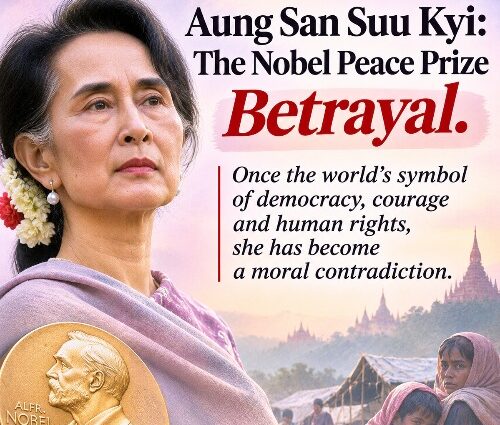
Aung San Suu Kyi, once the world’s symbol of democracy, courage and human rights has become a moral contradiction
Sunday, November 22, 2026
On November 19, 2026, the International Court of Justice delivered a historic judgment. Myanmar had committed genocide against the Rohingya Muslim minority during the military’s 2017 clearance operations in northern Rakhine State.
The ruling was decisive in its historical significance, even if the judges were divided on the evidence: nine voted in favour and six against. The Court found that Myanmar had violated its obligations under the Genocide Convention, including its duties to prevent and punish genocide.
It ordered Myanmar to investigate and prosecute those responsible, prevent further violations, provide reparations and facilitate the safe, voluntary and dignified return of displaced Rohingya.
It was the first time the world’s highest court had found a state responsible for committing genocide. And suddenly, a familiar name returned to the centre of this history: Aung San Suu Kyi.
There are few moral contradictions in modern political history as unsettling as her story.
In 1991, the world celebrated Aung San Suu Kyi as a champion of democracy and peaceful resistance. Imprisoned and confined under house arrest by Myanmar’s military dictatorship for years, she became an international symbol of courage against authoritarian power.
Her struggle earned her the Nobel Peace Prize. She was admired by human rights organisations, political leaders and ordinary people who saw in her a remarkable example of non-violent resistance.
Aung San Suu Kyi was the woman who had stood up to the generals. But when those same generals turned their military machinery against the Rohingya, the world witnessed a devastating reversal.
Aung San Suu Kyi stood up for the military! She did this as a political calculation to hold a fragile power-sharing arrangement and protect her domestic popularity.
It is important to understand that the Rohingya were not a population that suddenly appeared in Myanmar. Historical records document Muslim communities living in the ancient Arakan Kingdom, in what is now Rakhine State of Myanmar, as far back as the 15th century. Over the centuries, these communities lived through successive kingdoms, British colonial rule and Myanmar’s eventual independence in 1948, establishing deep ancestral, cultural and social roots in the region. Yet, in modern Myanmar, the Rohingya community with centuries of history was increasingly portrayed as foreign, its identity questioned and its right to belong denied in the very land its families had called home for generations.
In 2017, as Myanmar’s military consolidated its grip on power, the Rohingya were increasingly reduced to foreigners in their own homeland. Their identity was questioned, their citizenship denied and their existence treated as a threat to the country’s national identity. The persecution was rooted in decades of anti-Muslim prejudice, exclusionary ethnic nationalism and the military’s determination to assert control over Rakhine State. What followed was not merely a security operation, but a campaign of persecution that would ultimately culminate in one of the gravest humanitarian catastrophes of our time.
Let’s understand how it happened.
In August 2017, Myanmar’s military launched a brutal campaign in Rakhine State following attacks by the Arakan Rohingya Salvation Army on security posts. What followed was a catastrophe.
What the Rohingya endured was beyond ordinary descriptions of military brutality. Infants were snatched from their mothers’ arms and thrown alive into burning fires. Pregnant women were raped, beaten and, in documented witness accounts, had their stomachs slashed open and unborn babies ripped from their wombs. Women and girls were subjected to mass gang rapes, sexual slavery, mutilation and torture. Men were rounded up, shot, stabbed or burned. Children were beaten to death, thrown into rivers and sometimes killed in front of their parents. Entire villages were set ablaze, with families trapped inside their burning homes. Some survivors were forced to watch their loved ones being murdered before they themselves were attacked.
At this point, the international community expected Aung San Suu Kyi, then Myanmar’s de facto civilian leader, to speak with the moral authority she had accumulated during decades of resistance. Instead, her response became one of the most damaging chapters of her political career.
On September 6, 2017, as Rohingya refugees poured into Bangladesh with accounts of massacres, rape and burning villages, her office described the international reporting as a “huge iceberg of misinformation”, accusing those spreading it of promoting “the interests of terrorists”.
Twelve days later, in a televised address, she condemned human rights violations but did not acknowledge the full scale of the military’s atrocities.
Then, in December 2019, she travelled to The Hague and stood before the International Court of Justice to defend Myanmar against allegations of genocide. She described the crisis as an “internal armed conflict”, attributed its escalation to attacks by the Arakan Rohingya Salvation Army and argued that “genocidal intent cannot be the only hypothesis”.
The woman who had once become the world’s conscience against military oppression was now defending her country’s military establishment before the world’s highest court. She did not personally command the generals, but her words revealed the position she had chosen to take when the Rohingya needed her voice.
The image was extraordinary.
The woman once celebrated for confronting a military dictatorship was now standing before the world’s highest court defending the actions of that military dictatorship!
November 19, 2026: The judgment history will remember
Seven years after Suu Kyi’s appearance at The Hague, the ICJ has delivered its judgment.
The Court found that Myanmar committed genocide against the Rohingya during the 2017 operations. It found that the military and other state organs committed genocidal acts, including killings, serious bodily and mental harm, and measures intended to prevent births, with the intention of destroying a substantial part of the Rohingya population.
The Court also found that Myanmar failed to fulfil its obligations to prevent and punish genocide and had destroyed or failed to preserve important evidence.
Aung San Suu Kyi’s political role and her decision to defend Myanmar’s position before the Court remain central to the historical debate about her legacy.
The international reaction to Suu Kyi’ conduct was swift. In March 2018, the United States Holocaust Memorial Museum withdrew the Elie Wiesel Award it had given her in 2012; in November 2017, Oxford withdrew her Freedom of the City honour, originally bestowed in recognition of her opposition to military oppression; in September 2018, Canada’s Parliament revoked her honorary Canadian citizenship; and in November 2018, Amnesty International withdrew its prestigious Ambassador of Conscience Award, explaining that she had failed to use her political and moral authority to defend human rights.
And yet, one distinction remained untouched, her Nobel Peace Prize. Awarded in 1991, it could not be withdrawn. The Norwegian Nobel Committee has made its position explicit: a Nobel Prize cannot be revoked, transferred or shared once it has been announced. The committee’s responsibility is to assess the laureate’s contribution up to the time of the award, not to continually reassess subsequent political conduct.
A Nobel Prize can remain on a shelf. Moral authority, however, must be earned every day.
JANPATH NEWS NETWORK (JNN)
Independent. Fearless. On the People’s Path.