










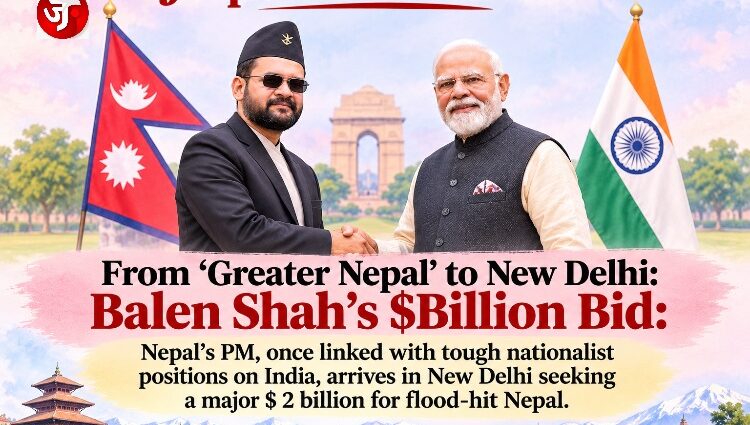
Nepal’s PM, once linked with tough nationalist positions on India, arrives in New Delhi seeking a major $ 2 billion for flood-hit Nepal
Monday, November 23, 2026
Nepal’s Prime Minister Balen Shah’s meeting today with Narendra Modi marks an important test of pragmatism, diplomacy and Nepal’s economic dependence on its larger neighbour.
Nepal Prime Minister Balendra Shah, popularly known as Balen, is meeting Prime Minister Narendra Modi in New Delhi on November 23, in what could become a significant turning point in India-Nepal relations.
The two-day visit, Shah’s first bilateral foreign visit since becoming Prime Minister in March 2026, comes against the backdrop of strained diplomatic relations, unresolved territorial disputes and Nepal’s urgent need for financial assistance following devastating floods in August.
But there is another important dimension to this visit: Nepal is seeking an economic package worth $2 billion from India.
According to reports in The Indian Express and The Kathmandu Post, Kathmandu has sought $1 billion in concessional loans, $500 million in grants and another $500 million for reconstruction and rehabilitation. India is reportedly considering a package of approximately $1.5 billion, although the final announcement remains awaited.
The money is intended to support reconstruction, infrastructure development and rehabilitation following the floods, which caused extensive destruction across Nepal.
From nationalist rhetoric to diplomatic pragmatism
Balen Shah has not always been viewed as a comfortable political partner in New Delhi.
As Mayor of Kathmandu, he displayed a map of Greater Nepal in his office in 2023, following controversy over the ‘Akhand Bharat’ mural displayed in India’s new Parliament building. The map included territories that Nepal claims but India considers its own.
His subsequent positions on the Lipulekh-Kalapani-Limpiyadhura territorial dispute further complicated relations.
In May 2026, Shah told Nepal’s Parliament that both countries had encroached upon each other’s territories and suggested involving historians, surveyors and experts to resolve the dispute. He also referred to engaging China and the United Kingdom. India rejected the involvement of third parties in resolving the boundary issue.
There were further diplomatic tensions when Shah initially declined meetings with senior foreign officials, including India’s Foreign Secretary Vikram Misri.
His present visit, therefore, represents a notable change in diplomatic engagement.
What does Nepal want from India?
The financial package is only one part of a much broader agenda.
The discussions include:
- A proposed $2 billion economic assistance package.
- Reconstruction of flood-damaged infrastructure.
- The Ayodhya-Janakpur railway connection.
- Hydropower and electricity cooperation.
- Additional air-entry routes for Nepal’s international airports.
- Trade, transit and cross-border connectivity.
- Technology, education and infrastructure cooperation.
India is also expected to announce support for several development projects.
The China factor
Nepal’s relationship with India cannot be viewed in isolation from its growing engagement with China.
As a landlocked country situated between two major powers, Nepal has historically attempted to balance its relationships with both neighbours.
India remains Nepal’s largest trading partner and an important source of development assistance, employment and transit access. China, meanwhile, remains an important infrastructure and investment partner.
For New Delhi, maintaining stable relations with Kathmandu is therefore not merely a matter of neighbourhood diplomacy. It also has wider strategic implications.
The larger question
Balen Shah’s visit raises an important question about the relationship between nationalism and economic reality.
A leader can assert territorial sovereignty, challenge a neighbouring country’s policies and seek an independent foreign policy. But governing a landlocked country with extensive economic and infrastructure requirements also demands practical cooperation with its neighbours.
For India, the challenge is equally significant: whether it can build a relationship based on mutual respect and cooperation rather than the familiar dynamics of a larger neighbour dealing with a smaller one.
The Modi-Shah meeting will indicate whether both governments are prepared to move beyond diplomatic friction and translate their renewed engagement into concrete outcomes.
For Balen Shah, the test is whether he can secure the assistance Nepal needs without compromising the independent nationalist image on which much of his political appeal was built.
JANPATH NEWS NETWORK (JNN)
Independent. Fearless. On the People’s Path.