










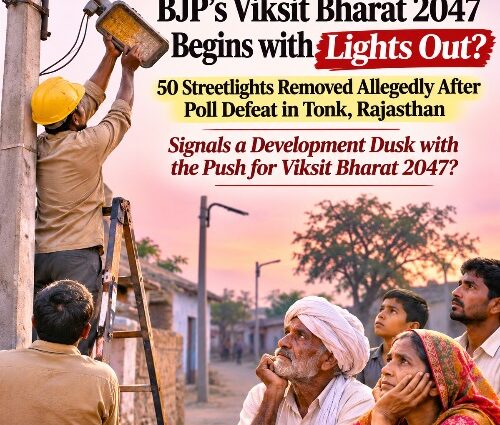
50 Streetlights Removed After Poll Defeat in Tonk Rajasthan Signals a Development Dusk with the Push for Viksit Bharat 2047?
Monday, November 23, 2026
When a political candidate loses, should an entire neighbourhood lose its streetlights?
The promise of Viksit Bharat 2047 speaks of modern infrastructure, improved living standards and development reaching every corner of the country. But in Rajasthan’s Tonk district, a rather different picture has emerged.
Hours after a BJP-backed candidate lost a Panchayat Samiti election, approximately 50 streetlights installed across several hamlets were removed by electricity department workers, and Tong was plunged into darkness.
The incident occurred in the Peeplu Panchayat Samiti area, where BJP candidate Priyanka Sharma lost to Congress candidate Dhanna Lal by 751 votes. Priyanka is married to Alok Sharma, personal assistant to BJP MLA Ramsahay Verma.
According to villagers, the lights had been installed before Diwali on October 24, illuminating streets and settlements that had remained dark after sunset. On November 20, shortly after the election results were announced, electricity department workers arrived to remove them.
The timing immediately raised suspicions of political retaliation.
The official explanation
The electricity department of Tonk maintained that the lights had been connected through unauthorised electricity connections. Officials said an inspection had confirmed the irregularities and an inquiry had been ordered.
The BJP MLA of Tonk denied any political connection with the removal. The department also maintained that similar action would be taken against other unauthorised installations.
Around 10 lights were reportedly removed before the intervention of newly elected sarpanches, who agreed to pay the electricity bills to prevent further removals.
But questions remain. If the installations were unauthorised, why were they allowed to remain operational for nearly a month? Why did the action coincide so closely with the announcement of the election result?
The inquiry must establish whether the action was routine enforcement or whether political considerations influenced its timing.
A familiar debate over punitive politics
The incident brings back a wider debate over the use of administrative power as a political instrument.
From demolitions in Uttar Pradesh following protests, to the post-violence demolitions in Khargone and Nuh, several BJP-governed states have faced allegations that administrative action was being used punitively against individuals or communities.
The Supreme Court’s November 2024 ruling on bulldozer demolitions made an important constitutional distinction: the executive cannot turn an accusation into punishment by demolishing someone’s property without due process.
These cases are not identical to the Tonk streetlight controversy. But they raise a common question about accountability and the limits of political and administrative power.
Development cannot be conditional on votes
The most troubling aspect of the Tonk episode is the possibility that public amenities could become entangled with electoral loyalties.
Streetlights are not party property. They are not campaign gifts that can be withdrawn when a candidate loses. If installations violate electricity regulations, the authorities must enforce the law transparently and consistently, irrespective of the election result.
But if the removal was politically motivated, the people who must answer for it are not merely the political candidates. They are those who allowed public infrastructure to become an instrument of political retaliation.
A village should not have to vote for the ruling party to remain illuminated after sunset, and this is the dusky story emerging from Tonk.
Viksit Bharat 2047 cannot mean development when you vote for us and darkness when you don’t.
JANPATH NEWS NETWORK (JNN)
Independent. Fearless. On the People’s Path.