










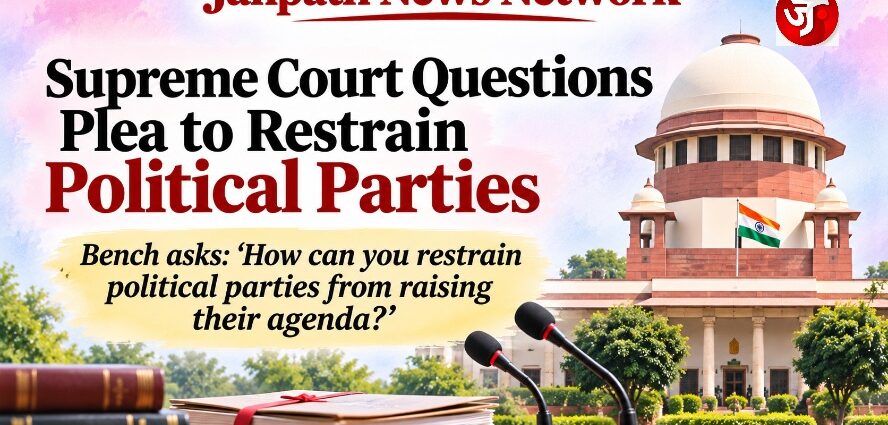
Supreme Court questions a petition seeking curbs on politicians remarks against judges, asking why such concerns can’t be taken in Parliament
Monday, November 23, 2026
The Supreme Court on Monday, November 23, pushed back against a petition seeking judicial guidelines to restrain political parties and their leaders from making allegedly derogatory remarks against sitting judges.
During the hearing, a bench comprising Justices Vikram Nath and Aparesh Kumar Singh posed a pointed question to senior advocate Gaurav Bhatia, appearing for the petitioners:
“How can you restrain political parties from raising their agenda?”
The bench also questioned why the concerns could not be taken up in Parliament.
“Why don’t you raise it in Parliament? You get a law framed,” the judges observed.
The petition, filed by two advocates, refers to recent statements and social media posts by politicians concerning the judiciary and alleges that certain remarks interfere with the administration of justice.
Among those named as respondents are the Union government, the Election Commission, the Congress, its leaders Rahul Gandhi and Mallikarjun Kharge, Trinamool Congress MP Mahua Moitra and others.
What prompted the petition?
The proceedings come amid growing friction between political leaders and the judiciary.
The petition refers to remarks made by politicians and social media posts criticising the Chief Justice of India, Surya Kant, and other judges. It also refers to Rahul Gandhi’s October 12 march to the Supreme Court, accompanied by Opposition leaders, over alleged voter deletions and irregularities in the Special Intensive Revision (SIR) of electoral rolls.
The petitioners argue that political criticism should not cross into personal attacks on judges or obstruct the administration of justice.
The issue also follows a separate controversy involving allegedly unsavoury remarks made by a lawyer against the Chief Justice inside the courtroom. The Supreme Court Bar Association had sought contempt action in that matter, and a three-judge bench issued notice on November 18.
The court’s response
When the petitioners’ counsel attempted to connect political statements with the larger issue of protecting the judiciary, the bench questioned why several distinct incidents and political developments had been combined in one petition.
The judges observed that the present matter should be placed before the bench already dealing with related contempt proceedings. The registry was directed to place the papers before the Chief Justice of India for appropriate directions.
No final ruling was delivered on the petition’s demands.
The larger constitutional question
The hearing brings into focus a difficult constitutional balance: protecting the independence and dignity of the judiciary while preserving the right of political parties and elected representatives to criticise institutions and raise questions of public concern.
Criticism of a judicial ruling, personal attacks on judges and conduct that obstructs the administration of justice are not necessarily the same thing. The distinction matters.
The Supreme Court’s questions on Monday bring that distinction into sharp focus. Whether the petition can establish a legitimate case for judicial intervention, without creating restrictions on political expression, remains to be examined.
For a democracy, the question is not whether institutions can be criticised. It is where legitimate criticism ends and unlawful interference begins.
JANPATH NEWS NETWORK (JNN)
Independent. Fearless. On the People’s Path.