










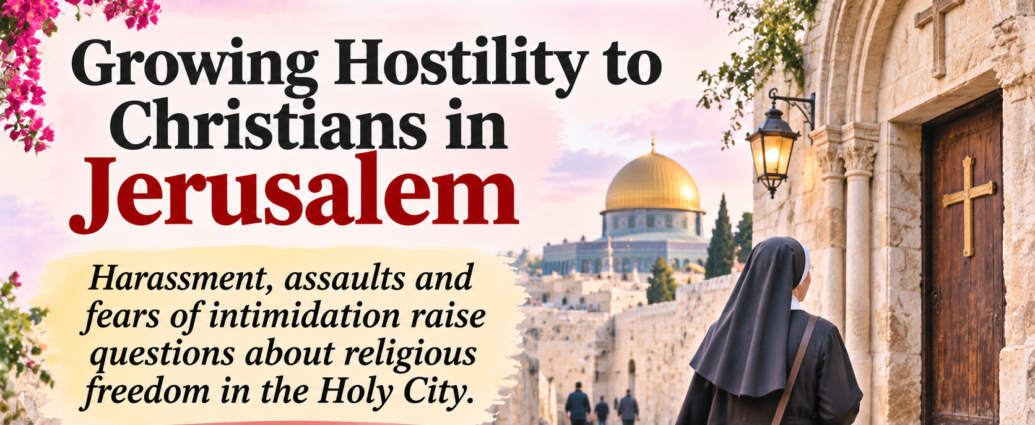
Jerusalem’s Christians Hide Their Crosses as Harassment Grows: Is the City Witnessing an Unsettling Return to Its History of Persecution?
Monday, November 23, 2026
There is something deeply unsettling about a Christian priest having to hide his cross before walking through Jerusalem.
In the Armenian Quarter of the Old City, surveillance footage from November 21, 2026 shows an ultra-Orthodox Jewish man crossing the street on Shabbat to spit towards St. James Monastery. It is one of a growing number of incidents in which Christian clergy, religious institutions and visible symbols of Christianity have become targets of harassment.
For a city that gave birth to Christianity, the irony is difficult to ignore.
Jerusalem is where Jesus was crucified, where Christians believe he was resurrected, and where his earliest followers gathered to establish the first Christian community. The streets in Jerusalem that today see priests, monks and pilgrims walking between ancient churches were once the setting for the earliest struggles of the Christian faith.
The first Christians in Jerusalem were not always welcomed. The biblical account in Acts describes the persecution and martyrdom of Stephen, one of the earliest Christian leaders. His death was followed by the scattering of members of the Jerusalem church.
Around 44 CE, James, the brother of John, was executed under Herod Agrippa I. Later, James, the brother of Jesus and a leading figure in the Jerusalem church, was also killed, around 62 CE, according to the ancient historian Josephus.
Christianity’s earliest history in this very city Jerusalem was therefore marked by hostility, intimidation and martyrdom.
Nearly two thousand years later, the nature and scale of persecution are different. There is no equivalence between the executions of early Christians and the present-day incidents of harassment. But the reappearance of religious intimidation in the streets of Jerusalem raises an uncomfortable historical question: are Christians once again being made to feel that their faith should remain invisible?
The latest figures from the Religious Freedom Data Center (RFDC) offer a troubling picture. Its third-quarter 2026 report recorded 106 acts of harassment across 96 incidents between July and September. Spitting accounted for 77 of those acts. Jerusalem recorded 88 incidents, with 45 along Armenian Patriarchate Street alone. The figures describe more than isolated acts of discourtesy.
Christian clergy have told researchers that they sometimes leave their religious institutions in ordinary clothes rather than identifiable clerical dress. Some conceal crosses beneath their clothing in Jerusalem. For people whose lives revolve around public expressions of faith, this is an extraordinary adjustment.
In August, six religious Jewish suspects, five of them minors, were arrested following an incident involving spitting and stone-throwing at the entrance to St. James Monastery. Other incidents have included verbal abuse, vandalism and attacks on Christian religious symbols.
The Armenian community has been particularly affected. Its presence in Jerusalem stretches back many centuries, and its quarter remains one of the city’s historic Christian centres.
Jerusalem is a city sacred to three faiths – Christians, Jews, and Muslims. Jerusalem cannot be understood through the history of one religion alone. It is sacred to Christians because of the life, crucifixion and resurrection of Jesus. It is central to Judaism because of the ancient Temples and the Western Wall. It holds profound significance for Muslims because of Al-Aqsa Mosque and the Noble Sanctuary.
For centuries, its identity has been shaped by successive rulers, religious communities, wars, conquests and competing claims to sacred spaces.
The Roman destruction of Jerusalem in 70 CE, followed by the suppression of the Bar Kokhba revolt in 132–135 CE, transformed the city and its religious landscape. Christianity, meanwhile, spread beyond Jerusalem into the wider Mediterranean world, eventually becoming one of the world’s major religions.
The survival of Jerusalem’s Christian communities through these centuries is part of the city’s history. Their churches, monasteries, schools and traditions are not recent additions to its landscape. They are part of Jerusalem itself.
Following these hostilities, the Israeli authorities have made arrests following several incidents and announced measures to improve protection for Christian institutions. Police have also stationed officers near St. James Cathedral in Jerusalem in response to repeated spitting incidents.
The government has faced growing pressure from church leaders and religious freedom advocates to ensure that perpetrators are held accountable.
But arrests after individual incidents do not necessarily resolve the wider problem. Christian representatives have expressed concern that repeated harassment is creating an atmosphere in which they feel increasingly unwelcome.
The issue is not simply whether a monastery is protected by security personnel. It is whether a Christian monk can walk through the streets of Jerusalem wearing his traditional robes without becoming a target.
This sounds the rumbles of uncomfortable historical echoes when the first Christians of Jerusalem faced a world in which publicly professing their faith could bring hostility, punishment and, in some cases, death.
Today, Christian communities are not facing the same organised persecution that marked certain periods of the Roman Empire. Israel has Christian citizens, functioning churches and institutions, and authorities that have publicly condemned attacks.
But when clergy begin concealing crosses, when monks are subjected to public humiliation and when religious institutions repeatedly require protection from harassment, the warning signs cannot simply be dismissed as isolated misbehaviour.
A city that holds the memory of Christianity’s earliest martyrs should understand what religious intolerance can do to a community. Jerusalem has survived empires, conquests and centuries of religious conflict. Its greatness has never rested on the disappearance of one faith in favour of another.
The question now is whether Christians can continue to live their faith openly in Jerusalem, the very city where Christianity began, or whether the cross, once carried openly through Jerusalem, must increasingly be hidden beneath a coat.
JANPATH NEWS NETWORK (JNN)
Independent. Fearless. On the People’s Path.