



Xi, Putin, Modi and Pezeshkian gather as the West struggles with Russia, Iran, rising debt and a global bond shock
SEPTEMBER 1, 2026
The world is no longer merely divided by ideology, but rather, beginning to divide along competing economic, strategic and diplomatic fault lines.
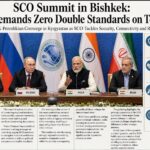
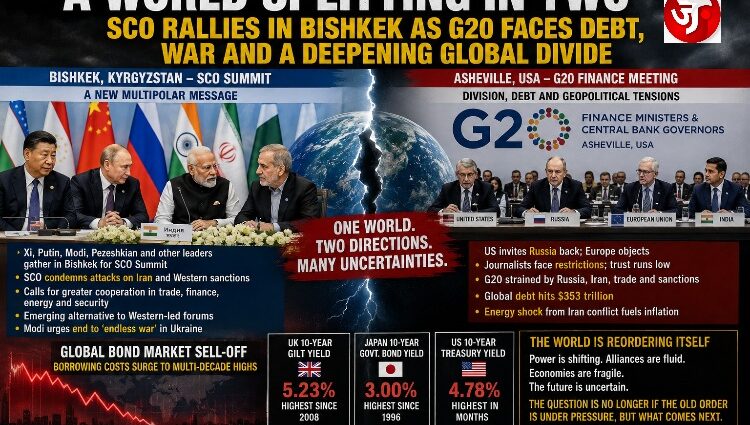
On one side, the leaders of China, Russia, India, Iran and other major Eurasian powers gathered in Bishkek, Kyrgyzstan, for the Shanghai Cooperation Organisation summit, projecting the image of an increasingly confident multipolar world.
On the other side, thousands of kilometres away, the G20 finance ministers and central bank governors met in Asheville, United States, amid deep disagreements over Russia, Iran, trade, debt and the future of the global economy.
While there are two summits, people sense two very different atmospheres, and one increasingly uncomfortable question: Who will shape the world order of the future?
Bishkek and the rise of the multipolar world
Chinese President Xi Jinping, Russian President Vladimir Putin, Indian Prime Minister Narendra Modi and Iranian President Masoud Pezeshkian were among the leaders at the SCO summit.
The gathering was more than a routine regional meeting. China and Russia increasingly portray the SCO as part of a broader alternative to Western-led institutions, while countries such as India use the forum to pursue their own strategic interests without being forced into a rigid geopolitical camp.
The SCO’s Bishkek Declaration went further, condemning military attacks on Iran and Western sanctions against some member states, while calling for greater economic, financial and energy cooperation.
The message from Bishkek was unmistakable: The West no longer has an uncontested monopoly over global diplomacy, economics or political influence.
China is positioning itself as a central power in this emerging order, maintaining strong relationships with both Moscow and Tehran while simultaneously engaging with Western capitals.
Modi sends a different message: The Bishkek gathering is not simply a united anti-Western front. Here, it is apparent that India’s position demonstrates precisely why the emerging world order is more complicated.
During his meeting with Vladimir Putin, Prime Minister Narendra Modi called for an end to the war in Ukraine, saying the world needed to move from “endless war” toward an end to hostilities.
India continues to maintain strategic and economic relations with Russia while simultaneously advocating diplomacy and peace. That is the new geopolitical reality: Countries are increasingly refusing to choose one permanent camp.
They are trading with one power, buying energy from another, maintaining security partnerships with a third and negotiating with everyone where the old Cold War map is being replaced by something far messier, and considerably harder to control.
As Bishkek projects power, Asheville exposes fracture
The contrast with the G20 meeting in Asheville could hardly be sharper. The United States invited Russian Finance Minister Anton Siluanov to the G20 finance gathering, marking the first time Russia’s finance chief attended the forum in person since the invasion of Ukraine.
European officials reacted angrily. Germany described Russia’s presence as a troubling signal, while Poland’s finance minister expressed deep distrust of Moscow. European officials also objected to aspects of the U.S. handling of the meeting, including restrictions on access for some journalists.
The gathering was supposed to focus on global growth. Instead, geopolitics walked straight through the door: Russia, Iran, China, trade, sanctions, debt, energy, and the increasingly difficult question of who still sets the rules.
Then came the bond market warning
While politicians argued over alliances and sanctions, financial markets delivered their own message, global bond markets came under renewed pressure as investors confronted rising inflation risks, higher energy prices and enormous government borrowing requirements.
UK 10-year gilt yields climbed to 5.23%, their highest level since 2008, while Japan’s 10-year yield reached 3%, its highest since 1996. U.S. 10-year Treasury yields also rose to around 4.78%.
The problem is bigger than one country’s bond market. Governments around the world are carrying enormous debt loads while simultaneously facing higher energy costs, geopolitical instability and pressure to spend more.
Global debt had already reached roughly $353 trillion earlier this year, according to figures cited in the G20 discussions.
And now the energy shock from the Iran conflict is adding another layer of pressure: Higher oil prices feed inflation; higher inflation pressures central banks; higher interest rates increase government borrowing costs; steep borrowing costs make already enormous debts even harder to manage.
It is a rather unpleasant mathematical circle, because apparently the global economy needed another problem.
The Iran conflict connects the two stories
The conflict involving Iran has become a crucial link between the geopolitical and financial crises. Disruption to energy flows has pushed up oil prices and threatened global supply chains, while the United States is pressing G20 countries to comply with its sanctions campaign against Tehran.
Meanwhile, China remains an important economic partner for both Russia and Iran. That makes Beijing’s role increasingly consequential.
The more Washington tries to isolate Moscow and Tehran, the more important China’s economic and diplomatic relationships with them become. And that is precisely why the Bishkek summit matters.
The real story is not simply SCO versus G20
The deeper story is not simply that one summit is “anti-Western” and the other is “Western.” It is that the old architecture of global power is becoming increasingly difficult to sustain.
The United States remains the world’s most powerful financial and military power, while China is expanding its economic and diplomatic reach. Russia unabated, continues to challenge Western policy while becoming increasingly dependent on China. Meanwhile, India is pursuing strategic autonomy, maintaining relationships across competing power centres. Deep in the heart of this is Iran seeking partners beyond the Western financial system, while Europe is increasingly questioning how much strategic independence it can exercise amid its dependence on the United States for security.
The leaders in Bishkek are debating a new political and economic order; while the officials in Asheville are trying to prevent the existing economic order from being destabilised by debt, inflation, energy shocks and geopolitical confrontation.
Cutting through the clutter, bond investors are demanding higher returns to lend governments money, and that may ultimately prove more consequential than any summit photograph.
JANPATH NEWS NETWORK (JNN)
Independent. Fearless. On the People’s Path.