










Thousands of flights disrupted as FAA orders unprecedented nationwide shutdown raises serious questions about aviation safety
November 14, 2026
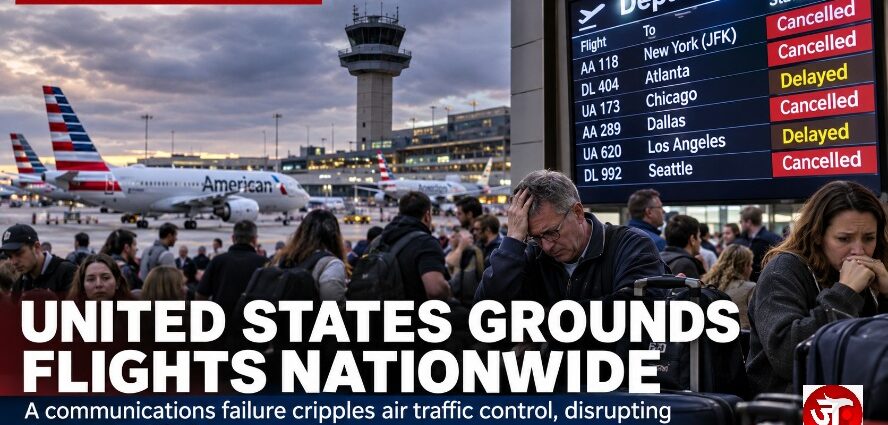
In one of the most extraordinary disruptions to American aviation in decades, the United States found itself facing a nationwide flight shutdown on Friday after a communications failure crippled critical air traffic control operations.
Airports across the country came to a virtual standstill. Aircraft were held on runways, passengers were stranded inside terminals, departure boards filled with cancellations and delays, and airlines struggled to explain when normal operations would resume.
The Federal Aviation Administration (FAA) issued a nationwide ground stop at approximately 3:54 pm Eastern Time on November 13, ordering departing aircraft across the United States to remain on the ground.
The reason was alarming: communications problems affecting all 22 regional Air Route Traffic Control Centres responsible for coordinating aircraft travelling across American airspace.
This was not an isolated airport malfunction. It was a disruption that struck the infrastructure connecting the country’s entire aviation network.
What went wrong?
Transportation Secretary Sean Duffy confirmed that a communications failure had affected the air traffic control network.
According to officials, problems involving ageing telecommunications infrastructure, including overloaded switches and routers, caused intermittent communications and radar disruptions.
The failure reportedly affected communications between air traffic controllers and aircraft operating across the country.
Faced with unreliable systems, aviation authorities took the extraordinary decision to halt departures rather than risk allowing aircraft to operate without dependable coordination.
Aircraft already airborne were generally permitted to continue and land safely, while certain international flights were handled individually.
The ground stop was subsequently lifted at approximately 8:15 pm Eastern Time, after the FAA tested its systems and determined that operations could resume.
But lifting the restriction did not instantly restore normality.
Thousands of flights caught in the disruption
The consequences spread rapidly. More than 10,000 flights were reported delayed, while thousands faced cancellations. At least 600 aircraft were diverted, according to Associated Press reporting.
Major airports, including New York, Atlanta, Chicago, Dallas, Los Angeles and Seattle, experienced widespread disruption.
International aviation was affected too, with airlines having to adjust schedules and manage aircraft and passengers caught in the sudden shutdown. Even after departures resumed, airlines faced the complicated task of repositioning aircraft, restoring crew schedules and clearing the enormous backlog.
The disruption was expected to continue into Saturday.
Arkansas among the affected states
Arkansas was also caught in the nationwide disruption.
The video circulating from Arkansas offers a glimpse of the situation confronting passengers and airport operations as the FAA’s order took effect.
Although the footage requires independent authentication to establish its exact location and timing, the state’s airports were within the wider national disruption.
For travellers, what began as an ordinary journey quickly turned into uncertainty, with departure schedules thrown into disarray.
Was America under cyberattack?
That question inevitably arose as flights across the country were grounded. Homeland Security Secretary Markwayne Mullin said officials had found no indication of a cyberattack or deliberate hostile action.
The administration attributed the immediate problem to telecommunications infrastructure, although a full technical investigation is still necessary to establish precisely what triggered the failure.
There is currently no verified evidence connecting the incident to a foreign government, terrorist organisation or act of sabotage.
The bigger question: How vulnerable is America’s aviation infrastructure?
Perhaps the most troubling aspect of this episode is what it reveals about the condition of the systems on which modern aviation depends.
The United States operates one of the busiest and most technologically sophisticated aviation networks in the world. Yet a failure in its communications infrastructure was enough to bring departures across the entire country to a halt.
The government has already been working to modernise the FAA’s ageing systems, replacing outdated copper lines and older communications equipment.
Transportation officials have argued that billions of additional dollars are required to complete the overhaul. The incident has now given that debate a new urgency.
An aviation system cannot depend on technology that struggles to cope with the demands placed upon it. Nor can passengers be expected to trust infrastructure whose weaknesses become visible only when something goes wrong.
A warning that cannot be ignored
Friday’s shutdown was not another routine airport delay. It was a nationwide aviation emergency triggered by a failure in the communications network responsible for coordinating aircraft.
There is no confirmed evidence of an attack, and officials say aircraft were kept safe.
But the incident raises a question that goes far beyond one day’s cancelled flights:
If a communications failure can bring America’s aviation network to a standstill, how resilient is the infrastructure that keeps millions of passengers moving every day?
For the world’s largest aviation market, that is a question demanding answers, not assurances.
JANPATH NEWS NETWORK (JNN)
Independent. Fearless. On the People’s Path.