









Country’s Strongest Earthquake of the Century Leaves Buildings Collapsed, Airports Shut, Hospitals Damaged and Thousands Searching for Missing Loved Ones
AUGUST 11: Colombia is confronting a massive humanitarian emergency after a 7.4-magnitude earthquake ripped through the country’s western region on Monday morning, killing at least 133 people and injuring more than 570, according to the latest media tallies as rescue operations continue. Earlier official figures had placed the death toll at 111 and injuries at 87, underscoring how rapidly the numbers have changed as rescuers reach damaged communities and search through rubble.
The earthquake struck at approximately 7:34 a.m. local time on August 10, with the epicentre near San José del Palmar in Chocó, a sparsely populated and difficult-to-access region west of Bogotá. The U.S. Geological Survey recorded the earthquake at 12:34:27 UTC, approximately five kilometres east of San José del Palmar, at a depth of 107 kilometres.
The intermediate-depth quake sent violent tremors across huge parts of Colombia and was felt beyond the country’s borders, including in Panama, Ecuador and Venezuela. Reports from across the country described people fleeing buildings, walls cracking, ceilings collapsing and streets filling with frightened residents.
WESTERN COLOMBIA BEARS THE BRUNT
The destruction has spread across numerous municipalities, with Cali, Pereira, Manizales, Quibdó and communities in Chocó among the hardest-hit areas.
In Pereira, authorities reported dozens of deaths, while damage to buildings and infrastructure triggered frantic rescue operations. In Valle del Cauca, including Cali, dozens were reported dead, among them children.
In Manizales, part of the city’s historic neo-Gothic cathedral was badly damaged, with a tower collapsing onto the nave. At Pereira’s airport, sections of the ceiling reportedly fell while passengers sheltered inside. Airports in several cities, including Pereira, Manizales, Quibdó, Armenia, Cartago and Buenaventura, suspended flights amid safety inspections and infrastructure damage.
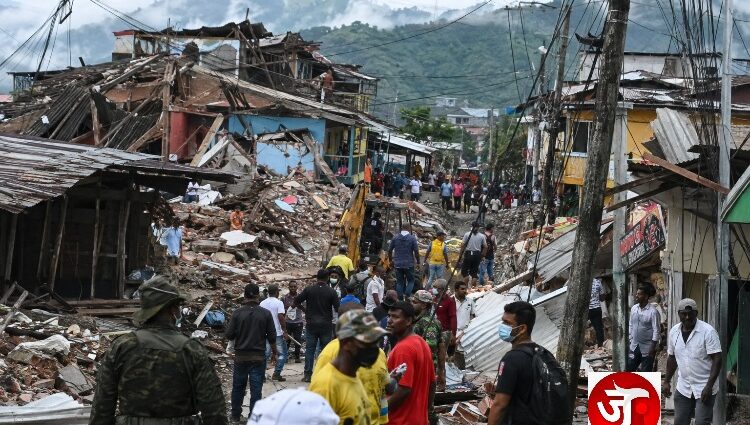
Across the country, at least 61 buildings were reported collapsed, while approximately 1,575 homes were affected. Damage was also reported at 18 health centres and 52 schools, alongside roads and other critical infrastructure.
The scale of destruction has made the rescue effort extraordinarily difficult.
Horrific visuals of the earthquake:
HUNDREDS STILL UNACCOUNTED FOR
Rescue teams, soldiers, emergency workers, firefighters, volunteers and ordinary residents have been digging through mountains of concrete, steel and shattered masonry in search of survivors.
In Cali alone, reports indicated that people were trapped in at least 19 collapsed structures. Other communities have reported people missing beneath large quantities of debris.
Citizen-run reporting systems were also carrying reports of more than 2,700 people listed as missing, although that figure has not been established as an official government casualty count and may include duplicate or unverified reports. The uncertainty has added another layer of anguish for families desperately trying to establish contact with relatives.
With communications disrupted in some areas and remote communities difficult to reach, authorities warned that the full scale of the disaster may not yet be known.
21 AFTERSHOCKS KEEP RESCUERS ON EDGE
The danger did not end when the main earthquake stopped.
Authorities recorded at least 21 aftershocks by late Monday, with the strongest measuring approximately 4.8 to 5.0 magnitude. Further tremors remain possible, forcing rescue crews to work cautiously around structures that could collapse without warning.
Residents have been urged to remain outdoors or stay away from visibly damaged buildings.
For rescuers, every aftershock brings a cruel calculation: move quickly enough to reach someone trapped beneath the rubble, but not so recklessly that another collapse creates more victims.
COLOMBIA DECLARES NATIONAL DISASTER
President Abelardo de la Espriella, who had taken office only days before the earthquake, declared a national disaster and said he had personally taken charge of the emergency response.
National and local authorities have mobilised rescue teams and heavy machinery, with the immediate priority being the search for people trapped beneath collapsed structures, medical treatment for the injured, evacuation of dangerous buildings and restoration of damaged infrastructure.
The Colombian Geological Service described the earthquake as an extraordinary seismic event and among the strongest recorded in the country’s recent history. The USGS confirmed its 7.4 magnitude, 107-kilometre depth and San José del Palmar epicentre.
A COUNTRY REACHES FOR ITS MISSING
The earthquake has left a trail of shattered homes, damaged hospitals, disrupted transport and terrified communities.
In some places, rescuers are working with sophisticated machinery. In others, residents are using their bare hands to move bricks and concrete in the hope of hearing a voice beneath the ruins.
That contrast captures the human reality of the catastrophe: a modern nation suddenly reduced, in places, to the oldest form of rescue imaginable.
WORLD RESPONDS
International assistance has begun to emerge as the scale of the catastrophe becomes clearer. Offers of support have come from the United States, European Union, United Nations and other international partners, while governments around the world have expressed condolences and solidarity with Colombia.
The response is expected to expand as Colombian authorities complete assessments of the damage and determine the scale of shelter, food, medical and reconstruction assistance required.
There was no tsunami threat associated with the earthquake.
THE GROUND HAS STOPPED. THE CRISIS HAS NOT.
The 7.4-magnitude earthquake lasted only moments.
Its consequences will last far longer.
Families remain separated. Hospitals are treating the injured. Rescue crews continue searching unstable ruins. Airports and roads remain disrupted in several regions. And aftershocks continue to remind a shaken population that the earth beneath them has not completely settled.
The final death toll is almost certainly not yet known.
JANPATH NEWS NETWORK (JNN)
Independent. Fearless. On the People’s Path.