









TRIBALS FIGHT FOR LAND IN KEN-BETWA, CITIZENS EMBRACE TREES IN UTTARAKHAND
New Delhi, August 1: Across two of India’s most ecologically sensitive landscapes, an extraordinary question is rising from the ground: When development arrives, who pays the price?
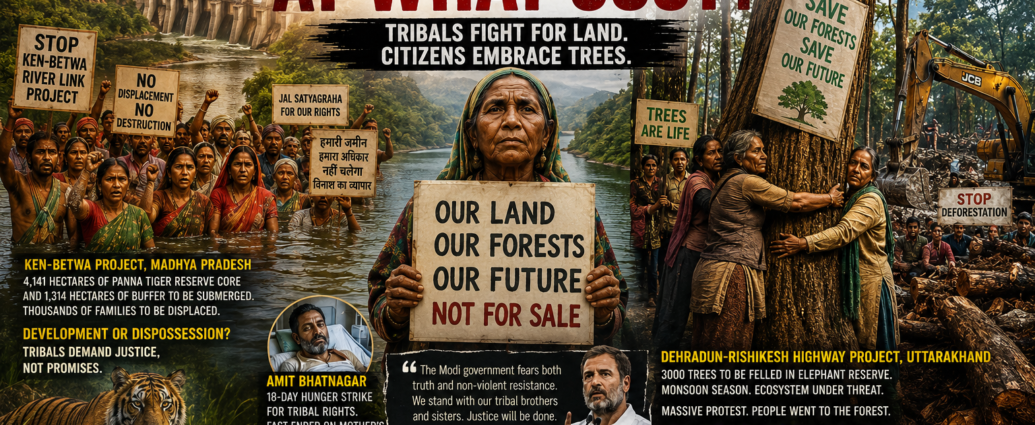
In Madhya Pradesh, tribal communities affected by the Ken-Betwa River Linking Project have mounted an intense resistance over displacement, compensation and rehabilitation. Protesters have staged Jal Satyagraha, standing in water, and even the haunting Chita Andolan, lying beside symbolic funeral pyres to declare that losing their land and livelihood would be like losing life itself.
Yes, they want their state and nation to progress, to develop. But is this the model of development that we desire where our forests are destroyed, wildlife is disturbed, mountains are ruthlessly cut, and rivers are ravaged?
If the homes of the Ken-Betwa tribals (primarily Gond, Kol and other Adivasi communities in the villages of Chhatarpur and Panna districts, Madhya Pradesh) are bulldozed, they stand to lose far more than brick, mud and thatch.
Picture this: The bulldozer’s blade bites into walls that have held generations. They lose identity. “Jal, jangal, zameen”, water, forest, land, are not just resources; they are the root of who these Adivasis are. When the homes fall, and the land is taken, that rootedness is severed. Compensation money is often delayed, disputed or insufficient, and cannot buy back the feeling of belonging to a place that has known their names for hundreds of years. In short: they lose shelter, livelihood, culture, memory, dignity and the very ground that made them a people. The bulldozer does not only demolish houses, but it also erases a living world
It is becoming a continuous fight: Forests, homes and wildlife become the new battleground as two powerful people’s movements challenge India’s model of development
The environmental stakes are enormous. The Centre has previously estimated that the Daudhan reservoir will submerge 4,141 hectares of the Panna Tiger Reserve’s core and another 1,314 hectares of its buffer, as well as villages and forest land.
At the heart of the agitation was activist Amit Bhatnagar, who escalated his protest into an 18-day hunger strike, continuing even after hospitalisation, before ending his fast following his mother’s intervention and an administrative assurance of fresh verification for affected families.
Leader of the Opposition Party, Rahul Gandhi, has thrown his weight behind the protesters, accusing the Modi government of fearing “truth and non-violent resistance” and demanding fair compensation and dignified rehabilitation for affected tribal families.
Hundreds of kilometres away, another environmental uprising erupted in Uttarakhand, where residents and activists hugged trees and confronted machinery over plans to fell thousands of trees for the Bhaniyawala-Rishikesh highway-widening project, a stretch passing through the ecologically sensitive Shivalik landscape and an elephant corridor.
After sustained protests, Uttarakhand Chief Minister Pushkar Singh Dhami ordered the tree-felling halted pending wider consultations.
So here are two movements with two landscapes: Tribals standing and lying in water to save their homes. Citizens embracing trees to save a forest. Tigers, elephants, rivers and human communities caught in between.
They admit that India needs roads, water, and development, but the protesters are forcing the country to confront a harder question: Must progress always arrive with a bulldozer?
Some scenes below!