




FROM AYODHYA TO JHARKHAND, MOSCOW TO THE RED SEA: INDIA FACES QUESTIONS AT HOME AS A RESTLESS WORLD BURNS
NEW DELHI, AUGUST 5: As Wednesday draws to a close, India finds itself navigating an extraordinary convergence of political confrontation, student unrest, economic defiance and global instability. From the Ram Temple controversy in Uttar Pradesh to young protesters sitting on hunger strike in Jharkhand, from record purchases of Russian crude to turmoil in the Red Sea and the skies above India, the evening’s news carries one recurring theme: institutions are being questioned, governments are being challenged, and an increasingly impatient public wants answers.
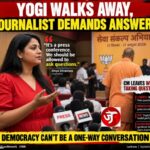
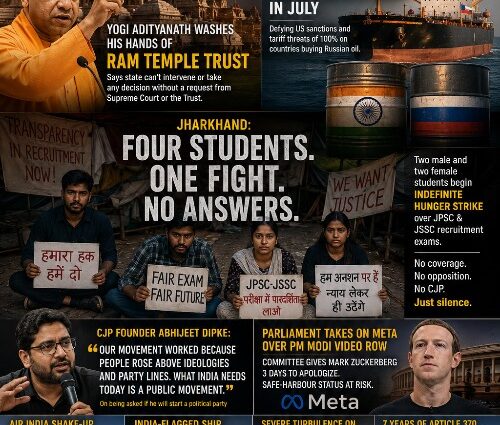
In Uttar Pradesh, Chief Minister Yogi Adityanath sought to draw a firm line between his government and the affairs surrounding the Shri Ram Janmabhoomi Teerth Kshetra Trust, telling the Assembly that the disputed matter is sub judice and that the state government cannot simply intervene in the functioning of the Trust. His remarks came amid opposition attacks over allegations concerning temple donations and financial irregularities.
Adityanath hit back at the Samajwadi Party and Congress, accusing them of politicising a sensitive issue involving the Ram Temple and its religious institutions. The controversy, however, is unlikely to disappear merely because jurisdictional boundaries have been invoked. The political battle over who bears responsibility, who has authority and who must answer the allegations is only intensifying.
And while Ayodhya generated political heat, India quietly rewrote another record in the global oil market.
Indian purchases of Russian crude reportedly surged to an unprecedented level in July, with Kpler data putting imports at around 2.78 million barrels per day, more than half of India’s total crude imports. The purchases came despite mounting pressure from Washington and the possibility of punitive US tariffs targeting countries that continue substantial trade in Russian energy.
The message from India’s refiners appears unmistakably pragmatic: energy security and economics remain powerful considerations even when geopolitics says otherwise.
But perhaps the most uncomfortable story tonight is unfolding far away from television studios.
FOUR STUDENTS. AN INDEFINITE FAST. AND AN AWKWARD SILENCE.
In Jharkhand, two male and two female students have reportedly begun an indefinite hunger strike amid continuing anger over alleged irregularities and demands for greater fairness and transparency in recruitment examinations conducted through the JPSC and JSSC.
Their protest raises a question extending well beyond examination papers and recruitment lists:
Who speaks for students when their protest is not happening in Delhi?
Critics and some supporters online have complained that the agitation has received nowhere near the national attention commanded by recent student movements in the capital. Questions are also being asked about the relative absence of major opposition leaders and youth movements that previously rallied behind examination-related protests.
The criticism has reached the Cockroach Janta Party, or CJP, the unconventional youth movement that emerged prominently during recent protests.
Its founder, Abhijeet Dipke, meanwhile, has rejected the idea that India’s answer lies in creating yet another political party.
Asked whether he intended to enter electoral politics, Dipke said the movement succeeded precisely because people were able to rise above ideological and party divisions and unite against forces they believed were weakening democracy.
His conclusion was simple: What India needs, he argued, is a public movement. That proposition may now face its real test. A movement built on solidarity must eventually answer the hardest question of solidarity: does it appear only when the cameras do?
PARLIAMENT TAKES ON META
Meanwhile, India’s confrontation with Big Tech escalated dramatically.
A parliamentary committee has reportedly demanded an apology from Meta chief Mark Zuckerberg following controversy over the temporary removal or restriction of a video involving Prime Minister Narendra Modi, warning of possible consequences involving the company’s intermediary protections.
The dispute has transformed what might once have been treated as a platform moderation error into a much larger argument over technology companies, political speech, accountability and the extraordinary power of global social-media platforms over national democratic conversations.
The underlying question is becoming impossible to avoid: when a handful of corporations control the digital public square, who ultimately holds them accountable?
TURBULENCE IN THE AIR, TURBULENCE AT AIR INDIA
Air India also remained under scrutiny after a Phuket–Delhi flight encountered severe turbulence on August 4.
Passenger accounts described terrifying moments inside the aircraft, with people reportedly thrown against parts of the cabin and luggage dislodged. Air India said the aircraft landed safely in Delhi and that a small number of passengers and crew suffered minor injuries and were taken for precautionary medical examinations.
For those aboard, however, the technical description of a “turbulence-related event” hardly captures the fear of suddenly being hurled around an aircraft thousands of metres above the ground.
The episode adds to the pressure surrounding India’s flagship airline at a time when aviation safety and operational oversight remain under intense public scrutiny.
SEVEN YEARS SINCE ARTICLE 370
In Jammu and Kashmir, August 5 once again became a day of competing political memories.
Seven years after the abrogation of Article 370, the BJP defended and celebrated the constitutional transformation of Jammu and Kashmir, while parties including the PDP continued demanding restoration of the former special status.
For one side, August 5 represents integration.
For the other, it remains a day of constitutional rupture.
Seven years later, the argument has not disappeared. It has simply become part of the political landscape.
AND BEYOND INDIA, THE WORLD REMAINS DANGEROUSLY UNSETTLED
In the Middle East, attention remains fixed on attempts to resolve the confrontation surrounding the Strait of Hormuz, one of the world’s most important energy corridors.
The Trump administration has been pursuing negotiations aimed at reopening the Strait and reaching a broader settlement with Iran, even while President Donald Trump has repeatedly warned that military action remains an option should diplomacy collapse.
That combination, negotiations conducted beneath the shadow of threatened force, leaves global energy markets hanging on every statement from Washington and Tehran.
The Red Sea remains dangerous too, with continuing attacks and threats against commercial shipping reinforcing fears over the security of some of the world’s most important maritime trade routes.
Meanwhile, the Russia–Ukraine war continues grinding forward, with missiles and drones again striking Ukrainian territory and civilians continuing to pay the price of a conflict that long ago stopped producing genuinely surprising headlines, which may itself be one of its greatest tragedies.
Gaza, too, remains trapped between grief, war and stalled diplomacy, while arguments over disarmament, Israeli military positions, hostages and the future governance of the territory continue without a durable political settlement.
And across parts of Europe and East Asia, another enemy requires neither armies nor missiles.
Extreme summer heat is pushing temperatures towards dangerous levels, straining electricity systems, worsening wildfire risks and placing vulnerable populations under growing pressure. Scientific assessments have warned of pronounced temperature anomalies across parts of East Asia during the 2026 summer.
So ends another August evening in which apparently unrelated stories begin to resemble one another.
A Chief Minister says there are limits to what his government can do.
Students in Jharkhand say institutions must do more.
India buys Russian oil despite American pressure.
Parliament demands accountability from one of the world’s most powerful technology companies.
Passengers emerge shaken from an aircraft.
Kashmir remembers August 5 in two profoundly different ways.
And beyond India’s borders, ships navigate dangerous seas while missiles, negotiations and warnings compete to determine what tomorrow will look like.
The names change. The countries change. The crises change.
But beneath tonight’s headlines lies the same stubborn question:
WHEN POWER SAYS ITS HANDS ARE TIED, WHOSE HANDS ARE LEFT TO ACT?
For four young students sitting on hunger strike in Jharkhand tonight, that is no philosophical question.
It is the reason they are still sitting there.
JANPATH NEWS NETWORK (JNN)
Independent. Fearless. On the People’s Path.