










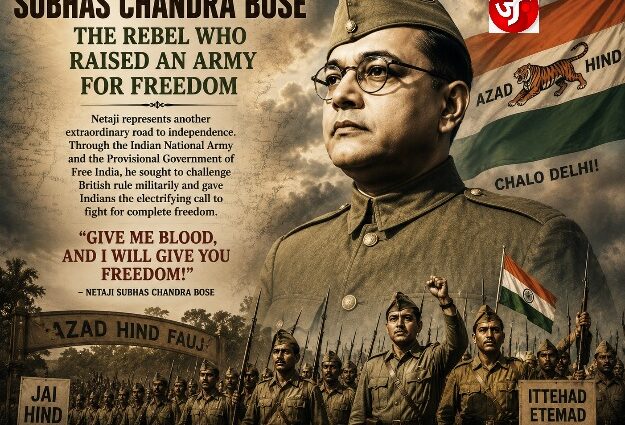
The Fire Called Netaji
A Pre-Independence Day Special
Subhas Chandra Bose was brilliant enough to enter the Indian Civil Service, but he walked away from it, and instead became president of the Indian National Congress.
He eventually broke with its leadership. During that time, he was imprisoned by the British, placed under surveillance and confined to his home, and then he disappeared.
Subhas Chandra Bose was not merely another leader in India’s struggle for independence; rather, he was a political storm: impatient, uncompromising and convinced that freedom could not indefinitely wait upon Britain’s willingness to surrender its empire.
Where Mahatma Gandhi mobilised millions through non-violent resistance, Bose chose another road: he would raise an army.
Born in Cuttack in 1897, Bose possessed the education and qualifications to build a comfortable career within the colonial establishment. After succeeding in the Indian Civil Service examination, however, he resigned before taking up a career under British rule.
For Bose, serving the Raj while India remained unfree was a contradiction he could not accept, and his political rise was extraordinary.
He became president of the Indian National Congress in 1938 and was re-elected in 1939 after defeating Pattabhi Sitaramayya, Gandhi’s candidate. But profound disagreements over strategy and leadership soon led Bose to resign.
The rebel was moving towards his own path.
The Great Escape!
In January 1941, Bose escaped house arrest in Calcutta in disguise and embarked upon an astonishing journey out of British-controlled India. He travelled through Afghanistan and eventually reached Germany.
His strategy remains one of the most controversial chapters of the independence movement. Determined to find international assistance against Britain, Bose sought support from the Axis powers during the Second World War.
He believed Britain’s war could become India’s opportunity for liberation. That decision has generated fierce historical debate ever since. Bose’s dealings with Nazi Germany and Imperial Japan cannot simply be romanticised. But neither can the central objective driving him be misunderstood: He wanted British rule in India destroyed.
By 1943, Bose had reached Southeast Asia and assumed leadership of the Indian National Army, or Azad Hind Fauj, which had initially been formed from Indian prisoners of war and expatriates under earlier leadership.
Under Netaji, the INA became something larger than a military organisation; it became an idea. Its soldiers came from different religions, regions and communities, united beneath one objective: India must be free.
Bose also announced the Provisional Government of Free India, Azad Hind, in Singapore in October 1943. It claimed sovereignty over India and declared war against Britain and the United States.
Then came the words that would echo across generations. “Give me blood, and I will give you freedom.” It was not metaphorical rhetoric.
Bose was asking Indians to sacrifice everything: their careers, homes, safety, and if necessary, their lives.
During This Time, a Woman Took Up Arms!
One of Bose’s most remarkable decisions was the creation of the Rani of Jhansi Regiment, an all-women combat unit of the INA commanded by Dr Lakshmi Swaminathan, later known as Lakshmi Sahgal.
At a time when women across much of the world were still fighting for basic political equality, Bose envisioned Indian women marching as soldiers in a national liberation army. It carried a revolutionary message: India’s freedom would not belong only to its men.
“CHALO DELHI!”
The INA advanced alongside Japanese forces towards India’s northeastern frontier. Its battle cry thundered: “Chalo Delhi!” Forward to Delhi.
INA forces fought in the campaigns around Imphal and Kohima in 1944. For a moment, the extraordinary possibility existed that an Indian nationalist army might enter India carrying the flag of rebellion against British rule.
But history turned against them. Japanese forces suffered catastrophic reverses. Supply lines collapsed. Disease, starvation, exhaustion and overwhelming Allied military strength devastated the campaign.
The INA was forced into retreat, and militarily, Bose’s great gamble failed.
But something unexpected happened afterwards.
While The Army Lost The War, The Idea Came Home:
After Japan surrendered in 1945, captured INA officers were brought back to India. The British decided to put prominent officers Shah Nawaz Khan, Prem Kumar Sahgal and Gurbaksh Singh Dhillon on trial at Delhi’s Red Fort.
Instead of humiliating the INA, the trials electrified India. Here were three officers, Muslim, Hindu and Sikh, standing together accused of waging war against the King-Emperor.
Across political and religious divisions, Indians rallied behind them. Students demonstrated, workers protested. Political leaders demanded clemency; the men the British intended to portray as traitors became symbols of patriotism to vast numbers of Indians.
Then, in February 1946, ratings of the Royal Indian Navy mutinied, with unrest spreading from Bombay to other centres. The British establishment was confronted with a frightening question: Could it continue to rule India if loyalty within the very armed forces on which colonial authority depended could no longer be taken for granted?
Historians continue to debate precisely how much the INA trials and subsequent military unrest influenced Britain’s decision to leave India. Independence resulted from many forces: decades of mass nationalism, revolutionary movements, economic pressures, World War II, international change, political negotiations and Britain’s declining imperial capacity.
But Bose had helped alter something profound: The psychological relationship between the Indian soldier and the British Empire.
THE MYSTERY THAT NEVER ENDED
Bose reportedly died following an aircraft crash in Japanese-controlled Taiwan on August 18, 1945. Subhas Chandra Bose’s physical body was never found or recovered. Official reports state he died from severe burns after a plane crash in Taihoku (Taipei, Taiwan) on August 18, 1945, and his remains were cremated locally, with ashes later kept at the Renkoji Temple in Tokyo.
Controversy surrounding his death has endured for decades.
Rumours of survival became part of India’s political folklore. Perhaps that persistence reflects something larger.
Netaji disappeared before he could see the country for which he had risked everything become free.
Less than two years later, at midnight on August 15, 1947, the Union Jack descended, and the flag of independent India rose.
Bose was not there. His soldiers did not march triumphantly into Delhi, nor did his provisional government become India’s government.
And yet his cry had already travelled farther than any army could. Subhas Chandra Bose’s legacy cannot be reduced to a slogan or sanitised into uncomplicated hero worship. His cry had already travelled farther than any army could. He was the fire called Netaji.