










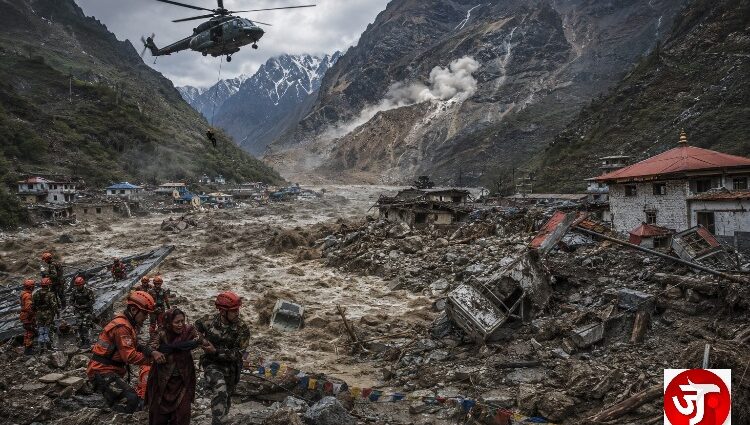
A catastrophe is unfolding across the Himalayas after a massive glacier and mountain collapse unleashed a torrent of ice, rock, mud and water along the Nepal-Tibet border, devastating villages, roads, bridges, hydropower installations and a major cross-border route.
August 29, 2026: By the latest available figures, at least 579 people have been confirmed dead in Nepal, while China has reported additional deaths in Tibet. More than 2,400 people are reported missing across Nepal and Tibet, although the figures remain fluid as rescuers reach previously inaccessible areas. The International Red Cross estimates that more than 93,000 people have been affected and require assistance.
The disaster has rapidly become one of the most serious Himalayan natural catastrophes in recent years, with the possibility of a second wave of flooding adding an extraordinary new danger to an already desperate rescue operation.
A wall of water, ice and debris
The disaster began on Wednesday, August 26, when a large section of ice and mountain material collapsed in the high Himalayas near the Nepal–China border.
The collapse sent enormous quantities of ice, rock, mud and water crashing into river systems below. The resulting surge travelled through steep Himalayan valleys with devastating force, sweeping away settlements and infrastructure almost instantaneously.
Satellite imagery and subsequent assessments indicate that the initial event involved a large chunk of glacier ice and rock breaking away high in the Langtang Lirung area, triggering a massive debris flow.
The emerging scientific picture is more specific than the initial reports suggested.
Multiple teams examining satellite imagery, seismic records and field evidence have described broadly the same chain of events. A huge ice-rock avalanche or glacial collapse appears to have occurred high above the valley. The mass then plunged a considerable vertical distance, generating a seismic signal estimated at around magnitude 5.2.
The seismic signal was initially mistaken by some observers for an earthquake.
But subsequent analysis pointed instead to the extraordinary force of the collapsing mass itself.
The avalanche then entered the Lhende River on the Tibetan side, generating a debris-laden surge. Enormous quantities of ice, rock and sediment were carried into the river system, potentially creating a temporary blockage.
That blockage effectively acted as a natural dam. Water accumulated behind the mass until the debris barrier was overtopped or failed, unleashing a violent downstream surge of mud, ice, rock and water.
The result was a disaster far larger than the initial mountain collapse alone. Witnesses described the flood as arriving with almost no warning.
In some places, the water and debris behaved less like a conventional river flood and more like a moving wall of destruction, carrying boulders, trees, vehicles and buildings downstream.
Entire sections of roads disappeared. Bridges were torn apart. Power infrastructure was destroyed. Homes were buried beneath thick layers of mud.
The damage has been particularly severe in Nepal’s Rasuwa and Nuwakot districts, while the Gyirong area on the Chinese side of the border has also suffered major destruction.
Nepal’s death toll reaches 579
Nepal’s disaster authorities reported 579 deaths as of Friday, with the toll expected to rise as search teams reach areas that remained cut off by destroyed roads and bridges.
The scale of the missing-person crisis is even more alarming.
Nepal reported 1,924 people missing, including hundreds of foreign nationals. China has separately reported hundreds missing in Tibet’s Gyirong County.
Taken together, the two sets of figures put the number of missing people at roughly 2,400 or more. Because the lists are still being compiled and cross-checked, the precise overall number remains uncertain.
That uncertainty is itself one of the defining characteristics of the disaster.
Remote Himalayan settlements have been cut off. Communications have been disrupted. Roads have disappeared under landslides and debris. In some locations, rescuers can reach survivors only by helicopter. And every hour matters.
A second disaster may be waiting upstream
The greatest immediate concern is no longer simply what has already happened. It is what could happen next.
The original collapse and debris flow blocked waterways and created temporary barrier lakes. These are effectively natural dams formed when enormous quantities of rock, mud and debris obstruct a river.
Water continues to accumulate behind these barriers.
One such lake on the Nepal side began overflowing on Friday, forcing authorities temporarily to suspend rescue operations and move rescuers and residents away from vulnerable river channels.
At one point, the reservoir was estimated to contain more than 2.5 million cubic metres of water.
On the Chinese side, authorities have also warned of another potentially dangerous lake. Chinese officials have estimated that millions of cubic metres of additional water could enter the area, creating the possibility of another destructive surge downstream.
The danger is brutally simple: if a temporary debris dam fails suddenly, millions of tonnes of water can be released in minutes.
For communities that have already been devastated once, that would amount to a second catastrophe arriving before the first one has even been understood.
Rescue operations under extraordinary conditions
Nepal has mobilised thousands of security personnel for the rescue effort.
Military and civilian helicopters are flying into isolated valleys, evacuating survivors and transporting food, drinking water, medicines and other emergency supplies.
More than 3,700 people have been rescued in Nepal, according to the latest reported figures. But the terrain is making conventional rescue operations extraordinarily difficult. The destruction of roads has effectively turned some communities into islands.
Bridges have been washed away. Landslides continue to threaten mountain roads. River levels remain dangerous. Rescue teams must also constantly assess whether they themselves could be trapped by another landslide or sudden flood.
Chinese rescuers finally reached the devastated Gyirong border crossing on Friday after access routes were destroyed.
Their assessment was devastating: the border complex had effectively been reduced to ruins. Reuters reported that a 21-member Chinese rescue team and a search-and-rescue dog had to cross mountains, forests and cliffs because the normal road route had disappeared.
The border crossing itself was once an important route connecting Tibet with Nepal and, ultimately, Kathmandu and Lhasa. Now much of it is buried beneath mud and debris.
Rumours of Chinese responsibility spread online
As the scale of the destruction became clear, another story began spreading rapidly across social media: that Chinese construction activity itself had caused the catastrophe.
Posts circulating online have alleged that years of nonstop blasting, tunnel cutting, hydropower construction and other Chinese infrastructure work destabilised the mountain and triggered the collapse.
Some versions of the claim go further, arguing that the explanation involving a glacier or ice-rock collapse, followed by river blockage and bursting, is deliberately being presented as a false explanation.
The allegation has gained traction partly because the disaster occurred in an area where China has undertaken extensive infrastructure development, including hydropower projects and border facilities.
But there is an important distinction between a legitimate question about infrastructure and risk and an unproven claim about the trigger of the geological event. The scientific evidence available so far does not support the assertion that construction blasting caused the initial collapse.
Multiple independent assessments based on satellite imagery, seismic records and field observations have instead described a broadly consistent sequence: an enormous ice-rock avalanche or glacial collapse in the Langtang Lirung region, the resulting seismic signal, the entry of the collapsing material into the Lhende River and a subsequent debris-laden surge.
The possibility that the debris temporarily dammed the river before the barrier failed provides a plausible explanation for the extraordinary volume and force of the downstream flood.
In other words, the glacier-collapse → debris blockage → river surge sequence is not simply an explanation produced by one government. It has been reflected in assessments from different scientific and reporting sources, including the USGS, ICIMOD and glaciologists cited by major international media outlets.
China, Nepal and USGS assessments have likewise pointed toward a broadly similar glacial or ice-rock mechanism.
There is currently no established scientific finding identifying construction blasting as the trigger.
That does not mean the question of construction should be dismissed.
It means the questions need to be kept separate.
Construction may have amplified the disaster without causing it
The Himalayan region has undergone enormous infrastructure expansion.
Hydropower plants, roads, tunnels, bridges, border facilities and settlements increasingly occupy narrow valleys beneath steep and unstable mountain slopes. That development creates a fundamental vulnerability.
When an extreme natural event occurs, there are simply more people, more buildings and more infrastructure in its path.
The Nepal–Tibet disaster provides a devastating illustration.
A single surge can move downstream through a chain of infrastructure installations. A road can be destroyed, cutting off a settlement. A bridge can disappear, preventing evacuation. A hydropower facility can be struck, creating additional debris and disruption. A border facility can be overwhelmed, severing a crucial international connection.
The result can become a cascading disaster.
This is a legitimate risk-amplification argument.
It is not the same thing as proving that construction caused the mountain to collapse.
That distinction is particularly important in a region where natural hazards are already extreme.
Why the Himalayas are becoming increasingly dangerous
The disaster has also reignited concerns about the growing instability of the Himalayan environment. The Himalayas contain some of the world’s largest concentrations of glaciers outside the polar regions. They are also among the world’s most geologically active mountain systems.
Climate-related glacier and permafrost instability is increasingly discussed by scientists as an important contributing risk factor.
As temperatures rise, glaciers retreat and frozen ground changes, potentially altering the stability of high-altitude slopes and increasing the likelihood of ice avalanches, landslides and unstable glacial lakes.
But climate change is not the only factor. The Himalayas are naturally prone to landslides and seismic activity. Extremely steep terrain, intense monsoon rainfall, rapidly changing glaciers and fragile mountain geology can combine to produce disasters with little warning.
The Nepal–Tibet catastrophe illustrates how several of these hazards can interact:
glacier and permafrost instability → ice-rock collapse → debris flow → river blockage → barrier failure → flash flood → secondary lake formation → potential second flood.
It is a chain reaction in which one geological event creates the conditions for another.
China orders intensified monitoring
The disaster has prompted a high-level response in China. Chinese President Xi Jinping called for intensified monitoring of glacier lakes, landslide risks and barrier lakes, as well as stronger disaster cooperation.
Premier Li Qiang travelled to the affected Gyirong region to oversee rescue efforts. Chinese authorities have warned that the terrain remains unstable and that additional collapses are possible.
The Chinese response has been complicated by the destruction of the main access routes into the disaster zone. The Gyirong border crossing, an important link between China and Nepal, was among the structures swept away.
Hundreds of foreign nationals caught in the disaster
The catastrophe has also become an international emergency because the affected region is a major destination for trekkers, tourists and religious pilgrims. Hundreds of foreigners were travelling through the region when the disaster struck.
Many were on their way to or returning from Mount Kailash and Lake Mansarovar, among the most important pilgrimage destinations in the Himalayas.
At least 540 foreigners were initially included among those missing, with nationals from countries including India, the United States, Britain, Malaysia, Australia and Canada reported unaccounted for.
The situation has triggered frantic efforts by governments around the world to establish the whereabouts of their citizens. Families are flying to Kathmandu. Others are desperately trying to establish contact with relatives whose last known locations were near the Nepal–Tibet border.
The problem is compounded by the fact that telecommunications infrastructure has been damaged, while some of the hardest-hit locations remain physically inaccessible.
For families, a missing-person list provides little comfort when there is no reliable information about whether someone is alive, injured, stranded or swept away.
India faces a major humanitarian concern
India has been particularly affected because a large number of Indian nationals were travelling through the region, especially pilgrims undertaking the Kailash Mansarovar journey.
India’s Ministry of External Affairs said 320 Indian nationals remained missing in Nepal, while more than 100 people of Indian origin holding other nationalities were also uncontactable.
At the same time, around 400 Indian nationals stranded on the Chinese side were reported safe and in contact with their families. India has also been working to evacuate those stranded.
At least 149 Indians stranded in Tibet had crossed safely into Nepal, while additional groups were being brought back to India.
New Delhi is also increasing humanitarian assistance to Nepal, including additional relief material, medical support and specialised assistance for rescue operations.
This is no longer simply a natural disaster occurring in a neighbouring country. The large number of Indian pilgrims and travellers caught in the catastrophe has made it a major consular and humanitarian crisis for India as well.
Nepal rejects foreign search-and-rescue teams for now
International offers of assistance have poured in. India, China, the United States, Britain, Japan, South Korea and other countries have offered support.
Nepal, however, has so far indicated that it does not require foreign search-and-rescue teams and intends to rely primarily on its own security forces for the rescue operation, while accepting other forms of assistance and technical support.
The United Nations has released $2 million from its Central Emergency Response Fund for emergency medical care, shelter, water and other relief requirements.
The Red Cross has estimated that tens of thousands of people urgently need food, clean water and humanitarian support.
The humanitarian crisis is only beginning
The immediate images are of destroyed villages, broken bridges and bodies being recovered from rivers. But the deeper humanitarian crisis will extend far beyond the first days of the disaster.
More than 93,000 people are believed to have been affected. Thousands have lost homes, livelihoods and access to basic services. Hospitals and health facilities have been damaged. Schools have been affected. Communities have been cut off from markets and supplies.
A catastrophe still unfolding
The most frightening aspect of the Nepal–Tibet disaster is that the final death toll is not yet known.
The 579 confirmed deaths in Nepal are already staggering, but thousands remain missing. The situation in Tibet is harder to assess, while rescue teams are still reaching areas that were previously inaccessible. And above the devastated valleys, unstable lakes and mountains continue to pose a threat.
The rescue workers are therefore fighting two battles simultaneously: finding people who survived the first flood while trying to ensure they are not caught in a second one.
The Himalayan catastrophe has become a stark reminder that in a warming and rapidly changing mountain environment, a disaster does not necessarily end when the first wave of water passes.
The rumours about Chinese construction will continue to circulate, because disasters of this magnitude inevitably create a hunger for someone or something to blame.
But the evidence currently tells a more complicated story.
A catastrophic natural process appears to have started the chain reaction. Climate-driven changes may be increasing the instability of the Himalayan environment. And decades of infrastructure development have placed more people and valuable installations directly in the path of extreme mountain hazards.
Those three facts can exist simultaneously.
A disaster can be natural in origin, climate-amplified in its risk, and made vastly more destructive by human development.
That may ultimately prove to be the most important lesson from the Himalayan catastrophe.
JANPATH NEWS NETWORK (JNN)
Independent. Fearless. On the People’s Path.