










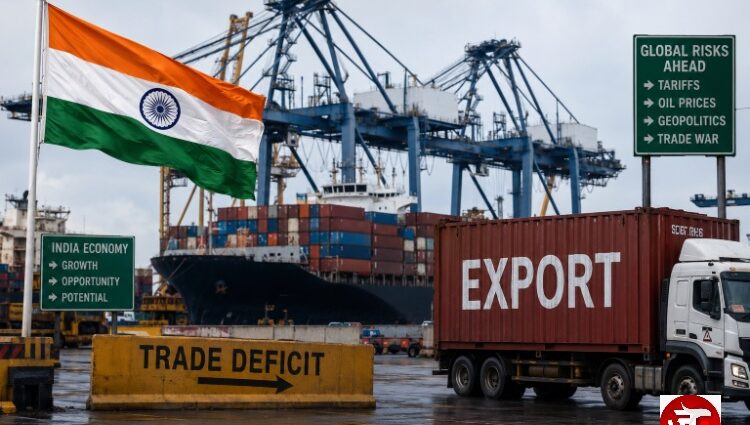
The US Senate has passed the Lindsey Graham Russia/Iran sanctions bill by 86–11, legislation that could give the US president authority to impose tariffs of up to 100% on countries continuing significant trade with Russia. India is squarely in the spotlight because of its Russian oil purchases. The bill is not itself a 100% tariff on India, but it creates a potentially enormous new threat to Indian exports.
Against that backdrop, the Reserve Bank of India has raised its FY27 GDP growth forecast to 6.7%, from 6.6%.
At the same time, the RBI kept the repo rate unchanged at 5.25% and retained a neutral policy stance. It expects FY27 inflation at around 5%. The central bank’s message is essentially that domestic demand, manufacturing, services and exports remain sufficiently resilient despite geopolitical uncertainty.
But, June produced a particularly uncomfortable number. India’s merchandise trade deficit widened to approximately $30.43 billion, with imports reaching a record $70.84 billion, up 31% year-on-year. Energy costs and geopolitical disruptions are among the factors pushing up the import bill.
That means India’s economy can be growing strongly while simultaneously becoming more vulnerable to oil prices, shipping costs, geopolitical conflict and currency movements.
Higher energy costs, geopolitical disruptions and India’s continuing dependence on imported goods are adding pressure to the external account.
At the same time, domestic economic activity continues to generate impressive government revenues. GST collections crossed ₹2.11 lakh crore in July, rising more than 15 per cent year-on-year. The numbers indicate that consumption and economic transactions inside India remain robust.
The greatest uncertainty, however, may be coming from Washington.
The US Senate has advanced legislation that could allow tariffs of up to 100 per cent on countries continuing significant trade with Russia, potentially placing India in a difficult position because of its purchases of Russian crude. Although such tariffs have not been imposed on India, the possibility represents a serious threat to exporters and businesses dependent on global markets.
China presents another strategic challenge. India imported approximately $131.6 billion in goods from China in FY26, highlighting the depth of the country’s dependence on Chinese manufacturing and industrial supplies.
India therefore enters the next phase with considerable economic strength, but also significant vulnerabilities.
The question is no longer simply whether India can grow at 6.7 per cent. The bigger question is whether that growth can withstand tariffs, expensive energy, trade deficits and an increasingly fragmented global economy.
JANPATH NEWS NETWORK (JNN)
Independent. Fearless. On the People’s Path.