









India appears to have discovered a remarkable new form of urban planning: build the flyovers, build the expressways, build the glass towers, announce the smart city, inaugurate the project with cameras rolling, and then wait for the monsoon to reveal where the water was supposed to go.
This year, the water seems to have found the answer before the planners did.
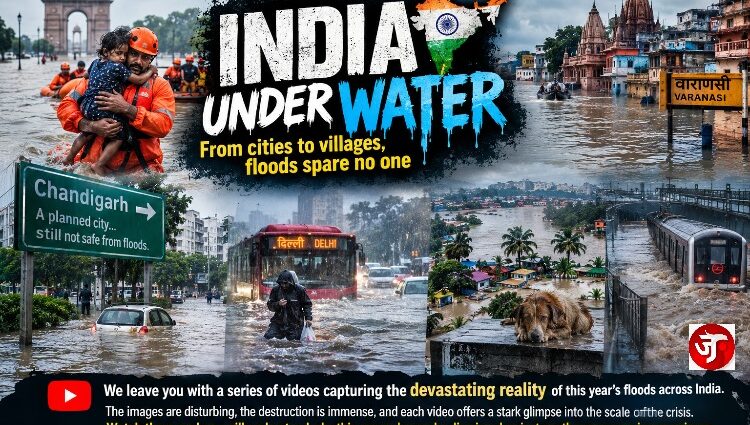
From Delhi-NCR to Chandigarh, from Maharashtra to Uttar Pradesh, Karnataka to Assam, and now even Varanasi, the floodwater is becoming a remarkably democratic force. It does not care which party runs the state, which religion lives in the neighbourhood or how many speeches have been delivered about world-class infrastructure. It simply arrives, looks at the drainage system and says: “You built all this, and this is where I am supposed to go?”
And even Varanasi, Prime Minister Narendra Modi’s Lok Sabha constituency, has not been spared. The Ganga has risen sharply, while the Varuna has pushed floodwater into low-lying areas, inundating homes. On August 25, Varanasi recorded nearly 120 mm of rain in 12 hours, leaving large parts of the city waterlogged.
At some point, perhaps we should stop calling every flood an “unprecedented natural disaster” and start asking an exceedingly unfashionable question: where did we expect the rainwater to go?
Heavy and prolonged rainfall is certainly the immediate trigger for flooding. When rain falls faster than soil, rivers, lakes and drainage networks can absorb or carry it, water has nowhere to go. But the Government of India’s own assessment acknowledges that urban flooding is made considerably worse by unplanned growth, encroachment of natural water bodies, inadequate sewerage and insufficient rainwater drainage systems.
In other words, the rain is not entirely innocent. But neither is the planning.
Consider Chandigarh, which has long been held up as one of India’s great examples of planned urban development. Designed around Le Corbusier’s modernist principles, divided into sectors and built with an organised road and green-space network, it was supposed to demonstrate that India could plan a city rather than merely allow one to happen.
Then came the rain. In August, Chandigarh received around 72–73 mm of rain in roughly two hours, leaving roads, markets and homes inundated and damaging a section of Madhya Marg. Reports pointed to inadequate drainage capacity, blocked road gullies and an overflowing N-choe. So much for the city that was designed before the city existed.
The problem is not that Chandigarh was badly conceived. The problem is that a city designed decades ago cannot simply be left to fend for itself while population, construction, traffic, concrete surfaces and rainfall patterns change around it. Infrastructure ages, cities grow, climate patterns change, drains, unfortunately, do not receive the memo.
And Mysuru offers another uncomfortable lesson. Long regarded as a relatively well-planned city with favourable topography, it too is experiencing increasing stormwater stagnation and urban flooding. A 2026 study from researchers at the University of Mysore notes that flooding is becoming more common and points to the interaction of rainfall variability, urbanisation, drainage performance and solid-waste mismanagement.
Then there is Panaji. There is a charming urban legend that its name is associated with a place that does not flood. Unfortunately, water has apparently failed to study the legend.
Panaji’s own planning documents have long recognised its vulnerability. The city sits beside the Mandovi, close to the Arabian Sea, and parts of it are low-lying and reclaimed. Its drainage system, much of it dating back to the Portuguese period, has faced persistent flooding problems, particularly when river levels and tides prevent stormwater from escaping. Encroachment, siltation, degraded natural drainage channels and the loss of wetlands have compounded the problem.
So perhaps the lesson is not that one particular government is incapable of stopping rain. Perhaps the lesson is much more embarrassing. India has a planning problem.
We have become extraordinarily good at reacting to floods after they happen, water enters homes, ministers inspect the rain, helicopters flying over torrents of rushing water, where people are dying, drowning or stranded, while the Army and NDRF springs into action. Disaster relief is generously gifted. After the monsoon ends, everyone goes home, until next year.
Meanwhile, natural lakes disappear under construction, drains become narrower, wetlands become real estate, stormwater channels become dumping grounds and roads are built without adequately considering where runoff will go.
Then the rain arrives and everyone looks surprised.
Humanity has put satellites around the Earth, landed spacecraft on the Moon and built artificial intelligence capable of writing this article. Yet apparently we remain collectively mystified by the concept that water flows downhill.
This is where the political argument also needs to change. Every time there is a flood, there is a temptation to turn it into a Hindu-Muslim argument, a BJP-Congress argument, a Centre-versus-state argument or some other version of India’s favourite national pastime: blaming the other fellow.
But rain does not vote, floodwater does not ask for someone’s Aadhaar card or citizenship proof. A blocked drain does not care whether the councillor is BJP, Congress, AAP, DMK, TMC, TVK or anything else.
Drainage is not ideological!
Cities need master plans that are actually followed. Natural drainage channels need protection. Wetlands and lakes need to be treated as flood infrastructure rather than vacant land waiting for construction. Stormwater networks need to be redesigned for today’s rainfall intensity, not yesterday’s climate. Drainage needs regular maintenance, desilting and monitoring.
Every new road, building, township and highway needs to answer one brutally simple question before construction begins: Where will the water go? The answer cannot forever be: We’ll figure it out when it rains. Because India is now figuring it out every time it rains.
And increasingly, the answer is appearing to be: Into your house.
We leave you with a series of videos capturing the devastating reality of this year’s floods across India. Amid the sarcasm, dark humour and banter between political parties, the images are disturbing, the destruction is immense, and each video offers a stark glimpse into the scale of the crisis. Watch them, and you will understand why this can no longer be dismissed as just another monsoon inconvenience. Here they are:
JANPATH NEWS NETWORK (JNN)
Independent. Fearless. On the People’s Path.