










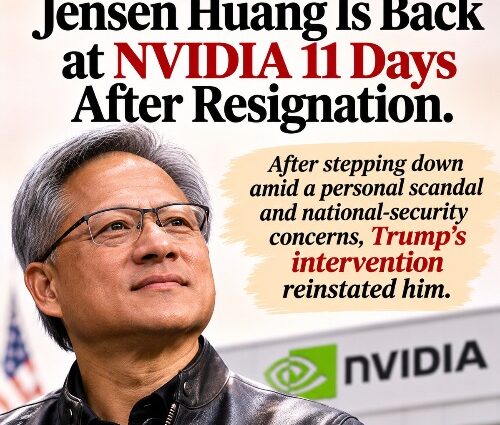
After stepping down amid a personal scandal and national-security concerns, Trump’s intervention reinstated Jensen Huang
Monday, November 23, 2026
In one of the most dramatic corporate leadership reversals of the year, NVIDIA has reinstated its co-founder Jensen Huang as President and Chief Executive Officer, just 11 days after announcing his resignation.
The company’s board voted unanimously on November 23 to bring Huang back, ending a brief but turbulent leadership transition that had unsettled the world’s most valuable AI chipmaker and attracted considerable attention in Washington.
The decision takes effect immediately. Huang has also returned to his position on the company’s board of directors.
In its announcement, NVIDIA said the board had held a series of discussions with Huang and was satisfied with his candour and ability to lead the company. It also confirmed that it had received input from senior US government officials and concluded that his reinstatement posed no national-security risk.
Harvey C. Jones, NVIDIA’s board chairman, said the company believed Huang was the right person to lead the business and that his return was in the interests of shareholders, employees, partners and customers.
Huang’s departure on November 12 followed reports of extramarital relationships that triggered a wider corporate and national-security controversy. One of the women named in reports was Alice Huang, a Chinese businesswoman and former executive of Singapore-based cloud computing company Megaspeed International. US authorities reportedly suspected her of having links to Chinese intelligence.
The allegations raised questions about whether sensitive commercial information and access to advanced NVIDIA chips could have been exposed to foreign intelligence interests.
Huang also acknowledged serious mistakes in his personal life. However, the allegations surrounding the suspected intelligence connection have not been established as proven wrongdoing by him. Beijing has rejected claims that Alice Huang was a Chinese intelligence asset.
The controversy also brought scrutiny to Megaspeed, which has been investigated over allegations that advanced NVIDIA chips were diverted to Chinese companies in violation of US export controls.
Huang’s resignation initially appeared final. NVIDIA’s board announced that it had accepted his departure and did not intend to reinstate him. But the situation changed as influential figures in Silicon Valley and Washington rallied behind the former CEO.
President Donald Trump publicly supported Huang’s return, saying the NVIDIA chief had learned a lesson and indicating that he would welcome his reinstatement.
The campaign also received support from prominent technology figures, including Elon Musk, and investors and employees who argued that removing Huang could disrupt the company’s leadership at a critical moment in the global AI race.
On November 23, the board reversed its earlier position.
The company said the government input it had received helped it conclude that Huang’s return did not present a national-security risk. The board’s investigation into whether Huang had been targeted by a foreign intelligence operation will nevertheless continue.
Huang’s return does not mean the controversies surrounding the company have ended. NVIDIA has established a National Security and Export Control Committee, comprising independent directors, to oversee trade compliance and national-security risks.
The company is also beginning a search for a Chief Compliance Officer who will oversee compliance across its operations and report to the board’s governance committee. NVIDIA has committed to cooperating with ongoing government investigations and inquiries.
Colette Kress, who took over as interim CEO following Huang’s resignation, will return to her continuing responsibilities as Chief Financial Officer. The board thanked her for leading the company during the transition.
Why Huang’s return matters
Huang co-founded NVIDIA in 1993 and transformed it from a graphics-chip manufacturer into the central supplier of processors powering much of the global artificial intelligence industry. Its chips are essential to the data centres, cloud-computing infrastructure and advanced AI systems being developed by some of the world’s largest technology companies.
His departure therefore raised questions about more than the future of one executive. It raised concerns about continuity, investor confidence and the leadership of a company at the centre of the US-China technological competition.
His reinstatement suggests that the board has decided that his leadership remains central to NVIDIA’s strategy, even as it strengthens oversight of national-security and export-control risks.
But the decision also leaves a difficult question for corporate governance: how should a company balance the importance of a founder’s leadership against the standards of conduct and accountability expected of its chief executive?
For now, Jensen Huang is back in the corner office. The investigations, however, are not over.
JANPATH NEWS NETWORK (JNN)
Independent. Fearless. On the People’s Path.