










Good evening. Tonight, India is battling water, grief, political shockwaves and public anger, while the world watches another dangerous spiral of war, diplomacy and disaster. Because apparently one crisis at a time was too modest.
Across India, the monsoon has tightened its grip. Delhi-NCR has been hit by intense rain, severe waterlogging and traffic paralysis, with the IMD issuing a red alert for the region. Ghaziabad saw roads cave in under the pressure of heavy rainfall, while floods and landslides across several states have once again exposed how quickly the monsoon can turn daily life into a survival test.
In Rajasthan, Jaipur is shaken by two disturbing stories: a 23-year-old daughter is accused of plotting her mother’s murder for money, property and a job, while the old Jaipur schoolgirl suicide case continues to haunt public conscience, with the family demanding stronger action against school authorities. The CCTV-linked case has become a chilling reminder that institutional negligence, when alleged, cannot be buried under polished school gates.
West Bengal tonight faces a political earthquake. Three former Trinamool Congress Rajya Sabha members, Sushmita Dev, Sukhendu Sekhar Ray and Prakash Chik Baraik, have joined the BJP in Kolkata, giving Mamata Banerjee’s party a major jolt at a sensitive political moment.
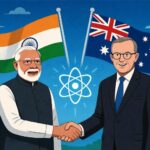
Prime Minister Narendra Modi’s Australia visit has produced a major strategic breakthrough, with Australia agreeing to begin uranium exports to India for peaceful nuclear use, alongside deeper defence and Indo-Pacific cooperation. The deal ends a long deadlock and strengthens India’s energy-security ambitions.
In Ayodhya, the Ram Mandir donation controversy has widened, with police recovering cash, gold jewellery and a car, freezing bank accounts and investigating alleged misuse of temple donations. The SIT has also flagged serious lapses in donation tracking.
In Baruipur, West Bengal, anger remains high after the horrific rape-murder of a minor girl. One of the key accused was killed in a police encounter, a development that has only intensified the public debate over justice, policing and rage after crimes against children.
And on India’s roads, a new fuel fight is rising. Protesters opposing E20 petrol gathered in Delhi, demanding consumer choice and raising fears over mileage, vehicle compatibility and repair costs. The government insists the rollout is safe; motorists are not convinced. Naturally, the engine of public anger is running perfectly.
Globally, the biggest alarm tonight is the Persian Gulf. The US and Iran have returned to open hostilities, with American strikes on Iranian targets followed by Iranian attacks on sites linked to US forces in Bahrain, Kuwait and Qatar. The Strait of Hormuz is again at the centre of the storm, threatening oil markets, shipping lanes and regional stability.
Ukraine has escalated its drone war against Russian energy infrastructure, claiming strikes on refineries, tankers and pipeline facilities, while NATO diplomacy in Turkey brought another major development: Donald Trump told Volodymyr Zelenskyy that Ukraine could be allowed to manufacture Patriot missile interceptors.
China, meanwhile, is reeling from deadly weather disasters. Severe flooding in southern China has killed dozens, forced evacuations and even triggered bizarre scenes after hundreds of snakes reportedly escaped from a flooded breeding farm.
Tonight’s warning is clear: India’s monsoon crisis, Bengal’s political churn, Ayodhya’s donation scandal, fuel protests, and the renewed US-Iran conflict could all change dramatically overnight.
This is JNN Nightly News Roll – bringing you the biggest, boldest stories first.
Stay safe. Stay alert. Stay informed.