










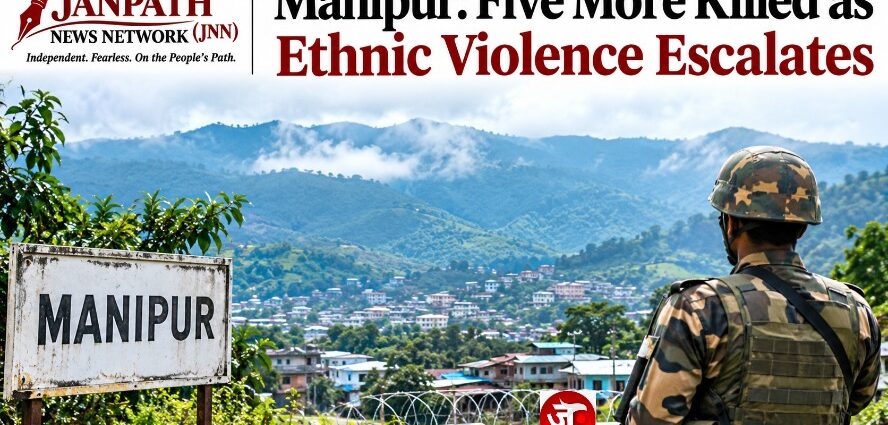
Manipur’s New Fault Lines: Five More Killed as Ethnic Violence Spreads, Peace Remains Elusive
Three years after the state was torn apart by Meitei–Kuki violence, Manipur is confronting another dangerous escalation. Fresh killings, mass protests and growing tensions between Kuki and Naga communities have pushed the state deeper into a cycle of insecurity, displacement and mistrust.
Manipur is once again witnessing a disturbing escalation of ethnic violence, with five Kuki men killed in two separate incidents in late October and early November 2026. The killings have intensified tensions between the Kuki and Naga communities, adding a new and increasingly dangerous dimension to a conflict that has already devastated the northeastern state.
The latest incidents in Manipur were reported in Noney and Kangpokpi districts. Three Kuki men were killed in an exchange of gunfire involving unidentified armed men in Noney on October 31. A day later, security personnel recovered the bodies of two Kuki men who had gone missing from Taphou Kuki village on October 28. Their deaths triggered fresh protests and heightened security deployments. Reuters+1
The killings came amid large demonstrations in Imphal on October 31, where protesters demanded the abrogation of the Suspension of Operations (SoO) agreement between the government and Kuki armed groups. The agreement, intended to keep militant cadres in designated camps and facilitate negotiations, has become a major point of political and security contention.
The protests reflect growing frustration over the government’s handling of security arrangements and allegations that armed groups are operating beyond the restrictions imposed under the agreement.
A second conflict within an already fractured state
The Kuki–Naga clashes, which intensified in February 2026 in Manipur, have now claimed dozens of lives. Scroll reported that the toll in this separate cycle of violence had reached 68 by November 1. The conflict has involved abductions, retaliatory killings, arson, hostage-taking and blockades of essential supply routes.
The killing of three Kuki church leaders in May, allegedly by Naga armed groups, further inflamed tensions. Subsequent abductions and killings on both sides deepened the hostility. Human Rights Watch had already warned in September that authorities were failing to adequately protect communities and restore security.
What makes the situation particularly alarming is that Manipur is no longer dealing with a single ethnic fault line. The original Meitei–Kuki conflict has now been compounded by serious Naga–Kuki hostilities, creating overlapping tensions involving three major communities.
The human cost: 306 dead and thousands still displaced
The scale of the humanitarian disaster is staggering.
According to figures presented by Manipur’s Home Minister Govindas Konthoujam in the state Assembly, 306 people had been killed and 49 remained missing as of August 31, 2026, in the violence that began in May 2023.
Approximately 60,000 people were displaced during the conflict. Although some have returned or been resettled, 24,000 people were still living in relief camps, according to the figures presented to the Assembly.
For thousands of families, the crisis is not a political statistic. It means destroyed homes, interrupted education, lost livelihoods, separation from ancestral villages and years of uncertainty about whether returning home is safe.
A government facing a growing test
The BJP-led government headed by Chief Minister Yumnam Khemchand Singh took office in February 2026, promising peace and reconciliation after a prolonged period of President’s Rule.
Yet violence has continued, and the latest killings have raised fresh questions about the effectiveness of security arrangements, the monitoring of armed groups and the government’s ability to restore confidence among communities.
Human Rights Watch has called for urgent action to protect civilians, investigate abuses and hold those responsible accountable. Human Rights Watch
The crisis India cannot afford to overlook
Manipur’s tragedy deserves sustained national attention, not occasional headlines whenever another killing takes place.
The danger is that repeated violence in Manipur will harden ethnic divisions, make reconciliation increasingly difficult and leave another generation growing up amid fear, displacement and mistrust.
The question confronting Manipur is no longer simply how to stop the next clash, but how to rebuild the trust, security and political confidence without which peace will remain an empty promise.
India cannot afford to look away while Manipur struggles to find its way back to normalcy.
JANPATH NEWS NETWORK (JNN)
Independent. Fearless. On the People’s Path.