










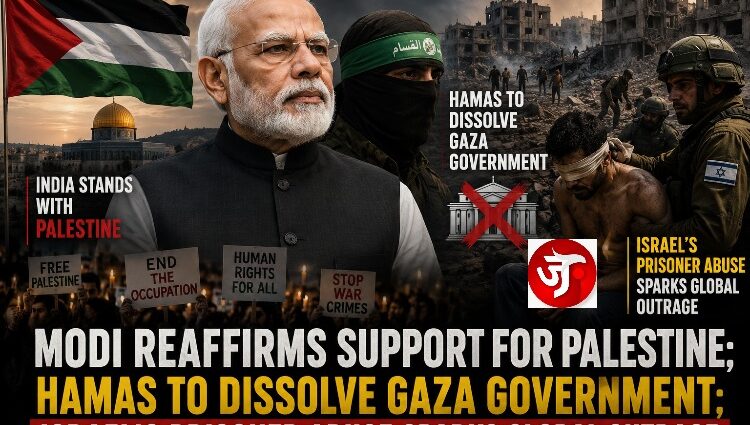
Modi Reaffirms Support for Palestine; Hamas to Dissolve Gaza Government; Israel ‘s Prisoner Abuse Sparks Global Outrage
NEW DELHI: July 8, 2026: As diplomatic efforts to reshape the future of Gaza gather pace, India has reiterated its long-standing support for an independent Palestinian state, Hamas has announced it will relinquish formal civilian governance in Gaza, and disturbing images of Palestinian detainees in Israel have reignited international scrutiny of Israel’s treatment of prisoners.
Prime Minister Narendra Modi this week reaffirmed India’s traditional position in favour of a two-state solution, calling for a peaceful resolution that allows Israel and Palestine to coexist as secure, sovereign states. The statement underscored New Delhi’s decades-old policy of supporting Palestinian statehood while maintaining increasingly close strategic relations with Israel.
The remarks came only days after Israeli Prime Minister Benjamin Netanyahu, during a television interview, claimed that Israel enjoyed the backing of “1.4 billion Indians,” citing India’s growing partnership with Israel in defence, technology, and security cooperation. Modi’s renewed endorsement of Palestinian statehood was widely interpreted as a reminder that India’s diplomacy continues to balance its expanding ties with Israel with its historic commitment to the Palestinian cause.
The timing has also drawn attention because Modi became the first recipient of Israel’s newly established Knesset Medal during his visit to Israel earlier this year, a symbolic honour recognising his role in strengthening bilateral relations. Critics viewed this award as an ad hoc creation, unusually timed, while supporters described it as reflecting the unprecedented closeness between the two countries.
Modi could have said that to protect relations with the Arab/Muslim world (oil, remittances, trade, Gulf investments) and its Global South leadership image; as well as align with broad international consensus on the two-state solution (supported by most countries, UN, etc.), while India has backed Palestinian statehood since the 1950s; Modi hasn’t abandoned this.
Modi’s government is pragmatic. It notices global moods and reputational risks but prioritizes India’s interests. This is classic Indian foreign policy: multi-alignment, not picking sides, except for Indira Gandhi, 1960s–1980s; the only Indian prime minister who was ideologically vocal and took clearer “sides” in global affairs She tilted strongly toward the Soviet Union, Palestine, and sharply critical of US policy, and was very unpopular with Washington.
Even as diplomacy unfolds, developments within Gaza itself could prove equally significant.
Hamas announced that it intends to dissolve its civilian governing administration after nearly two decades in power, describing the move as part of efforts to facilitate an internationally backed transitional arrangement. Under the proposal, day-to-day civilian administration would gradually be transferred to the National Committee for the Administration of Gaza (NCAG), a technocratic Palestinian body expected to oversee humanitarian relief, reconstruction, and public services.
Hamas officials said relinquishing formal governance would remove what they described as “pretexts for the occupation” and help create conditions for a broader political settlement. However, the organisation has made clear that the transition will not happen overnight. Existing ministries and civil servants are expected to remain in place during the initial phase, while Hamas is still expected to retain considerable influence over security matters in areas under its control. Analysts therefore caution that the announcement represents a significant political gesture but not necessarily an immediate end to Hamas’ influence inside Gaza.
The proposed transfer forms part of wider ceasefire and post-conflict discussions being promoted under a U.S.-backed diplomatic framework aimed at stabilising Gaza and eventually paving the way for broader Palestinian political reforms.
Meanwhile, a heartbreaking image has gone viral: A blindfolded Palestinian detainee from Gaza, stripped of dignity, kneels with his hands tightly bound behind his back, wrists zip-tied, head forced downward in submission. The man’s posture screams vulnerability and fear. Two devastated mothers in Gaza are convinced this is their missing son. Israel admits the photo is real… but still refuses to reveal his name, condition, or whereabouts.”
The photograph has become the centre of an emotional humanitarian story after two Palestinian mothers separately claimed that the man pictured could be their missing son, each having lost contact with their child during Israeli military operations. Their search for answers has highlighted the anguish faced by thousands of Palestinian families still searching for relatives who disappeared during the conflict. The absence of official information has fuelled growing international concern among humanitarian organisations and human rights advocates, who continue to call for greater transparency regarding detainees and missing civilians.
The images, widely shared by international media and social platforms, have intensified debate over the humanitarian consequences of the Gaza conflict. Reports of families unable to trace detained relatives, limited communication, and uncertainty surrounding prisoners have become recurring themes throughout the war, adding further pressure on ongoing diplomatic efforts.
Together, India’s renewed support for Palestinian statehood, Hamas’ willingness to step back from formal governance, and mounting international concern over the treatment of detainees illustrate how the conflict is entering an increasingly complex phase, one in which diplomacy, governance, humanitarian accountability, and regional geopolitics are becoming ever more deeply intertwined.