







From Jantar Mantar to Bankipur and Datia, India’s restless young generation is becoming harder for established politics to ignore. As RSS chief Mohan Bhagwat prepares to meet 2,000 students in Mumbai, a larger question emerges: who will capture the politics of India’s next generation?
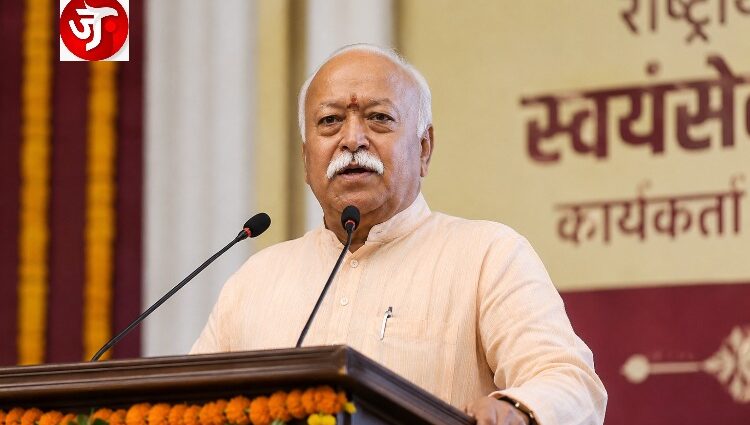
NEW DELHI, AUGUST 4: RSS Sarsanghchalak Dr Mohan Bhagwat’s upcoming interaction with more than 2,000 young Indians in Mumbai might ordinarily have been viewed simply as another youth engagement. But after weeks of student unrest and two uncomfortable bypoll results for the BJP, its timing carries considerably greater political weight.
Dr Mohan Bhagwat will interact with students from more than 100 cities at the Nita Mukesh Ambani Cultural Centre on August 6 during the I.I.M.U.N. Annual Championship Conference.
The theme, “The Role of Youth in Uniting the World, the Indian Way,” could hardly arrive at a more politically charged moment.
Only days earlier, while student-led protests over examination irregularities were dominating attention at Jantar Mantar, Bhagwat offered a remarkably direct assessment of India’s younger generation.
“The new generation asks questions,” he said, stressing the importance of explaining reasoning and communicating with young people. His prescription was memorable: “Not dictation, but discussion. Not orders, but consensus.”
Bhagwat never directly attributed his remarks to the Jantar Mantar agitation. Yet their timing inevitably placed them against the backdrop of a growing youth protest movement.
Then came the August 3 bypoll results.
In Bihar’s Bankipur, Jan Suraaj founder Prashant Kishor delivered a stunning breach of what had been a BJP fortress, defeating the party by nearly 19,000 votes and ending its decades-long dominance of the constituency. Kishor on Monday said the nationwide Gen Z protests may have contributed to his victory in the Bankipur Assembly bypoll, where he ended the BJP’s three-decade dominance.
In Madhya Pradesh’s Datia, meanwhile, Congress’s Ghanshyam Singh defeated BJP challenger Ashutosh Tiwari, allowing Congress to retain the constituency.
Two bypolls cannot establish a national electoral trend. Nor can India’s vast Gen Z electorate be treated as a single political bloc.
But taken together, Jantar Mantar, Bhagwat’s unusually explicit appeal for dialogue, Bankipur and Datia raise a question the BJP and its ideological family cannot comfortably dismiss: is something shifting beneath the political surface?
For more than a decade, the BJP mastered the language of aspiration, nationalism and digital communication, particularly among younger voters. But a generation preoccupied with examinations, jobs, education, inflation and its own economic future may prove less permanently attached to political identities than previous generations.
And that raises another fascinating question: If the BJP’s grip on sections of young India is loosening, who inherits that space?
Congress remains the principal national opposition, but Bankipur introduces another possibility. Prashant Kishor has attempted to build Jan Suraaj around governance, employment, education and grassroots political mobilisation. His victory does not suddenly make him a national alternative, but breaking a three-decade BJP stronghold ensures that he can no longer be dismissed as merely a political strategist attempting to become a politician.
There may not even be a single beneficiary. India’s next political realignment could instead produce a fragmented youth vote, moving among Congress, regional forces, emerging parties, and independent movements according to issues rather than inherited loyalties.
That may explain why Bhagwat’s words deserve attention beyond the Mumbai conference.
“Not dictation, but discussion” is more than advice about communicating with teenagers. In the political climate of August 2026, it sounds remarkably like recognition that India’s youngest citizens are changing the terms of the conversation.
Jantar Mantar demonstrated their capacity to protest. Bankipur offered at least one tantalising glimpse of their potential electoral influence.
Now, as the political tremors of a restless generation begin to register beyond the streets, the RSS chief is preparing to sit across from 2,000 young Indians in Mumbai, to speak to them.
Perhaps the crucial political question is no longer whether India’s Gen Z is listening to its leaders; it is whether India’s leaders have realised that they must start listening to Gen Z.
JANPATH NEWS NETWORK (JNN)
Independent. Fearless. On the People’s Path.