










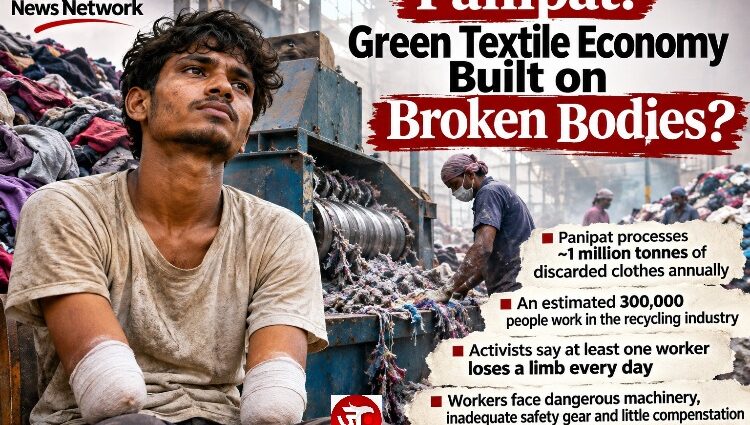
Textile’s Green Economy while workers in Panipat’s recycling factories lose limbs and livelihoods processing clothes for global markets.
November 9, 2026: The world is embracing textile recycling as a solution to fast fashion’s mounting waste crisis. But behind the industry’s green credentials lies a disturbing human story: workers in India’s recycling factories are losing their arms, legs and livelihoods while processing discarded clothes for global markets.
A recent investigation by The Guardian, published on November 6, has exposed the dangerous working conditions in Panipat, Haryana, one of the world’s largest textile recycling hubs.
The city processes an estimated one million tonnes of discarded clothing annually, much of it imported from the United States, Canada and Europe. These garments are shredded, converted into fibres and spun into yarn for products that eventually reach international markets.
But the human cost is devastating. Nineteen-year-old Suraj Kumar, who migrated from West Bengal in search of work, lost both his arms in August after an electrical short circuit propelled him into an industrial shredding machine. He had worked at the factory for barely three months, hoping to earn enough to support his parents.
His tragedy is not an isolated incident. The Guardian monitored reports from 11 private and two government hospitals in Panipat over one week in August and identified six textile workers who had suffered serious limb injuries. An activist tracking industrial accidents estimates that at least one worker loses a limb every day, although this figure has not been independently established through official accident records.
Dangerous machines, inadequate protection
Workers reportedly operate heavy shredding and spinning machinery without adequate safety guards, protective equipment or proper training. In some factories, machines continue rotating even after the power is switched off, leaving workers vulnerable to catastrophic injuries.
The vulnerability extends beyond the factory floor. More than 90% of Panipat’s workers are reportedly employed informally, leaving many without reliable employment contracts, social security or guaranteed compensation.
For workers who survive serious accidents, losing a limb often means losing their only source of income. Some struggle for years to obtain compensation, medical support or disability benefits.
Who is accountable?
The irony is difficult to ignore. International markets increasingly celebrate recycled textiles as an environmentally responsible alternative to fast fashion. Yet the people turning discarded garments into new products often work in conditions that threaten their health and survival.
Products made from recycled fibres enter supply chains serving international retailers, including H&M Home, IKEA, Primark, Tesco and Walmart. The investigation raises serious questions about whether commercial audits and sustainability commitments adequately examine the safety of the workers behind these products. Their inclusion in supply chains does not, by itself, establish responsibility for individual factory accidents.
India’s textile industry is a major source of employment, but its recycling economy cannot be called sustainable if workers are left to bear the consequences of unsafe machinery and inadequate labour protection.
The question is no longer simply what happens to discarded clothes. It is what happens to the people who handle them.
A green economy cannot be built on broken bodies.
JANPATH NEWS NETWORK (JNN)
Independent. Fearless. On the People’s Path.