









Indian Youth Congress launches SOS outreach as young women caught in political firestorm face doxxing, sexualised threats and fear beyond the screen
NEW DELHI, AUGUST 3: A political argument can be answered. An offensive remark can be condemned. An apology can be demanded. But when disagreement mutates into rape threats, death threats, doxxing and the circulation of a young woman’s personal information, something far more dangerous has begun.
At the centre of that storm is Ruchika Singh, whose remarks concerning Prime Minister Narendra Modi during a Jantar Mantar protest went viral, triggering outrage, a police complaint, an apology and an extraordinary wave of online hostility.
On July 29, a Zero FIR was registered at Noida’s Expressway Police Station following a complaint by advocate Smriti Singh. It invoked Sections 352, 353(1) and 356(1) of the Bharatiya Nyaya Sanhita, concerning intentional insult, statements conducing to public mischief and defamation. Because the alleged remarks were made in Delhi, the matter was subsequently transferred to Delhi Police.
Singh later appeared in an apology video with folded hands, describing herself as 15 and seeking forgiveness from the country.
But the apology did not end the nightmare.
Her case has become part of a wider controversy over young women protesters reportedly facing rape and death threats, doxxing and mass online harassment. The issue is no longer simply about what Ruchika said. It is about what happens when punishment escapes the boundaries of law and enters the terrifying anonymity of the internet.
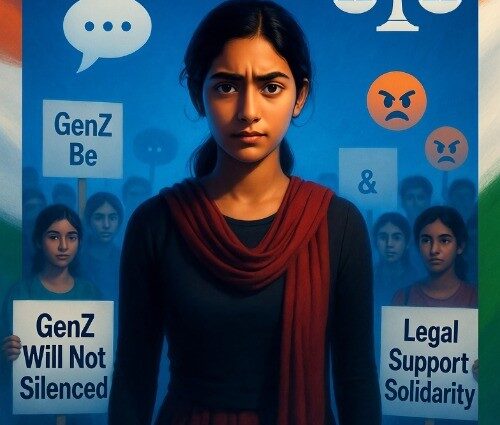
Into this atmosphere has stepped the Indian Youth Congress, extending legal and organisational assistance to young protesters and women facing intimidation. Its intervention comes alongside the Congress-backed “Chhatron Ki Goonj” campaign, created around the student protests and examination controversy.
Political activist Yogendra Yadav publicly applauded the initiative, writing: “Well done IYC” and calling upon people to stand with young persons facing what he described as “witch-hunting.”
But behind the politics lies something brutally human.
For a girl receiving sexualised threats, switching off a phone does not switch off fear. Every unknown caller becomes frightening. Every stranger outside the house becomes a question. Every leaked detail makes home feel a little less private. Parents become afraid. Families withdraw. Ordinary routines collapse.
That is the trauma too easily hidden behind hashtags and political shouting.
For a girl receiving sexualised threats, switching off a phone does not switch off fear. Every unknown caller becomes frightening. Every stranger outside the house becomes a question. Every leaked detail makes home feel a little less private. Parents become afraid. Families withdraw. Ordinary routines collapse.
Ruchika Singh may be criticised for her words. Her conduct may be debated, and the law allowed to take its course.
But rape is not a rebuttal. Death is not a counterargument. Doxxing is not democracy.
A republic must be strong enough to distinguish between holding someone accountable for speech and unleashing terror upon them.
Because once political disagreement makes young women afraid for their bodies and their lives, the argument is no longer about one protester or one political party. It is about what kind of democracy India intends to be.
Political disagreement cannot become permission for psychological terror.
JANPATH NEWS NETWORK (JNN)
Independent. Fearless. On the People’s Path.