










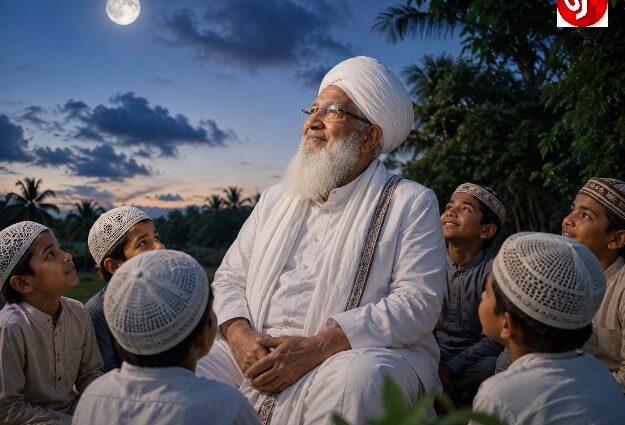
There are lives that are measured by titles, and there are lives that make the titles themselves seem too small.
Sheikh Abubakr Ahmad, widely known as Kanthapuram A.P. Aboobacker Musliyar and recognised as the Grand Mufti of India, belongs to the second category. His story is not simply that of a religious scholar who rose to prominence. It is the story of a man whose understanding of faith became inseparable from service, whose experience of loss became a source of compassion, and whose concern for a handful of vulnerable children eventually grew into a vast educational and humanitarian mission.
And perhaps the most important part of the story begins not in a great institution, but in a small village in Kerala, with a boy who lost his father.
He was child of Kanthapuram
Sheikh Abubakr Ahmad was born in Kanthapuram, in present-day Kozhikode district of Kerala. Born on 22 March 1939, he came from a modest, deeply religious family. His father, Ahmed Haji, is described in his biographical profile as a pious man, while his mother, Kunheema Hajjumma, came from a family associated with Qur’anic teaching. His earliest education combined public instruction with Islamic learning.
Then, when he was twelve, his father died. For a child, twelve is an age when the world is still supposed to be held together by adults. Losing a father at that age can make the fragility of life impossible to ignore.
There is no reliable record that allows us to identify a single dramatic moment when the young Abubakr announced that he would devote his life to helping humanity. What his life does reveal, however, is something more profound. The experience of vulnerability appears to have become part of the moral landscape through which he viewed the world. He knew what it meant for a child to lose the person who was supposed to protect him. Decades later, that understanding would become central to his work with orphans.
When faith became service
For Sheikh Abubakr Ahmad, scholarship was never intended to be confined to books, sermons or theological argument. At the centre of his outlook was the Sufi principle of khidma, service to humanity.
Religion can become an abstract exercise in declaring what people should believe. Sheikh Abubakr’s public life has instead been marked by an insistence that faith must produce responsibility towards human beings: He had a strong belief that the vulnerable child must be protected; the poor must be given dignity, students without means must be given education; the person without opportunity must be given a pathway into employment; and communities divided by suspicion must be reminded that coexistence is not weakness but civilisation.
That philosophy would eventually produce one of the most remarkable educational and charitable movements to emerge from Kerala’s Muslim community.
It began with children
The early history of the movement is associated with a small group of orphans. The often-repeated account is that Sheikh Abubakr Ahmad began by taking responsibility for 25 orphans, providing them with education, shelter and care.
The figure should be treated carefully. It is widely associated with the institution’s story, but it is not independently established as an audited statistic in the official historical material available today. But the precise number is almost beside the point. Twenty-five children are enough to change the moral direction of a man’s life. And that is where the story becomes extraordinary.
What began as care for vulnerable children eventually became Markazu Saquafathi Sunniyya, popularly known as Markaz, established at Karanthur in Kozhikode in 1978. The institution grew around a deceptively simple proposition: Education should not be a privilege reserved for those who can afford it. That idea transformed the scale of the mission.
From an orphanage to a movement
Markaz did not remain merely an orphanage or a religious school. It expanded into a network encompassing Islamic studies, general education, professional education, higher education, healthcare, special education, welfare and humanitarian assistance.
Its own published material describes a wide range of programmes covering orphan care, education, employment, healthcare, housing, food assistance and support for disadvantaged communities. A Markaz brochure marking its 45-year journey, for example, reported figures including 18,745 beneficiaries of orphan-care programmes, more than 135,000 job opportunities, 16,937 shelters, 9,920 lavatories and more than 12,000 drinking-water projects. These are institutional figures and should therefore be understood as reported programme statistics rather than independently audited totals.
But statistics alone cannot explain the significance of the transformation. A child who receives food survives, acquires possibility, receives education, skills, healthcare, shelter and dignity acquires something even more important: Agency.
That is the real philosophy behind the Markaz experiment. Charity should not merely keep people alive. It should help them become capable of shaping their own lives.
The making of “Abul Aytam”
Among the names associated with Sheikh Abubakr Ahmad is “Abul Aytam”, meaning Father of Orphans. It is one of those titles that can easily become ceremonial. In his case, it carries a more tangible meaning because orphan care has remained part of the institutional mission associated with him. The title also reveals something about the moral architecture of his life. He did not simply speak about compassion, but institutionalised it.
He turned compassion into hostels, classrooms, scholarships, food programmes, medical initiatives and welfare structures, which is a far more demanding form of charity, requiring requires buildings, teachers, doctors, administrators, funding, logistics and decades of persistence.
The educational revolution
Perhaps Sheikh Abubakr Ahmad’s most consequential contribution lies in education. He recognised that communities cannot be lifted permanently through charity alone. They have to be educated, and education, in his vision, was not supposed to mean only traditional religious instruction. His work has been associated with integrating modern disciplines into Islamic educational environments and developing institutions that combine religious scholarship with contemporary knowledge.
The resulting network has expanded into schools, colleges and professional institutions, including law, medicine, arts and sciences and specialised educational programmes.
Markaz’s published materials also highlight institutions within its wider educational ecosystem, including a Unani medical college, law college, business and research initiatives and other professional and academic centres. This is where Sheikh Abubakr’s vision becomes particularly significant. He did not see modern education as a threat to tradition, rather saw knowledge as a bridge between tradition and the future.
A social mission far beyond Kerala
The remarkable thing about the movement is not simply that it became large, it is that its original moral concern remained recognisable even as the institutional structure expanded where the child remained at the centre, the student from a poor family remained important, as did the orphan, migrant worker, woman seeking education, and the person needing healthcare, housing, employment or basic necessities.
And the mission extended beyond Kerala. Markaz’s institutional accounts describe educational and welfare activities across India and among Indian communities abroad, including the Gulf. That expansion also reflects another important feature of Kerala’s modern social history: the economic transformation produced by migration and Gulf remittances.
Sheikh Abubakr Ahmad’s initiatives sought to channel that economic energy into education, infrastructure, employment and community development rather than allowing wealth to remain merely private consumption.
It was, in its own way, an argument about what prosperity is for.
A different understanding of leadership
There is a particular kind of leadership that seeks power by making people dependent, there is another that seeks influence by making people capable. Sheikh Abubakr Ahmad’s educational model belongs much closer to the second, where the students should never remain forever beneath his shadow. but they leave carrying knowledge into the world.
That is why the scale of the alumni and educational network matters more than the size of any single campus where the school is a building, the university is an institution, but the educated generation is a social transformation.
A man who made harmony part of the mission
His public role has also increasingly been associated with social harmony and inter-community coexistence, and this dimension matters particularly in contemporary India.
Sheikh Abubakr Ahmad has repeatedly emphasized social harmony, brotherhood and civic responsibility. That aspect of his work received unusually direct recognition from Prime Minister Narendra Modi in February 2026. When the Prime Minister met Sheikh Abubakr Ahmad on 16 February 2026, he publicly noted the Grand Mufti’s efforts to advance social harmony, brotherhood and education across the country. The significance lies not merely in the meeting itself.
It is an acknowledgement from the country’s highest political leadership that educational and humanitarian work can become part of the larger project of social cohesion.
Recognition beyond India
His work has also attracted international recognition. In 2023, Malaysia conferred upon him the International Tokoh Ma’al Hijrah Award, one of the country’s highest recognitions for influential Muslim scholars. The Malaysian government’s official publication identifies him as the recipient for 1445H/2023 and records his positions and areas of scholarship. His other reported honours span education, humanitarian service, Islamic scholarship and peace initiatives, reflecting the breadth of the roles he has occupied over the decades.
But awards are ultimately the least interesting part of the story as a trophy does not educate a child, nor a certificate does not feed an orphan: The real legacy lies in what happens after the ceremony is over. This is why the title Abul Aytam, Father of Orphans, has acquired meaning beyond symbolism, his
Sheikh Abubakr Ahmad’s life offers a particularly powerful lesson for India: the strongest form of social reform is the kind that gives people knowledge, dignity, opportunity and the confidence to stand on their own feet.
The boy who knew loss grew into a man determined to ensure that other children would not be defined by theirs.
JANPATH NEWS NETWORK (JNN)
Independent. Fearless. On the People’s Path.