









India’s day of hospital fires, toxic leaks, rising prices, diplomatic tensions and weather chaos comes as wars, sanctions and trade conflicts deepen an increasingly unstable world.
As August 24, 2026 draws to a close, India finds itself confronting a grim mixture of tragedy, infrastructure failures, rising prices, diplomatic manoeuvring and weather disruptions, while beyond its borders the world is being pulled deeper into economic confrontation and war. It is one of those days when the headlines seem less like separate stories and more like pieces of a much larger warning about how fragile modern life can become when institutions, infrastructure and geopolitics collide.
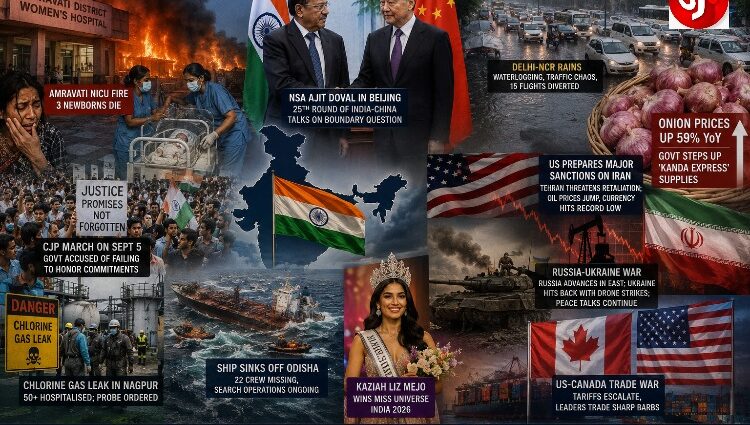
The most heartbreaking story comes from Amravati in Maharashtra, where three premature newborns died after a fire broke out in the Special Newborn Care Unit of the government-run District Women’s Hospital in the early hours of Monday. The fire reportedly began after a ventilator caught fire at around 3.15–3.30 a.m., sending smoke through a ward where 39 newborns were being treated. Hospital staff and others rushed to evacuate the babies, with 36 infants rescued and six critically affected newborns shifted to another hospital.
The tragedy has inevitably raised questions about hospital safety and emergency preparedness. Reports from the scene have pointed to alarms that did not activate and sprinklers that failed to operate, while officials have said the hospital had undergone fire audits and had applied for another this year. A high-level inquiry has been ordered. The questions now are painfully simple: could these deaths have been prevented, and why must the answers arrive only after three families have lost their newborn children?
Meanwhile, on the diplomatic front, National Security Adviser Ajit Doval has arrived in Beijing for the 25th round of India-China Special Representatives talks on the boundary question. Doval is scheduled to meet Chinese Foreign Minister Wang Yi on August 25, with the talks coming at a time when New Delhi and Beijing are attempting to stabilise relations after years of severe tensions along the Himalayan frontier. His visit also comes ahead of the BRICS summit in New Delhi, where Chinese President Xi Jinping is expected.
At home, political tensions are simmering as the Cockroach Janta Party has announced a September 5 march in Delhi from India Gate to the New Delhi Police Headquarters. The group says the government has failed to honour commitments made during the July agitation, particularly assurances concerning the withdrawal of FIRs against students and protesters. The march is expected to involve students, youth organisations and families of NEET victims.
Rahul Gandhi’s “Chhatron Ki Goonj” is emerging as more than a student outreach programme, giving young Indians a powerful public platform to speak, question and demand a political future in which their voices are not merely heard, but taken seriously.
For the ordinary household, another familiar source of anxiety is becoming more expensive: the humble onion. The all-India average retail price has risen 59 per cent year-on-year to ₹43.53 a kilogram, according to government data. In response, the Centre has begun moving buffer stocks from Nashik through dedicated railway rakes, the aptly named “Kanda Express”, to major consuming centres in an effort to increase supplies and contain the seasonal price surge.
The weather has provided little relief. Delhi-NCR has again faced episodes of heavy rain and thunderstorms, bringing waterlogging, traffic disruption and flight diversions, adding to the familiar spectacle of a major capital discovering, every monsoon, that rain continues to possess the remarkable ability to defeat roads, drains and traffic systems.
Infrastructure worries have also surfaced dramatically in Nagpur, where a chlorine gas leak at a water-treatment plant sent more than 50 people to hospital with breathing difficulties. The leak reportedly came from a 900-kg chlorine cylinder, prompting questions over why such a large reserve cylinder was being kept in an open area rather than a properly contained facility. A technical inquiry has been ordered.
Elsewhere, the government is dealing with the consequences of economic and administrative pressures. The US Ambassador Sergio Gor’s visit to the Tata-Lockheed Martin facility in Hyderabad has highlighted the continuing deepening of India-US defence cooperation. In Tamil Nadu, the government has decided to drop the Parandur airport project in favour of alternative sites, while the Enforcement Directorate has carried out searches in a case involving alleged GST input-tax-credit fraud.
And amid all the grim news, there is at least one lighter headline. Nineteen-year-old Kerala-born law student and model Kaziah Liz Mejo has been crowned Miss Universe India 2026 in Jaipur after defeating 52 other contestants. She will represent India at the Miss Universe pageant in Puerto Rico later this year.
But India’s troubles today are not confined to its borders. Off the Odisha coast, a Panama-flagged bulk carrier sank in the Bay of Bengal while carrying 24 crew members. Two have been rescued, while 22 remain missing, prompting an intensive search involving the Indian Navy and Coast Guard. The crew included 20 Chinese nationals, three from Myanmar and one Bangladeshi national.
The international picture is even more volatile. The United States is preparing a sweeping new round of sanctions against Iran, described by Treasury Secretary Scott Bessent as an “economic D-Day”. Tehran has threatened retaliation, while Iran’s currency has plunged to a record low and tensions around the strategically vital Strait of Hormuz have intensified. Iran has blacklisted 45 tankers over alleged violations of its transit rules, raising fresh concerns about shipping and global energy supplies.
The Russia-Ukraine war continues to grind on with no clean diplomatic exit in sight. Ukraine marked its 35th Independence Day with President Volodymyr Zelenskyy insisting that Kyiv wants peace but will not surrender its sovereignty. British Prime Minister Andy Burnham travelled to Kyiv for his first overseas visit, while Britain announced further defence cooperation, including assistance aimed at establishing local production lines for the SCALP long-range missile. European leaders condemned continuing Russian strikes on Ukrainian cities and infrastructure.
And as if two major geopolitical confrontations were not enough, the United States and Canada have plunged into a fresh trade war. Washington has imposed 50 per cent tariffs on about $20 billion worth of Canadian goods, while Prime Minister Mark Carney has vowed a dollar-for-dollar response. The dispute threatens to damage one of the world’s most integrated economic relationships and adds another layer of uncertainty to already nervous global markets.
Taken together, the headlines of August 24 tell a rather unsettling story. In Amravati, vulnerable newborns died amid questions about hospital safety. In Nagpur, a toxic gas leak exposed weaknesses in industrial safeguards. On the roads and in the skies around Delhi, extreme weather once again tested urban infrastructure. Onion prices reminded households that even basic food security can be vulnerable to supply shocks. At the same time, India’s diplomats are navigating a delicate relationship with China, while the country’s strategic and economic interests are being pulled into an increasingly turbulent international environment.
And beyond India, sanctions, tariffs, wars and threats are steadily replacing the language of cooperation with the language of confrontation.
The modern world, it seems, has perfected the art of connecting everything to everything else. A fire in a hospital, a leaking chlorine cylinder, an onion becoming expensive, a ship disappearing into the Bay of Bengal, a border negotiation in Beijing, sanctions on Iran and tariffs on Canada may appear to belong to entirely different worlds.
They do not.
They are all reminders of the same uncomfortable truth: when systems fail, it is ordinary people who pay the price.
JANPATH NEWS NETWORK (JNN)
Independent. Fearless. On the People’s Path.