









In the heart of New Delhi, outside the gates of the Election Commission of India (ECI), a theatrical protest unfolded on the morning of June 11, 2026. Young activists from the National Students’ Union of India (NSUI), the student wing of the Congress party, gathered to voice outrage over the rejection of senior leader Meenakshi Natarajan’s nomination for a Rajya Sabha seat from Madhya Pradesh.
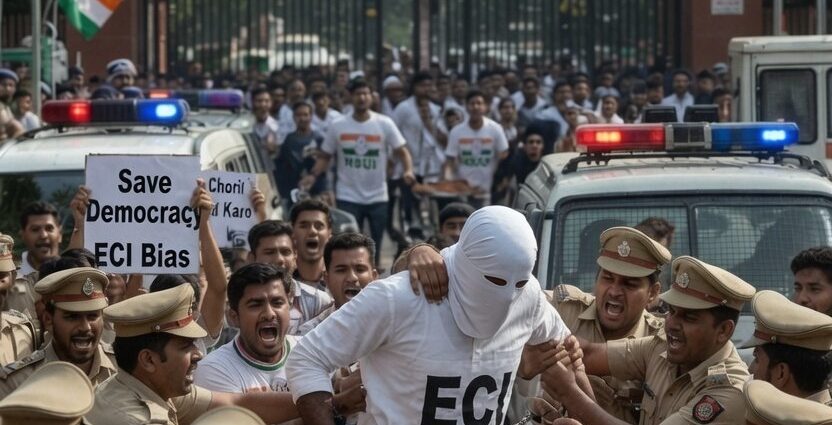
What began as a symbolic “Kathputli” (puppet) performance, complete with a demonstrator dressed in white attire labeled “ECI,” bound with ropes and paraded as a manipulated figure, quickly escalated into a scene of physical confrontation captured on video and now circulating widely.
The Trigger: A Nomination Rejected: The immediate cause was the Returning Officer’s rejection of Meenakshi Natarajan’s papers on June 9–10, 2026. The objection centered on non-disclosure of a pending private complaint filed in a Hyderabad court (a case with no FIR or framed charges, according to reports). Congress leaders, including Abhishek Manu Singhvi, called the order “egregious, blatantly unlawful,” and an attack on democratic processes. They met the Election Commission and have now moved the Supreme Court challenging the decision.
With Natarajan’s nomination out, the three BJP candidates for Madhya Pradesh Rajya Sabha seats are set to go unopposed, given the party’s strong majority in the state assembly. Congress frames this as political targeting and “vote chori” (vote theft) by other means; critics on the other side argue it upholds strict disclosure norms under the Representation of the People Act.
NSUI’s protest was framed as a defense of constitutional values, transparency, and the right to fair electoral participation. Their statement emphasized that “in a democracy, fairness, transparency, and the spirit of the Constitution are paramount.
The demonstration featured creative symbolism: activists performed a “Kathputli dance” protest, with one participant costumed and bound to represent alleged manipulation of institutions. Placards and slogans accused the ECI of bias. Media personnel were present, filming the event. The widely shared video (posted by NSUI itself) shows tense moments: police personnel in khaki uniforms physically engaging with protesters, individuals being restrained or guided toward a police vehicle, scuffles near the entrance, and cameras capturing every angle. One frame shows the bound white manipulated figure in the protest costume being roughly handled by the policed and pushed into a police bus; others depict heated exchanges and detentions.
See video: https://x.com/nsui/status/2064997516916257108?s=20
NSUI and Congress supporters describe the police response as excessive force against a peaceful, symbolic demonstration allowed under democratic norms. Videos of the rough handling have fueled accusations of brutality and suppression of dissent.
The force used, visible pushing, binding (even if part of the performance), and loading into vehicles, appears disproportionate for a student-led symbolic action outside a government office. Such visuals resonate powerfully in an era of instant social media amplification, raising familiar questions about the balance between protest rights and law enforcement duties. Congress and NSUI leaders have historically used such protests to highlight perceived institutional bias, especially ahead of elections. The ECI, for its part, maintains it acts independently based on legal scrutiny of nominations.
This incident is not isolated. Student and youth wings across parties frequently stage demonstrations outside key institutions, NTA offices during exam controversies, Parliament, or the ECI-often blending creative symbolism with demands for accountability. The NEET-related protests earlier in 2026 followed a similar pattern of passionate mobilization met with security deployments.
It touches on deeper fault lines with electoral integrity versus political competition: Strict scrutiny of nominations protects transparency but can be weaponized if applied selectively.
Right to protest: Peaceful dissent is a cornerstone of democracy, yet the line between expression and disruption is often contested in real time.
Police-protester dynamics: Viral videos of physical confrontations erode public trust when they appear one-sided, regardless of the underlying cause.
Student politics: NSUI’s activism keeps youth voices in the national conversation but also invites charges of being an extension of party machinery.
Moving forward, as the Supreme Court prepares to hear Meenakshi Natarajan’s challenge, the images from outside the ECI office serve as a stark reminder: democracy thrives not just on institutions and laws, but on how those institutions and their guardians respond to dissent. Whether the protest is seen as legitimate expression or disruptive theatre, and whether the police response was proportionate or heavy-handed, will depend on full investigations, eyewitness accounts, and official statements. What is clear is that such moments test the resilience of India’s democratic fabric demanding transparency from all sides, restraint from authorities, and constructive dialogue over confrontation.
In the end, the health of any democracy is measured not by the absence of protests, but by how fairly and peacefully they are conducted and managed. The scenes outside the Election Commission on June 11 add another chapter to that ongoing story.