









From Rajasthan to Uttar Pradesh, a new generation is discovering that sometimes the first lesson in democracy is learning how to demand a classroom that is safe enough to sit in.
On August 15, India will once again celebrate freedom, the flags will rise, the speeches will begin, and children will march in neat rows, sing patriotic songs and listen to adults tell them about the sacrifices that created the Republic.
But somewhere in Rajasthan, a different kind of pre-Independence Day story is unfolding. In Jodhawas village in Alwar’s Thanagazi area, students and villagers locked the gates of their government higher secondary school after a roof slab reportedly collapsed in one of the school buildings.
Fortunately, there were no students inside when it happened. That word, fortunately, should perhaps trouble us more than it does. A school is supposed to be a place where children worry about examinations, friendships and the occasional terrifying mathematics teacher. They should not have to calculate whether the ceiling above their heads is safe.
The school reportedly has around 174 students but only three usable classrooms. Two buildings have already been declared unsafe, yet remain standing. Five of six sanctioned senior teacher positions are vacant. During the monsoon, roofs leak.
And the students have been demanding something astonishingly modest: A school that works.
This is not an isolated story. In Jaipur, more than a hundred hearing- and speech-impaired students staged a largely silent protest, using sign language, placards and messages to demand basic facilities at their school, pointing out the cracked walls, unusable toilets, water shortages, poor sanitation, hostel problems.
There is also a shortage of teachers trained in sign language. Their protest was silent, but their demands were not.
Officials inspected the school and found the complaints valid. The principal was suspended and other administrative action followed.
Elsewhere, students in Chandigarh have demanded trained teachers, better food, proper Maths and Science education, sign-language training and better transport.
In Uttar Pradesh, roughly 1,500 students at a school in Fatehpur reportedly staged a sit-in demanding something that should never have required a protest: functioning fans, electricity, drinking water, toilets, desks, benches and decent mid-day meals.
In Hamirpur, students and villagers marched with the Tricolour to demand something even more fundamental: a usable road to their school.
In Kannauj, students protested over basic facilities, food and alleged teacher behaviour.
In Lucknow, hundreds of students took to the streets amid severe teacher shortages.
In Barmer, Jalore, Jodhpur and Bundi, students and parents have similarly locked school gates, held sit-ins or blocked roads over vacant teacher posts and deteriorating educational infrastructure.
In Bihar, students marched kilometres to demand functioning water facilities, clean toilets, usable benches and fans and better meals.
In Uttarakhand, students protested over filthy facilities, poor food, drinking water, electricity and sanitation.
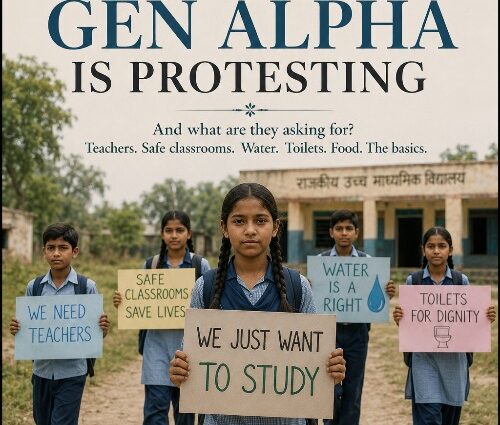
There are different districts, different schools, different demands, but beneath them lies the same question: Why must children protest for the basics?
These are not children demanding luxury classrooms, air-conditioning or expensive technology: They are demanding teachers, water, toilets, electricity, food, safe buildings, roads, desks, books – the ordinary infrastructure of childhood.
And something else is happening here: A generation is learning the language of citizenship.
These students are not necessarily marching because they have read political theory, rather, they are marching because they have discovered something much simpler: When the system does not listen, people have to make themselves heard. That is democracy in its most elemental form.
We frequently describe our young population as India’s greatest asset, about a demographic dividend, the knowledge economy, artificial intelligence, innovation and becoming a global power, but the demographic dividend begins in a classroom.
Before a child becomes an engineer, scientist, entrepreneur, soldier, teacher or civil servant, that child has to survive school, and a nation cannot build a 21st-century economy on 20th-century classrooms with leaking roofs, or crumbling infrastructure, no roads to school, no electricity, proper food or water and vacant posts.
The problem is not merely infrastructure, but it is the distance between the India we celebrate in speeches and the India children experience every morning.
A government school can be a child’s first encounter with the Republic, and this is where the Constitution becomes real. But in all the maze, while the children have the democratic right to protest, let us remember: A free nation should not have children fighting to keep the roof from falling on them. It should have children fighting over who gets the highest marks.
JANPATH NEWS NETWORK (JNN)
Independent. Fearless. On the People’s Path.