










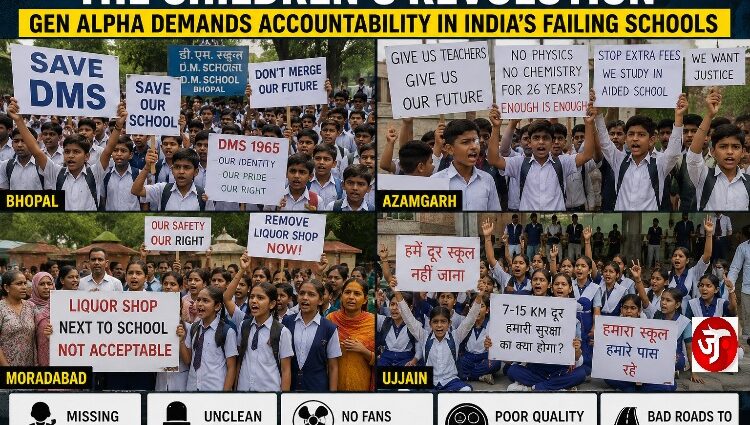
A stunning phenomenon is occurring across India, a children’s revolution is unfolding, with no leader, no political party behind them, but only holding a burning zeal in their hearts that their government schools should be set right.
In Madhya Pradesh and Uttar Pradesh in mid-August 2026, schoolchildren, born roughly between 2010 and the mid-2020s, labeled Generation Alpha, have taken to the streets.
These are not orchestrated political rallies but spontaneous protests by students as young as primary and secondary levels, demanding the basics their schools deny them. From Bhopal to Azamgarh, Moradabad to Ujjain, kids have forced administrators to listen.
Some of the videos and their voices are set below:
One of the girls said, ““We trusted PM Modi for a very long time. Not anymore; he has too much arrogance in him.”
This wave reveals deep structural failures in India’s public education system, where chronic understaffing, opaque decision-making, and resource mismanagement leave the youngest generation to fill the accountability gap left by adults.
In Bhopal, nearly 400 students of the NCERT-run Demonstration Multipurpose School (DMS), an experimental institution established in 1965 for innovative teaching, staged a “Save DMS” rally against a proposed merger with the Kendriya Vidyalaya Sangathan. They submitted a memorandum to the principal, warning of phased escalation if the school’s unique vocational programs and identity were diluted. News reports confirm an NCERT order dated August 7 constituted a committee to transfer four such PM SHRI schools to KVS. Students and parents argued the move ignored consultation and risked academic character.
In Azamgarh’s Smith Inter College, students protested teacher shortages lasting years, no regular Physics or Chemistry instructors for up to 26 years in some accounts, and Mathematics posts vacant for nearly a decade, alongside alleged extra fees of ₹50 per student under the guise of private arrangements, despite the aided status. They demanded appointments and clarity on collections, receiving temporary assurances of a Chemistry teacher within 48 hours.
Moradabad saw hundreds of Gen Alpha students, joined by parents and women, demonstrate against a liquor shop operating meters from BMD Public School and a temple. The District Magistrate arrived, assured investigation and removal, and ordered immediate canteen closure, direct administrative response to child-led pressure.
In Ujjain, girls from Rani Laxmibai Government Sarafa Higher Secondary School staged a tearful sit-in at the Collectorate against relocation to a site 7–15 km away as part of school mergers into Sandipani Vidyalayas. Fearing safety risks and inaccessible commutes for children of daily-wage families, their protest, echoing earlier Gen Z education agitations, prompted Chief Minister Mohan Yadav’s intervention. The shift was put on hold until alternatives are ready.
These are not isolated incidents. Parallel Gen Alpha actions have erupted in Lucknow, Fatehpur, Hamirpur, Rajasthan, and Bihar over missing teachers, absent fans, unclean toilets, poor food, and blocked roads to school. Inspired by 2026 Gen Z protests over examination scandals that forced a Union Education Minister’s resignation, these younger students leverage social media for visibility while focusing on hyper-local failures.
Factually, the roots lie in systemic issues: prolonged teacher vacancies often tied to recruitment delays, court cases, and administrative inertia; school rationalization policies that prioritize consolidation over accessibility; and licensing lapses allowing commercial establishments near educational institutions.
Government officials and ministers rarely enroll their own children in the same systems, underscoring a trust deficit.
Powerfully, this children’s revolution exposes a generational rupture. India’s demographic dividend depends on educated youth, yet schools remain sites of neglect. When 10- and 12-year-olds must march, sit-in, and confront collectors because classrooms lack teachers or safety, the state has failed its most basic compact.
Their victories, policy pauses, on-site assurances, prove peaceful pressure works. Sustained reform, however, requires filling vacancies, transparent funding, and genuine consultation. Until then, Gen Alpha will continue rewriting the script of accountability from the schoolyard.
While writing this, it is also important analyze the nature of Generation Alpha (roughly those born 2010–2025, currently up to about age 16). They are the first fully digital-native cohort. They have no memory of a pre-smartphone, pre-algorithm, pre-AI world. Technology is not a tool they pick up; it is an extension of thought, play, learning, and social life.
They show low trust in institutions and corporations from an early age, elevated awareness of issues like climate, inequality, mental health, diversity, and fairness, and a greater willingness to ask “why” rather than simply comply.
This is not purely a Gen Alpha invention. The archetype of the child who speaks uncomfortable truth runs deep: Hans Christian Andersen’s “The Emperor’s New Clothes” captures the psychological reality that children often lack the social filters, status anxieties, and pragmatic compromises that silence adults.
Gen Alpha adds amplification and acceleration, holding the “torch of truth” shaped by digital immersion, information saturation, and inherited skepticism, makes them especially effective and visible torch-bearers whose formative environment has sharpened the edge of classic capacity.
JANPATH NEWS NETWORK (JNN)
Independent. Fearless. On the People’s Path.