







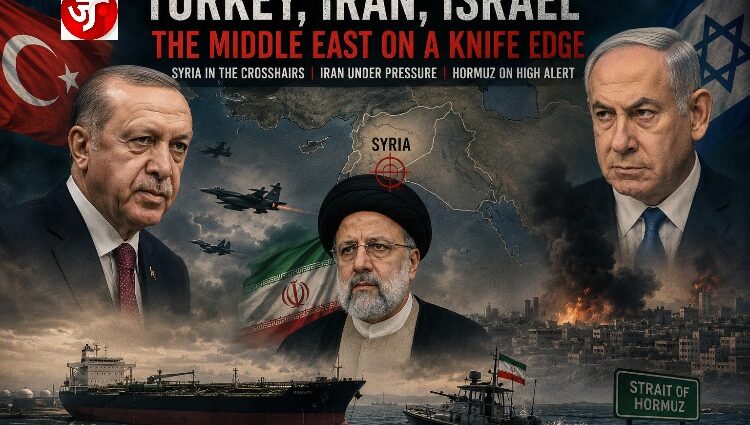
The BBC sent out a video titled: “Are Turkey and Israel nearing a clash in Syria? Why are Turkey and Israel facing off in Syria and can Israel take the risk of clashing with Turkey?” The crux of the matter is the Middle East is no longer moving from one crisis to another. The crises are beginning to move into each other.
From Ankara to Tehran to Jerusalem, three powers are now locked into a dangerous triangle in which Syria has become the fault line, Iran the strategic battlefield, and the Strait of Hormuz the economic weapon. No government has formally declared a new regional war. That is precisely what makes the moment so dangerous.
The most immediate spark is Syria.
Israel’s strike on the Abu al-Duhur airbase has turned what might once have been a dispute over military positioning into a confrontation over who gets to shape Syria’s post-Assad security order. Israel says it acted over concerns about a possible Turkish military presence at the base. Ankara has rejected claims that it was preparing to deploy troops there, while Syria has also denied that a Turkish military build-up was being organised. US envoy Tom Barrack has suggested that Israeli intelligence about Turkish military movements was incorrect.
But bombs have a peculiar way of making disputed intelligence much more consequential. Washington is now trying to build a deconfliction mechanism involving Turkey, Israel and Syria, an attempt to prevent competing military calculations from turning into an accidental confrontation.
For Ankara, the issue is larger than one airbase. Turkey wants influence over the emerging political and security architecture of Syria. Israel wants to ensure that no hostile military infrastructure, Iranian or otherwise, takes root near its borders. Damascus wants sovereignty without becoming the battlefield on which stronger neighbours settle their arguments.
Three objectives. One country. Turkey is simultaneously attempting to project itself as a regional power while pursuing a different kind of transformation at home. Its Kurdish peace process has entered an implementation phase, including efforts to verify PKK disarmament, while Ankara has welcomed reports concerning the dissolution and integration of the YPG/SDF into the Syrian army.
Yet Turkey’s relationship with Israel is deteriorating into something considerably more bitter. Ankara is even pursuing an Interpol red notice for Benjamin Netanyahu in connection with a Gaza flotilla case. Meanwhile, the European Court of Human Rights has again pressed Turkey over the continued imprisonment of philanthropist Osman Kavala, reviving the long-running question of judicial independence.
So Turkey is simultaneously trying to consolidate peace on one front and expand its strategic influence on another. That is the Middle East in 2026: peace processes and military calculations sharing the same desk.
Then there is Iran. If Syria is the geographic fault line, Iran is the economic and military centre of gravity.
Washington’s campaign against Tehran is shifting increasingly from bombs to financial suffocation. The United States is tightening pressure on Iranian shipping, aviation, gold and digital assets, while warning companies and countries that continue doing business with Iran that they too could face consequences. Tehran insists the campaign will fail.
But the most important battlefield may not be on land at all. It is a narrow strip of water.
The Strait of Hormuz remains one of the world’s great strategic chokepoints, and Iran’s ability to restrict shipping through it has transformed a regional conflict into a global economic problem. A tanker was reportedly struck in the strait, while Tehran has insisted that reopening the waterway depends upon conditions being met. At the same time, Iran and Oman have discussed arrangements that could permit some form of controlled transit and revenue-sharing.
Qatar is now stepping into the diplomatic gap. Its prime minister is visiting Tehran in an effort to revive negotiations and push the United States and Iran away from another military escalation.
That diplomacy matters because the alternative is frighteningly simple where a tanker is hit, missile is launched, aircraft is shot down, a radar installation is mistaken for something else, a military convoy crosses a line somebody else believes does not exist, then everyone discovers, usually several hours too late, that the war they said they did not want has already begun.
Israel, meanwhile, is pushing Washington toward greater pressure on Tehran.
Netanyahu has said he urged Donald Trump to “tighten the siege” on Iran and has expressed deep scepticism that a diplomatic agreement with Tehran is possible. Washington’s expanded economic campaign is now being presented as an alternative to immediate large-scale military action, while Netanyahu has warned that Israel would respond forcefully if Iran attacked.
History is full of wars that began because somebody misunderstood.
And Israel has another battlefield demanding attention: Gaza and the West Bank. Questions surrounding a US-backed Gaza plan, Hamas’s continued presence, Israeli military deployments and growing tensions in the West Bank are keeping the Palestinian conflict firmly alive. Meanwhile, Netanyahu faces domestic political pressure as polls show Likud struggling and his government searches for a campaign narrative.
The irony is brutal.
The Israeli government is trying to control Iran, Gaza, the West Bank and Syria simultaneously while also confronting political uncertainty at home.
Turkey is trying to manage Syria, the Kurdish question, its relationship with Israel and its position in Europe.
Iran is trying to survive sanctions, preserve military deterrence, maintain leverage over Hormuz and keep diplomacy alive without appearing to surrender.
And Syria sits in the middle of all three calculations. This is why the most dangerous scenario is not necessarily a deliberate Turkey-Israel war, but an accidental one.
Israel does not appear to want a direct confrontation with Turkey. Turkey has signalled restraint. Washington is actively trying to create mechanisms to prevent miscalculation. Yet the military geography is becoming increasingly crowded. Bases, aircraft, radar systems, advisers, militias, intelligence networks and foreign troops are operating within a region where political trust is almost nonexistent.
One mistake can therefore become a strategic event. The Middle East does not need another government announcing that it wants war. It needs only three governments convinced that the other two are preparing for one.
That is the real story tonight.
JANPATH NEWS NETWORK (JNN)
Independent. Fearless. On the People’s Path.