









JNN EVENING WORLD ROUNDUP – JULY 29
As darkness falls across another turbulent day, the world seems determined to remind humanity that peace is becoming an increasingly rare luxury. From the Pacific Ring of Fire to the battlefields of the Middle East, from Europe’s burning forests to India’s flooded villages and restless campuses, July 29 unfolded as a day of devastation, confrontation and reckoning.
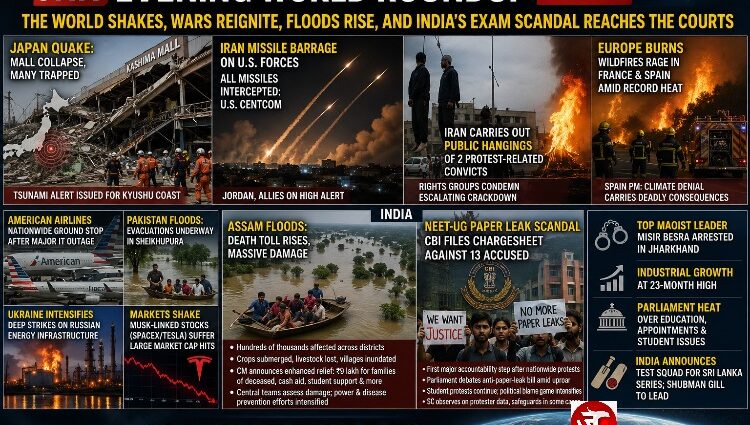
The most dramatic images emerged from Japan, where a powerful earthquake struck the Kyushu region, triggering tsunami alerts and widespread destruction. In Kashima, the floor of a shopping mall collapsed with scores of people inside, trapping shoppers beneath twisted concrete and steel. Rescue teams worked relentlessly through the night as fears grew that the death toll would rise. Structural damage, fires and injuries were reported across the affected region, turning one of Japan’s busiest areas into a race against time.
Thousands of kilometres away, the fragile calm in the Middle East was shattered once again. Iran’s Revolutionary Guard launched a surprise ballistic missile barrage targeting American forces after several days of relative silence. U.S. Central Command said all incoming missiles were intercepted, while Jordan and regional allies activated their own air defences.
Amid the escalating tensions, U.S. President Donald Trump met separately with Israeli Prime Minister Benjamin Netanyahu and Ukrainian President Volodymyr Zelenskyy in Washington to discuss the widening security crisis. Adding to international outrage, Iran publicly executed two people linked to earlier anti-government protests, drawing fresh condemnation from human rights organisations over the country’s intensifying crackdown.
Across Europe, another battle raged, this time against nature. Massive wildfires swept through France and Spain as relentless heatwaves fuelled rapidly spreading infernos. Firefighters fought exhausting battles to protect communities while Spanish Prime Minister Pedro Sánchez warned that denying climate change would only deepen future disasters.
Elsewhere around the world, American Airlines suffered nationwide operational paralysis following a major IT outage; Ukraine intensified deep strikes on Russian energy infrastructure; Pakistan evacuated communities threatened by rising floodwaters; and global markets absorbed fresh shocks as major technology-linked stocks recorded significant losses.
In India, nature’s fury and political upheaval dominated the national conversation.
The flood emergency in Assam deepened into one of the state’s gravest humanitarian disasters in recent years. Rising waters claimed more lives, submerged thousands of hectares of farmland, devastated livelihoods, displaced hundreds of thousands of residents and caused widespread livestock losses across multiple districts. Relief operations intensified after Chief Minister Himanta Biswa Sarma announced enhanced compensation packages for bereaved families, emergency financial assistance, educational support for affected students, and expanded rehabilitation measures, while central assessment teams arrived in the state to evaluate the enormous scale of the destruction.
Meanwhile, the country’s biggest education controversy entered a decisive legal chapter. The Central Bureau of Investigation filed its first chargesheet against 13 accused in the NEET-UG paper leak investigation, marking the most significant accountability step since nationwide student protests erupted months ago. Even as Parliament debated stronger anti-paper-leak legislation, fierce political confrontations continued over police action against protesters, examination reforms and the future credibility of India’s public education system.
The day also saw the arrest of senior Maoist leader Misir Besra in Jharkhand, industrial output touching a 23-month high, renewed political battles over education appointments and student activism, and India’s announcement of its Test squad for the upcoming Sri Lanka series under captain Shubman Gill.
The day’s most sensational developments formed a grim chain of crises stretching across continents. Japan’s earthquake, with trapped shoppers and ongoing rescue operations, became one of the world’s most urgent humanitarian emergencies. Iran’s sudden missile barrage abruptly ended a brief pause in hostilities, while the public hangings in Tehran underscored the growing severity of the regime’s internal crackdown. In India, Assam’s worsening floods continued to devastate lives and livelihoods, even as the formal CBI chargesheet in the NEET-UG paper leak case entered a crucial legal phase amid ongoing political and student unrest.
These were not isolated headlines. Together, they captured the defining themes of July 29: the fury of nature, the return of military confrontation, the harsh exercise of state power, and growing public demands for justice and accountability.
From collapsed buildings in Japan to missile interceptions over the Middle East, from Europe’s burning forests to Iran’s execution chambers, from Assam’s flood-ravaged villages to India’s classrooms, courtrooms and Parliament, July 29 delivered a sobering reminder that today’s headlines are no longer unfolding one by one. They are colliding all at once, shaping a world where natural disasters, geopolitical conflict, political upheaval and human resilience are writing history simultaneously.
JANPATH NEWS NETWORK (JNN)
Independent. Fearless. On the People’s Path.