










A government school is public property. Its classrooms are funded by public money. Its children belong to the public. So why does showing the public what is happening inside become a problem?
The images emerging from Rampura Kanwarpura near Jaipur are difficult to dismiss as political theatre.
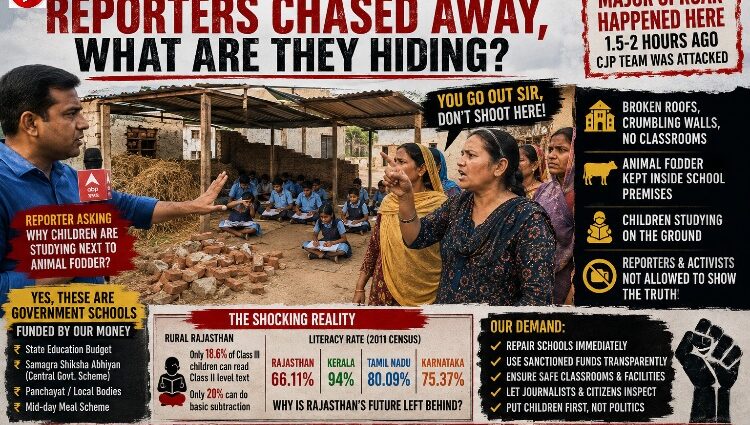
A ground report by ABP News, filmed after the confrontation involving the Cockroach Janta Party’s School Thik Karo campaign, shows children studying beneath makeshift tin structures, with damaged roofs, crumbling walls, scattered building material and animal fodder lying around the premises. The reporter repeatedly questions why children are being taught in an area where fodder is stored and why they are being made to sit beneath structures that appear unsafe.
Then comes another extraordinary part of the story. The reporter is challenged by people on the premises and repeatedly told to leave. That raises a question that should make the Rajasthan government uncomfortable:
If there is nothing to hide, why is the camera being chased away?
The answer may not necessarily be sinister. Schools have legitimate responsibilities to protect children’s privacy and safety, and the Rajasthan education department has cited precisely those concerns in its August 16 directive restricting unauthorised entry, photography, videography, interviews and live-streaming on school premises. But the timing is impossible to ignore. The order came just after the CJP announced its campaign to inspect government schools across Rajasthan.
That is where the issue becomes much bigger than one school, one reporter or one political organisation.
Government schools are financed primarily through public expenditure, with state and central government support. Rajasthan’s own 2026-27 budget provides ₹68,989 crore under Education, Sports, Arts and Culture. The state has therefore not simply abandoned education financially. In fact, education receives a substantial share of the state budget.
So the question is not simply:
“Is the government spending money on education?”
It clearly is.
The harder question is:
Where is that money going, and why can a government school still look like this?
That is the accountability gap.
And Rajasthan’s own numbers make that question impossible to dismiss.
A report cited by the Rajasthan school education department found 3,768 government school buildings, 83,783 classrooms and 16,765 toilets in dilapidated condition, while another 2,19,902 classrooms and 29,753 toilets required repairs across the state’s government-school system.
Another survey estimated that around 5,500 government schools were in such poor condition that they required complete reconstruction.
And in Bhilwara alone, a recent assessment reportedly found 116 government school buildings structurally unsafe, with 68 already demolished.
This is no longer one embarrassing photograph from one village. It is a structural problem. A school is not successful merely because the government can put a building on a map. A school exists to educate children.
The 2024 Annual Status of Education Report provides a sobering picture of rural Rajasthan.
Among children in government schools, only 18.6% of Class III children could read a Class II-level text in 2024. Only 20% could perform at least basic subtraction.
By Class V, 47.6% could read a Class II-level text, while only 21.9% could do division.
By Class VIII, 69.1% could read a Class II-level text, but only 33.3% could do division.
These figures are not a verdict on Rajasthan’s children.
They are a verdict on the conditions in which millions of children are expected to learn.
A child cannot choose the school, or its teachers, nor can they repair the roof, demand a functioning toilet, or write a budget. The adults are responsible.
The latest completed Census literacy figures put Rajasthan’s literacy rate at 66.11% in 2011, compared with 94% in Kerala, 80.09% in Tamil Nadu and 75.37% in Karnataka. The all-India figure was 72.99%.
Those are Census figures, not a current 2026 measurement, and they should not be presented as today’s literacy rates. But they remain an important indicator of the enormous historical gap Rajasthan has had to close. The question is why that gap remains so stubborn.
And this is where looking south becomes uncomfortable.
It would be intellectually lazy to pretend every southern state has solved education. It hasn’t.
Tamil Nadu, for example, still has serious learning challenges. In ASER 2024, only 12% of Class III government-school children could read a Class II-level text, although 27.7% could perform at least subtraction.
Karnataka was also hardly a model of perfection: 15.9% of Class III government-school children could read a Class II-level text, while 25.9% could perform at least subtraction.
But Kerala demonstrates what sustained investment in human development can produce. In 2024, 45.6% of Class III government-school children in rural Kerala could read a Class II-level text, compared with Rajasthan’s 18.6%. In Class V, Kerala’s figure was 66%, compared with Rajasthan’s 47.6%. And among Class VIII government-school children, Kerala reached 84.5% in reading, compared with Rajasthan’s 69.1%.
The infrastructure story is even more striking. UDISE+ data for 2024-25 shows electricity connections in 99.8% of Kerala’s government schools, 99.9% of Tamil Nadu’s and 98.9% of Karnataka’s, compared with 90.9% in Rajasthan’s government schools. Functional electricity was reported at 99.4% in Kerala, 99.7% in Tamil Nadu and 97.8% in Karnataka, versus 89.9% in Rajasthan.
These are not cosmetic differences. Electricity, safe buildings, toilets, water, classrooms and learning materials are the physical foundations upon which education is built.
So does Rajasthan not invest in education? That claim would be too simple.. The numbers actually show something more complicated. Rajasthan allocated 18% of its total expenditure to education in 2025-26, above the then-average allocation of 15% across states. In 2026-27, education’s share was about 17.1%, again above the average cited by PRS.
So this is not simply a story about a government refusing to spend. It is a story about whether spending translates into functioning schools. And there is an important warning hidden inside Rajasthan’s finances.
PRS notes that Rajasthan’s actual capital expenditure has repeatedly fallen below budget estimates. Capital outlay was 31% below budget in 2024-25, while the revised estimate for 2025-26 was 27% below the original budget estimate.
That matters because classrooms, buildings and physical infrastructure require capital expenditure.
A government can announce money.
A department can sanction money.
A file can move.
A tender can be issued.
A contractor can be selected.
And yet a child can still be sitting underneath a broken tin roof.
That is where governance is measured.
Not in the budget speech.
Not in the press release.
Not in the file.
In the classroom.
The Rajasthan government says its new restrictions are about protecting children’s privacy, dignity and safety. That is a legitimate concern. Children should not become unwilling subjects of political publicity or media spectacle.
But there is another side to the equation: Government schools are publicly funded institutions, while journalists investigating public expenditure have a legitimate public-interest role, along with that, parents have a legitimate interest in knowing what conditions their children are studying in, and citizens have a legitimate interest in knowing whether infrastructure promised in government records actually exists on the ground.
And independent inspection is precisely what accountability looks like.
The answer to an allegation of a broken school should not be:
“Don’t come inside.”
The answer should be:
“Come inside. Here are the records. Here is the sanctioned amount. Here is the contractor. Here is the work order. Here is the completion date. Here is what has been repaired. And here is what remains.”
That would end the controversy very quickly.
The lesson is that education improves when governments treat it as human infrastructure rather than merely another department. Perhaps that is the question Rajasthan needs to confront.
Does it see education as an investment in its children, or as an expense to be managed? Because a broken classroom is not just a broken building. It is a message to a child about how much the state believes that child’s future is worth.
And when reporters arrive with cameras to document that reality, the instinct should not be to chase them away.
And no circular can hide it.
JANPATH NEWS NETWORK (JNN)
Independent. Fearless. On the People’s Path.