







The Rebel of the Roof of the World Sonam Wangchuk, “Phunsukh Wangdu” is Stonily Being Ignored by the Central Government, into the Second Week of His Hunger Strike and Questions are Rising.
In late June 2026, renowned Ladakhi education reformer and climate activist Sonam Wangchuk joined an indefinite hunger strike at Delhi’s Jantar Mantar, led by the Cockroach Janta Party (CJP) and supported by affected students and parents. He began the fast on or around June 28, 2026, and by early-to-mid July it had entered its second week (reports mention Day 11–15), with him losing over 7–7.8 kg and his health deteriorating (weight down to 59 kg, with low blood pressure).
The trigger was the NEET-UG 2026 paper leak scandal – one of India’s largest competitive exam controversies in years. The National Eligibility-cum-Entrance Test (Undergraduate) for medical/dental seats, held on May 3, 2026, involved over 2.27 million aspirants. Investigations revealed a major leak: a “guess paper” or solved question set (including nearly all Biology and many Chemistry questions) allegedly circulated in advance through a multi-state “paper solver gang.” Prices reportedly ranged from ₹10–25 lakh per copy. The exam was cancelled on May 12, leading to a re-test amid chaos, uncertainty, and massive stress.
The scandal and its fallout triggered a wave of despair. Reports linked at least 6–11 (or more) student suicides/deaths in the weeks following the leak and cancellation:
Wangchuk framed the protest as standing with students who “did nothing wrong” but paid the price for institutional failure. He emphasized transparency, accountability, and systemic reform in public exams.
Despite widespread protests, opposition campaigns (Congress, student unions), and demands for resignation, Dharmendra Pradhan, Education Minister, has not stepped down. The government has defended the handling as proactive (CBI probe, arrests, re-exam) and resisted calls for ministerial accountability, viewing it as an operational failure rather than one requiring top-level resignation.
Wangchuk’s fast, blending his lifelong education advocacy with this scandal, highlights broader frustrations with institutional reliability and the human cost of repeated failures. As of mid-July 2026, the protest continues with calls for a march to Parliament, keeping pressure on the system.
Sonam Wangchuk is not an ordinary man. His epic fight for Ladakh in the wind-scoured Himalayas, where temperatures plunge to -30°C and oxygen thins like a dying breath, he was always a boy refused to be broken. Born on September 1, 1966, in the tiny village of Uleytokpo near Alchi, Sonam Wangchuk entered a world that seemed determined to crush dreamers. No schools. No roads. Just endless mountains and silence. His mother, Tsering Wangmo, became his only teacher, pouring Ladakhi wisdom into his young ears while the world outside waited like a frozen giant.
Fate had other plans, and they were brutal. At age nine, his politician father, Sonam Wangyal, dragged the family to Srinagar after becoming a minister. Suddenly, the mountain boy was thrown into a hostile classroom where teachers barked in languages he didn’t understand. Classmates mocked his “different” looks. Teachers labeled him stupid. This wasn’t education, it was erasure. Young Sonam called it the darkest chapter of his life. Then, in a moment of pure defiance at age 11, he ran away. Alone. Across dangerous terrain to Delhi. He stood before a Kendriya Vidyalaya principal and pleaded for a chance. That single act of courage changed everything.
He clawed through high school while funding his own dreams after clashing with his father over career choices. In 1987, he emerged from the National Institute of Technology Srinagar with a B.Tech. in Mechanical Engineering, and a burning mission. The education system in Ladakh was failing 95% of students. Textbooks spoke of mangoes and monsoons to children who had only seen apricots and blizzards. It was cultural murder.
In 1988, together with his brother and a handful of fellow “victims” of the system, the 22-year-old engineer founded the Students’ Educational and Cultural Movement of Ladakh (SECMOL). What started as desperate coaching classes exploded into a full-blown revolution. They launched Operation New Hope in 1994, a daring alliance with the government, villages, and locals. Pass rates skyrocketed from single digits to over 75%. Wangchuk rebuilt schools from the soul outward.
He designed the legendary SECMOL campus, a solar-powered marvel of rammed-earth architecture that stays warm without a single drop of fossil fuel. Even at bone-chilling temperatures, students thrived inside buildings that felt alive. The world noticed: awards poured in, including the International Terra Award. But Sonam was just getting started.
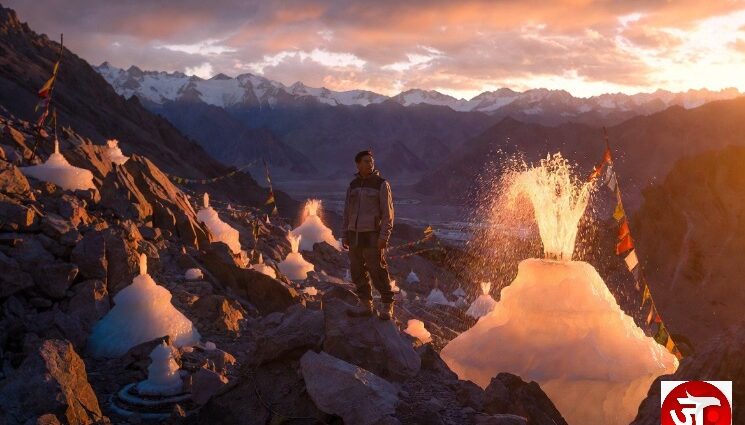
By the early 2010s, climate change was devouring Ladakh’s glaciers like a silent predator. Rivers ran dry in spring when farmers needed water most. In 2013–14, Wangchuk unveiled his masterpiece: the Ice Stupa. In the dead of winter, when streams flowed uselessly, he sprayed water into freezing air, sculpting massive, cone-shaped ice towers, artificial glaciers that looked like sacred Buddhist stupas. Come spring, they melted exactly when fields cried out for irrigation, storing millions of liters that would otherwise vanish.
The technique spread like wildfire – in Sikkim, Nepal, even the Swiss Alps. He battled deadly glacial lake outbursts with siphons and ingenuity when governments wanted explosives. He built solar tents for soldiers guarding the world’s highest battlefields. He created FarmStays so tourists could live with local families, empowering women and preserving culture.
In 2009, Bollywood immortalized him as Phunsukh Wangdu in 3 Idiots, the eccentric genius who turned impossible dreams real. International acclaim followed: the Ramon Magsaysay Award (Asia’s Nobel), Rolex Award, and more than a dozen honours. He founded the Himalayan Institute of Alternatives (HIAL) to train mountain leaders for mountain problems.
The Indian central government (under the Modi-led NDA) has repeatedly rejected or delayed core issues that he brought up, like full statehood and Sixth Schedule status. This has created deep frustration, leading to protests, violence in September 2025, Wangchuk’s detention under the National Security Act (NSA), and ongoing tensions as of 2026.
To cut a long story short, success brought new battles. After Ladakh lost its special status in 2019, Wangchuk saw fragile ecosystems and unique tribal identity under threat. He launched hunger strikes, marches, and peaceful protests demanding Sixth Schedule protections and statehood. In 2025, authorities arrested him under the stringent National Security Act amid protests, where the government accused Wangchuk of delivering provocative speeches that incited an unruly mob. He spent months in distant jails, but emerged unbowed, calling the experience transformative and urging continued dialogue.
Today, Sonam Wangchuk, engineer, rebel, visionary, lives on the SECMOL campus with his wife Gitanjali J. Angmo, still tinkering, teaching, and fighting, but his cause and focus is very different at the present time, in context to the situation.
It does appear striking, and frustrating to many, that a nationally respected figure like Sonam Wangchuk, with his track record of innovation, awards (including the Ramon Magsaysay), and non-violent activism, receives limited direct high-level engagement from the central government on these issues, while Education Minister Dharmendra Pradhan has faced sustained calls for resignation but remains in position.
It is unusual for someone of Wangchuk’s stature, the real-life inspiration for 3 Idiots’ Rancho, a climate innovator whose Ice Stupas are studied globally, to get what feels like radio silence. Many see it as a symptom of disconnect between ground-level icons and Delhi’s power corridors; weak institutional accountability mechanisms (unlike countries where PMs/ministers resign over far less, e.g., deadly protest mishandling in Nepal 2025 or UK scandals); and a political culture where survival in office often trumps symbolic accountability, especially when the ruling party holds a strong majority.
Whether this is pragmatic governance or tone-deaf arrogance is hotly debated. Wangchuk’s continued fast and growing support keep the pressure alive, but systemic change in India often moves slowly unless electoral or judicial forces accelerate it. This pattern isn’t new – similar dynamics have played out in past exam leaks, farmer protests, and regional demands. It leaves many wondering if moral authority and public service alone are enough in today’s politics.