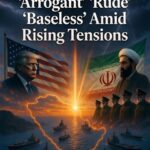


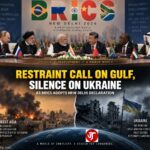

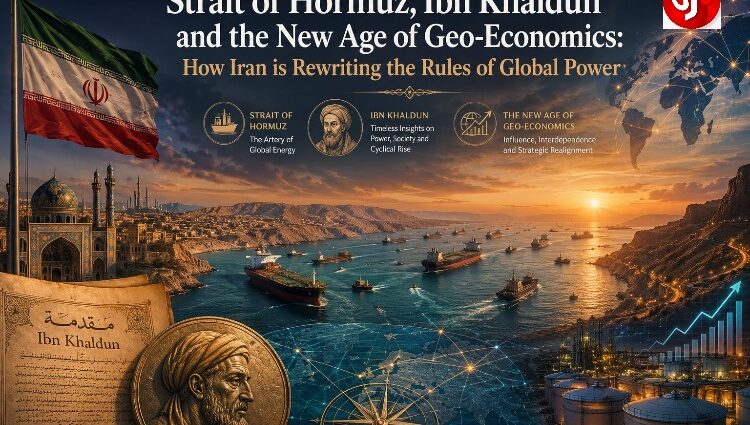
NEW DELHI: July 9, 2026: As tensions brew across the Persian Gulf, an influential analysis published by The Wire Urdu argues that Iran’s increasingly assertive posture in the Strait of Hormuz represents far more than a response to recent military confrontations. It reflects a profound shift in global power politics, where geography, trade routes, and economic leverage are becoming as decisive as armies and missiles.
The article draws inspiration from the political philosophy of the renowned 14th-century historian and philosopher Ibn Khaldun, whose seminal work Muqaddimah argued that the true strength of a state lies not merely in military force or accumulated wealth, but in its ability to command economic resources, organise society, and control the arteries of commerce.
For more than two decades, the United States sought to constrain Iran through sweeping sanctions, financial isolation, restrictions on oil exports, exclusion from the SWIFT banking system, and technological embargoes. Economic pressure became Washington’s principle strategic instrument, designed to weaken Tehran without direct confrontation.
According to the analysis, Iran is now reversing that equation.
Rather than remaining the target of economic warfare, Tehran is attempting to transform its geographic position into a source of strategic influence. The Strait of Hormuz, through which roughly one-fifth of the world’s oil supply and significant volumes of liquefied natural gas pass, has become Iran’s principle geopolitical asset.
By proposing designated navigation corridors, offering maritime security in coordination with Oman, and signalling its ability to influence shipping movements, Iran is seeking to convert a natural maritime chokepoint into political and economic leverage.
The article argues that this strategy closely mirrors Ibn Khaldun’s understanding of statecraft. He believed that maritime dominance was not simply a military capability but the outward expression of a civilisation’s organisational strength. Nations that controlled sea routes, he observed, could shape global commerce and extend their influence far beyond their borders.
Perhaps the article’s most striking observation is that geography alone does not create power. States become powerful only when they organise their resources, institutions, and political will to transform geographic advantages into strategic assets. In that sense, Iran’s actions represent an attempt to convert location into leverage.
The analysis further suggests that prolonged reliance on economic sanctions has produced an inevitable strategic response. Drawing again from Ibn Khaldun, it argues that when one power repeatedly employs economic dominance to constrain another, resistance eventually evolves into new forms of power projection.
Beyond Iran itself, the article places the Hormuz dispute within a much broader transformation of international politics. Modern competition is increasingly centred on control of supply chains, energy corridors, maritime chokepoints, semiconductor production, critical minerals, digital infrastructure, and undersea communications networks. The conflicts surrounding the Red Sea, the Russia-Ukraine war’s impact on grain exports, and growing competition across the Taiwan Strait are presented as examples of this emerging geo-economic order.
The analysis concludes that the real contest is no longer confined to Iran’s nuclear programme or regional influence. Instead, it asks whether geography itself can be successfully weaponised against decades of financial and technological coercion, potentially reshaping the future rules governing global trade, maritime security, and international power.
Offering his perspective on the broader significance of the article, senior journalist Mr. Gilani observed:
“This analysis is significant because it shifts the conversation from missiles and military hardware to geo-economics. By invoking Ibn Khaldun, it reminds us that control over trade routes and economic lifelines has always shaped the rise and fall of states. Whether one agrees with Iran’s policies or not, the Strait of Hormuz has become a test case for how geography, economics, and strategy are redefining power in the twenty-first century.”
Whether Iran ultimately succeeds in reshaping the strategic balance in the Strait of Hormuz remains uncertain. Yet one reality is becoming increasingly difficult to ignore: the nature of power is changing. As the world moves deeper into an era of geo-economics, control over trade routes, energy corridors, digital infrastructure, and critical supply chains is becoming as influential as conventional military strength. The Strait of Hormuz has emerged as a symbol of this transformation, where geography, economics, and strategy intersect in ways that could redefine international relations for decades to come.
Viewed through the lens of Ibn Khaldun’s political philosophy, the debate raises a broader question for the international community: in an interconnected world, can economic pressure and strategic chokepoints be used as instruments of power without fundamentally altering the global order they were meant to preserve? The answer may shape not only the future of the Middle East, but also the rules governing commerce, security, and diplomacy in the twenty-first century.