








Modi inaugurates Andhra Pradesh’s new international airport as Assam flood toll rises to 82; India strikes double boxing gold, commercial LPG prices fall, Nathu La trade reopens after six years. Beyond India, Trump threatens Iran with devastating strikes as Gaza hangs between a fragile peace roadmap and continuing bloodshed.
NEW DELHI, AUGUST 1: India entered the first evening of August with dramatically contrasting images: a new international airport opening its doors in Andhra Pradesh, floodwaters continuing to ravage Assam, two Indian women standing victorious with Commonwealth Games gold medals, an old Himalayan trade route reopening after six years, and political tremors spreading through Delhi. Beyond India’s borders, an increasingly volatile confrontation between the United States and Iran threatened to push the Middle East towards another dangerous escalation.
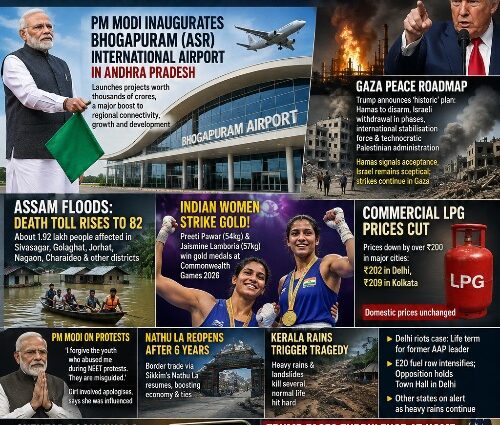
Prime Minister Narendra Modi inaugurated the new Bhogapuram International Airport in Andhra Pradesh, launching alongside it development projects worth thousands of crores in what is being projected as a major push for regional connectivity, investment and economic growth. The airport is expected to strengthen Andhra Pradesh’s links with domestic and international destinations while opening new possibilities for tourism, trade, industry and employment. Meanwhile, Shehzad Poonawalla surprised everyone by resigning from the Bharatiya Janata Party.
Yet even as a new gateway to the skies became a symbol of development in the south, the picture from the Northeast was devastating.
In Assam, the flood death toll has climbed to 82, while approximately 1.92 lakh people remain affected across districts including Sivasagar, Golaghat, Jorhat, Nagaon and Charaideo. Families continue to struggle with swollen rivers, inundated villages, damaged agricultural land, and disrupted livelihoods as the monsoon exacts an increasingly painful human toll. Kerala, too, remained battered by severe weather, with heavy rain and landslides causing deaths and destruction.
Amid the grim news came a burst of sporting glory. At the 2026 Commonwealth Games, Indian boxers Preeti Pawar and Jaismine Lamboria delivered a magnificent double, winning gold in the 54kg and 57kg categories respectively. On an evening crowded with political confrontation, natural disaster and international tension, two Indian women climbing to the top of the podium gave the country an uncomplicated reason to celebrate.
There was some economic relief as well. Commercial LPG cylinder prices were reduced by more than ₹200 in major cities, including cuts of approximately ₹202 in Delhi and ₹209 in Kolkata. Domestic LPG prices, however, remain unchanged, meaning the immediate benefit will largely be felt by restaurants, hotels and other businesses dependent on commercial cooking gas.
Politics, inevitably, refused to stay away from the headlines.
Prime Minister Modi addressed the abuse directed at him during the recent CJP-led NEET protests, saying he had forgiven the young protesters and describing them as “misguided”. A young woman involved in the episode later reportedly apologised, saying she had been influenced. But the Prime Minister’s remarks come against the backdrop of a much larger wave of student anger that has shaken campuses and spilt onto streets, keeping questions surrounding examinations, accountability and the treatment of protesting youth firmly in the national conversation. Demands for Union Home Minister Amit Shah’s resignation over the July 20 crackdown on anti-paper-leak protesters in Delhi are growing louder. AISA president
said the movement has evolved into a wider campaign seeking accountability from the Centre over the alleged police action.
Another battle is simultaneously gathering around E20 petrol, with opposition to the ethanol-blended fuel policy continuing to grow. Questions over mileage, vehicle compatibility, consumer choice, environmental benefits and the economics of ethanol blending have transformed what once appeared to be a technical energy-policy decision into an increasingly heated public and political debate.
There was, however, an important breakthrough high in the Himalayas. Border trade through Sikkim’s Nathu La Pass resumed after a six-year hiatus, restoring an historic commercial link between India and China. The reopening carries significance far beyond the movement of goods. After years of strained relations and military tensions along the frontier, even the reopening of a trading passage carries considerable diplomatic symbolism.
But as India wrestled with floods, politics, fuel and development, the most dangerous developments of the evening were unfolding thousands of kilometres away.
The Middle East is once again hovering dangerously close to a wider confrontation, with President Donald Trump warning that Iran could be hit “very hard” amid reports that Washington, potentially in coordination with Israel, is considering fresh attacks on Iranian energy-related infrastructure.
The threats come amid an already explosive environment. Iranian drone activity, interceptions over Gulf states, tanker incidents around the Strait of Hormuz and the Gulf of Oman, and warnings urging Americans to consider leaving vulnerable areas have intensified fears that another round of military retaliation could spiral rapidly beyond anyone’s control.
The Strait of Hormuz now stands at the centre of global anxiety. Any sustained disruption to one of the world’s most important energy corridors could send oil prices soaring, disrupt shipping and carry the economic consequences of a Middle Eastern war into households thousands of kilometres from the battlefield.
Trump is simultaneously dealing with political friction at home, including tensions surrounding his administration’s legal and political agenda and disputes involving Republican senators. Yet those domestic battles risk being eclipsed by the far greater question confronting Washington: whether the confrontation with Tehran can still be contained.
And then there is Gaza, where diplomacy and destruction continue to exist side by side.
Trump has announced what he describes as a historic roadmap under which Hamas and other armed groups would move towards phased or complete disarmament, accompanied by gradual Israeli withdrawal, an international stabilisation force and a new Palestinian technocratic administration. Hamas has reportedly indicated acceptance of a roadmap, while Israel remains sceptical about crucial elements and sequencing.
Meanwhile, Israeli strikes have continued.
And so the first evening of August closes on a world filled with striking contradictions.
In Andhra Pradesh, aircraft prepare to connect new destinations while in Assam families wait for floodwaters to recede. At the Commonwealth Games, two Indian women raise gold medals above their heads while political battles rage back home. At Nathu La, an old road between India and China opens again after six long years, while thousands of kilometres away the Strait of Hormuz threatens to become the passage through which another war could enter the world economy.
India is building, mourning, celebrating and arguing all at once.
And beyond its borders, diplomacy is racing against missiles.
From Bhogapuram to Assam, from Delhi to Nathu La, from Gaza to the Persian Gulf, August has begun with a world moving forward at extraordinary speed, yet standing frighteningly close to the edge.