










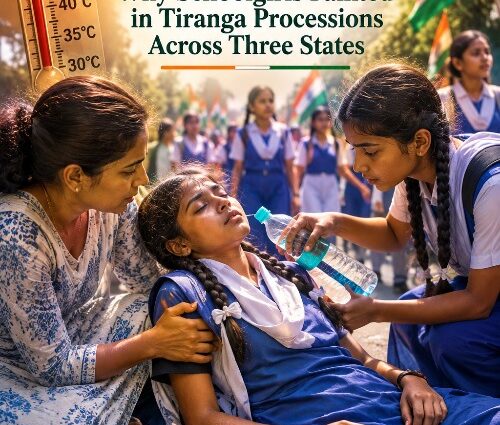
In the sweltering August heat of 2026, as India prepared to celebrate its 80th Independence Day, the tricolour, symbol of freedom, sacrifice, and national pride, was carried by thousands of schoolchildren across the country. What should have been moments of joyful patriotism turned into scenes of distress, ambulances, and hospital beds.
In Uttar Pradesh’s Deoria, Madhya Pradesh’s Singrauli, and Bihar’s Siwan, dozens of schoolgirls fainted or fell ill during Tiranga Yatra and Har Ghar Tiranga events, victims not of any enemy, but of heat, humidity, dehydration, empty stomachs, and organisers’ failure to prioritise their safety.
In Deoria, more than 40 girls, many from Kasturba Gandhi Government Girls Inter College, participated in a district-level Tiranga Yatra that began around 11 a.m. on August 13.
Nearly 4,000–5,000 students from various schools marched under the blazing sun and oppressive humidity. Some had reportedly skipped breakfast. Teachers distributed water along the way, but it was not enough.
By the time the procession reached the stadium, dizziness set in. Girls collapsed. Ambulances rushed over two dozen to Maharshi Devraha Baba Autonomous State Medical College. Doctors pointed to severe dehydration caused by heat, prolonged exertion, and inadequate hydration or nutrition.
District officials, including the Magistrate, visited the hospital. Most students stabilised after IV fluids and treatment; several were discharged the same day. Officials spoke of a sudden humidity spike and the children’s own “excitement” that made them overlook drinking water.
Yet the basic question lingered: Why march schoolgirls for a kilometre or more in peak heat without rigorous safeguards? The pattern repeated elsewhere.
In Singrauli’s Chitrangi area of Madhya Pradesh, over 200 students from eight government schools walked about 6 km for a Tiranga Yatra. They then waited nearly an hour in the open for a state minister.
Water and snack arrangements proved inadequate. Twelve children, some of whom had skipped meals, suffered dizziness, exhaustion, and in one case breathing difficulty requiring oxygen. They were treated at a community health centre and discharged. Local officials later issued show-cause notices, while the minister attributed the ill-effects to heat and walking.
In Bihar’s Siwan district, around 30 girls fell ill during a Prabhat Pheri linked to the Har Ghar Tiranga campaign, again blamed on intense sun, humidity, and dehydration. Hospitals filled with anxious parents and pale schoolgirls.
These are not isolated mishaps. They form a troubling mosaic of events organised under the banner of national celebration in the days leading to August 15. Videos circulating online showed crowded emergency wards and distressed children.
Voices on social media and in local reporting rightly criticised the lack of foresight: insufficient shade, water stations, medical support on standby, shorter routes, or simply scheduling events for cooler hours.
When patriotism is measured by the length of a march or the size of a crowd of uniformed schoolchildren, the cost is paid by the most vulnerable.The Tiranga represents hard-won liberty. It should never become an instrument that endangers the very generation meant to inherit that freedom.
Schoolgirls, many from government institutions serving less privileged communities, were asked to perform public displays of loyalty under conditions that any responsible adult would hesitate to impose on themselves.
Heat exhaustion and dehydration are predictable in India’s August climate. Skipping meals compounds the risk. Waiting for VIP arrivals in the open sun turns ceremony into endurance test.
Official responses have been prompt in treating the children and issuing reassurances that all are out of danger. That is necessary but insufficient. Accountability must go further. District administrations and education departments need clear protocols: mandatory hydration breaks, medical teams on site, weather assessments before events, limits on march distances for younger students, and the option for voluntary or indoor alternatives.
Teachers and principals should not feel pressured to deliver large turnouts at the expense of child welfare. Parents deserve transparency, not after-the-fact explanations.
True love of country is not proven by how many children can be made to walk under a merciless sun while holding the flag. It is proven by how carefully we protect those children so they grow up healthy enough to serve the nation in meaningful ways.
As hospitals discharge the last of the affected girls and Independence Day ceremonies continue, the images of schoolgirls on IV drips should remain a warning. The tricolour flies highest when those who carry it are safe, nourished, and respected, not when they collapse in its shadow.
JANPATH NEWS NETWORK (JNN)
Independent. Fearless. On the People’s Path.