




August 14, 2026: A remarkable crack has appeared in the carefully guarded language surrounding Israel and its most controversial extremists, and it came from Mike Huckabee, the U.S. ambassador to Israel and one of Washington’s most outspoken supporters of Israel and its settlement movement.
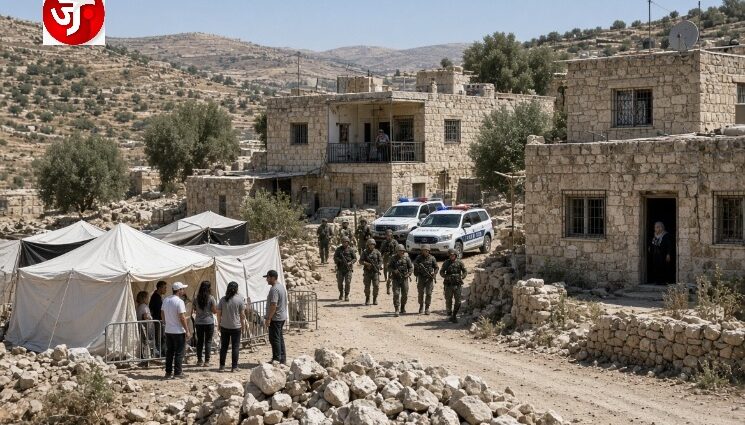
After Israeli settlers surrounded three Palestinian homes in Qusra for days, blocking their entrances, cutting off water and electricity, restricting movement and throwing stones at the properties, families were left effectively trapped inside their own houses as food and essential supplies dwindled. One of the homes belonged to a Palestinian-American. It was this siege, and the intimidation of the families inside, that U.S. Ambassador Mike Huckabee described as a “horrific act of terror,” calling those responsible “Israeli terrorists.”
Huckabee insisted that Washington had not stood by. He said the U.S. Embassy in Jerusalem had been “VERY involved” and that Israeli military and police forces had gone into Qusra at the American request to remove the settlers. Israeli forces subsequently declared the area a closed military zone and moved against illegal settler outposts.
But Huckabee was equally careful about where he drew the line.
He later argued that “settlers” are not the problem, distinguishing what he called legitimate settlers from a small extremist minority he labelled “unsettlers.” That distinction matters. His statement was a condemnation of specific acts of violence, not a repudiation of Israel’s settlement policy or the broader settlement project.
And that is precisely why the language is so striking.
Huckabee has spent years defending Israel, using the biblical terminology of “Judea and Samaria” and supporting the settlement movement. For a figure so firmly identified with Israel’s right wing to publicly describe Israelis as terrorists is unusual enough to reverberate far beyond one West Bank village.
Yet Qusra is not an isolated story. The incident has unfolded amid escalating settler violence across the West Bank, with the United Nations and other observers warning of a worsening pattern of attacks and intimidation.
AND THEN THERE IS IRAN
Against this backdrop, another Middle Eastern crisis continues to refuse the neat ending promised by political rhetoric.
The U.S.-Israeli war against Iran, which began with major strikes on February 28, is still unresolved nearly six months later.
There is an increasingly difficult reality for Washington: the conflict has not produced the clean, decisive conclusion its most triumphalist rhetoric suggested.
Iran’s leadership has survived. The Strait of Hormuz remains at the centre of the confrontation. Tehran continues to claim control over the strategic waterway, while Trump insists the United States has “total control.” Meanwhile, negotiations have stalled and the interim June peace framework has collapsed.
Washington has now pivoted heavily toward economic pressure. Trump has revived sanctions under “Operation Economic Fury,” betting that economic pain will force Tehran back to the negotiating table. At the same time, Defense Secretary Pete Hegseth says the U.S. Navy can maintain its blockade of Iranian ports indefinitely.
That is not the language of a war that has been cleanly won, but the language of a conflict still searching for an exit.
TRUMP AND NETANYAHU: ALLIANCE, BUT NOT BLANK CHEQUES
The same tension has surfaced repeatedly over Lebanon.
Trump has pressured Israeli Prime Minister Benjamin Netanyahu to restrain Israeli operations against Hezbollah. In April, Trump said Israel should limit its actions to “surgical” strikes rather than return to full-scale war. In June, he went further, helping halt planned Israeli strikes on Beirut after Iran threatened to abandon negotiations with Washington. Israeli Defence Minister Israel Katz later acknowledged that Israel had paused further strikes at the U.S. request.
The message from Washington has therefore become increasingly complicated: Support Israel. Confront Iran. Pressure Netanyahu. Restrain extremists. Keep the regional war from exploding further. That balancing act is becoming harder.
And now, in Qusra, one of America’s strongest pro-Israel voices has publicly drawn a line around settler violence. The significance is not that Huckabee has suddenly become an opponent of Israel, as he has not. Rather, the significance is that even one of Israel’s most committed American defenders appears to recognize that unrestrained extremist violence can become a strategic liability for Israel itself.
For Palestinians in Qusra, however, the issue is far more immediate than diplomacy, it is about families trapped inside their homes, without water, electricity, food, movement and safety, and for them, it is about whether the law applies equally when the people holding the stones, building the outposts and blocking the roads are Israeli settlers.
JANPATH NEWS NETWORK (JNN)
Independent. Fearless. On the People’s Path.