








Rahul Gandhi is one of the most powerful opposition politicians in the country, leader of the Opposition in the Lok Sabha, with direct access to Parliament, lawyers, journalists, political networks and national attention, yet has to fight for an FIR to be registered for an injured teenager.
A 19-year-old student was allegedly hit by pellets during a student protest. Nearly a month later, his complaint became a confrontation at a Delhi police station. As nothing seemed to be proceeding, Rahul Gandhi sat in dharna. Priyanka Gandhi joined him. Youth Congress leaders took positions outside. And only after the pressure mounted did the Delhi Police register an FIR. The question is no longer merely about one boy. It is about what happens to justice when the police appear unwilling to even open the door.
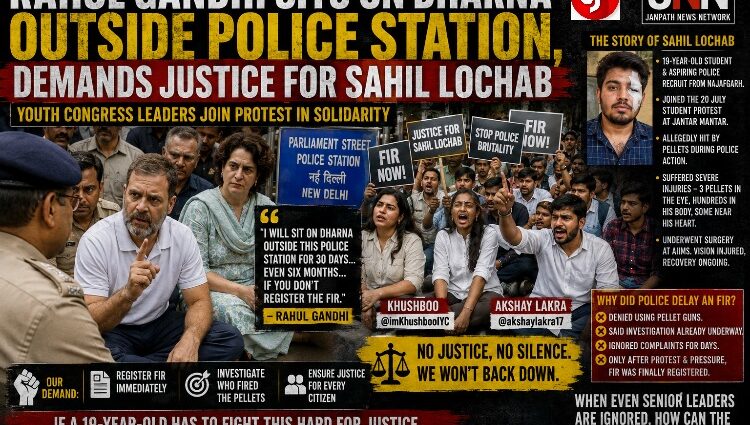
The image from Parliament Street Police Station on Friday was extraordinary. Rahul Gandhi, the Leader of the Opposition in the Lok Sabha, was not standing on a parliamentary podium or addressing a rally. He was sitting outside a police office, demanding something that should ordinarily require neither political influence nor a sit-in: the registration of an FIR on behalf of an injured 19-year-old student.
Youth Congress leaders, including Khushboo and Delhi Youth Congress president Akshay Lakra, also reached the police station and staged a dharna in solidarity, turning the demand into a broader political protest for accountability.
The demand was simple: Register the FIR. Investigate who fired the pellets. Establish responsibility. Give the injured student justice. And yet, according to reports from the confrontation, the police initially did not register the case.
That is where this story becomes deeply disturbing. Because if a young citizen can sustain serious injuries during a public protest, submit a complaint, approach the authorities and still find himself waiting for an FIR, what happens to someone without a national political party standing beside him?
Sahil Lochab is 19, a student and an aspiring police recruit from Najafgarh who joined the July 20 CJP-led “Sansad Chalo” protest at Jantar Mantar over the NEET examination controversy. According to Sahil and his family, he was struck by pellets during the police action against protesters. His injuries were severe.
He was initially taken to Lady Hardinge Medical College and subsequently referred to the AIIMS Trauma Centre, where he underwent surgery. Reports from his treatment described extensive injuries, particularly to his right eye. The Indian Express reported in July that Sahil feared he might never regain sight in that eye, while later accounts said his vision remained unclear.
The account presented by Rahul Gandhi on Friday was even more alarming: Gandhi said medical records showed three pellets in Sahil’s eye and roughly 200 elsewhere in his body, with some pellets near his heart that doctors could not safely remove. Those details are Gandhi’s account of the medical evidence and should be independently verified through the relevant medical records.
Almost a month later, the question remained unanswered. Sahil reportedly submitted a written complaint on August 14. According to the Congress, the family and its lawyers pursued the matter again by email and telephone on August 17 but did not receive an FIR number or acknowledgement.
On August 21, Rahul Gandhi accompanied Sahil first to Mandir Marg Police Station and then to Parliament Street Police Station after the demand for registration was not accepted. Gandhi then sat down. He refused to leave. His message was blunt: the protest would continue until the FIR was registered.
Priyanka Gandhi Vadra subsequently joined the dharna; the arrival of Youth Congress leaders outside Parliament Street Police Station gave the confrontation another dimension. Khushboo and Akshay Lakra, along with other Youth Congress workers, joined the dharna in support of Sahil and Rahul Gandhi’s demand.
Their presence sent a political message, but the underlying issue is larger than party politics.Youth Congress workers and leaders gathered outside the police station. The police, meanwhile, said Sahil’s complaint had been received and that the Crime Branch was already investigating cases arising from the July 20 protest. Police also pointed to a Supreme Court-appointed High-Powered Expert Committee examining allegations of excessive or disproportionate force during the protests.
Why did Sahil and his family have to escalate the matter to the Leader of the Opposition before an FIR was registered?
The Delhi Police registered the FIR on August 21 after the confrontation and political pressure. The FIR is welcome. But it also makes the preceding delay even more difficult to explain.
Why was an FIR so difficult?
This is the question Delhi Police must answer clearly. The police have denied using pellet guns during the July 20 crackdown. That denial has been reported consistently. At the same time, Sahil and other injured protesters have reported pellet injuries, while medical accounts have documented injuries consistent with pellets.
There have also been reports alleging that an RAF personnel fired seven pellet rounds during the protest, although the broader question of responsibility and command remains subject to investigation. That is precisely why an FIR and a transparent investigation matter.
The Rahul Gandhi question is bigger than Rahul Gandhi
There is a strange irony here. Rahul Gandhi is one of the most powerful opposition politicians in the country. He is the Leader of the Opposition in the Lok Sabha, has direct access to Parliament, lawyers, journalists, political networks and national attention, yet he still found himself sitting outside a police station demanding that an FIR be registered for an injured teenager.
That should not reassure ordinary citizens. It should frighten them. Because the obvious question is:
If a Leader of the Opposition has to sit on a police-station floor to get the police to act, what happens to a farmer from a village, a migrant worker, or a normal citizen with no political connections?
A young man wanted to join the police. Now he is seeking accountability from them. A young man preparing for a career in law enforcement should be able to believe that the law protects him.
Instead, he says he was injured during a protest and has spent weeks fighting to get his complaint formally registered.
His present condition remains serious. Reports on August 21 said his vision in the injured eye was still unclear after surgery, while his broader injuries have included his eye, abdomen, face and torso.
Whatever the eventual findings of the investigation, Sahil deserves something more basic than political sympathy. He deserves the truth, and justice.
JANPATH NEWS NETWORK (JNN)
Independent. Fearless. On the People’s Path.