









If a former envoy who represented India abroad must produce his passport to establish citizenship, what happens to the ordinary voter?
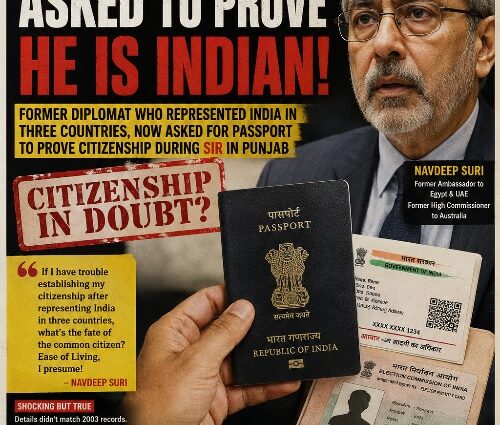
Aug 24th: In a bureaucratic twist so astonishing it almost reads like political satire, a retired Indian diplomat who spent decades representing India abroad has found himself having to prove that he is, in fact, an Indian citizen.
Navdeep Suri, former Ambassador to Egypt and the United Arab Emirates and former High Commissioner to Australia, encountered the problem during the ongoing Special Intensive Revision (SIR) of electoral rolls in Punjab.
Suri submitted his voter ID and Aadhaar card to the booth-level officer and was initially told that everything was in order. Then came the message: his details did not match the 2003 electoral records.
There was one small complication. Suri was posted overseas in 2003, doing precisely what the Indian government had sent him abroad to do: represent India.
He was subsequently asked to collect a notice and return with additional documents. The document eventually produced to establish his citizenship was, inevitably, his passport.
The irony was apparently too large even for Suri to ignore.
“If I have trouble establishing my citizenship after representing India in three countries, what’s the fate of the common citizen? Ease of Living, I presume!”
That one sentence captures the extraordinary predicament created by a verification exercise that is supposed to clean up electoral rolls but can instead leave genuine citizens scrambling through decades-old paperwork to prove what should scarcely require proving.
When Serving India Abroad Becomes A Paperwork Problem: Suri’s case raises a much larger question.
If a former senior diplomat, whose career included officially representing the Republic of India in three foreign countries, can be flagged because his present details do not neatly correspond with a 2003 record, what happens to millions of ordinary Indians whose lives are nowhere near as well documented?
For such citizens, a mismatch with an electoral roll from more than two decades ago could become far more than an administrative inconvenience. It could mean repeated visits to government offices, additional documentation, uncertainty, delays and, potentially, the terrifying possibility of one’s name being left out of the electoral roll.
The burden of proof is where the SIR exercise deserves much greater scrutiny. Cleaning electoral rolls is a legitimate objective. Removing duplicate, deceased or otherwise ineligible entries is necessary for the integrity of elections.
But the method matters. A system designed to improve electoral accuracy cannot become so documentation-heavy that genuine citizens are made to feel like suspects.
The fundamental question is simple: should the citizen have to prove his existence to the State, or should the State have a system capable of recognising its own citizens?
Suri’s experience suggests that the machinery can sometimes become more interested in matching old paperwork than understanding the lives of the people standing before it. And there lies the great absurdity.
A man who once carried the Indian government’s diplomatic authority abroad can return home and discover that, according to a database, his citizenship apparently needs a little more explaining.
If that is, “The Ease of Living..” The Modi government’s promise of reducing bureaucratic friction and making governance easier for citizens sits rather uncomfortably beside episodes such as this. Instead of making verification seamless through interconnected government records, the exercise risks putting the administrative burden back on the individual.
Suri’s case should therefore not be dismissed as the inconvenience of one retired diplomat. It should be treated as a warning. If someone who served India at the highest diplomatic levels can be caught in this bureaucratic maze, the real test of SIR will be how it treats the citizen who has no passport, no influential connections and no easy access to government offices.
With such an exhaustive, and frightening for many, bureaucratic maze, the government may want to explain exactly how this is supposed to qualify as “Ease of Living.”
JANPATH NEWS NETWORK (JNN)
Independent. Fearless. On the People’s Path.