










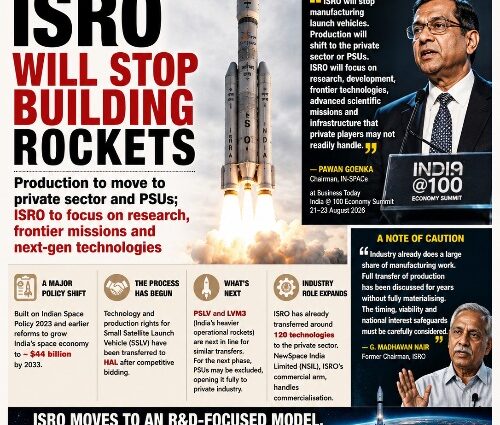
“Irony has left Earth’s orbit. The person who screamed that Congress would sell your Mangalsutra has now gone ahead and sold ISRO itself.” That was Congress leader Pawan Khera’s cutting reaction to the government’s decision to move ISRO away from manufacturing launch vehicles.
The line is political. But beneath the politics lies a question that deserves a much more serious answer: Is India commercialising ISRO, or is it gradually commercialising the public wealth that ISRO spent decades creating?
The government insists that ISRO is not being privatised. The organisation remains firmly under government control. Its scientists will increasingly concentrate on research, advanced technologies, scientific missions and the next generation of space capabilities, while private companies and PSUs manufacture mature launch vehicles.
IN-SPACe Chairman Pawan Goenka put the policy bluntly: “ISRO will not make any launch vehicles and will not manufacture any launch vehicles. That will all be done by the private sector or PSU.” He has also said around 120 ISRO technologies have already been transferred to industry.
The logic is understandable. India cannot build a globally competitive space economy if every mature technology remains inside a government factory.
But there is another side to the equation.
WHO PAID FOR THE TECHNOLOGY?
The PSLV was not born inside a private boardroom, neither was the LVM3. Their development rested on decades of public investment, public laboratories, publicly funded scientists, testing facilities and, inevitably, public failures. The Indian taxpayer absorbed the risk while ISRO learned how to do what few countries could do. Now that knowledge has commercial value.
And this is where a Parliamentary Standing Committee has already raised an uncomfortable warning. Its 410th Report expressed concern that space technologies developed by public institutions were being transferred to private players at “disproportionately low prices” compared with their commercial potential. The committee warned that private partners could earn significant profits while the institutions that created the technology received only a marginal share of the value.
Reports based on the committee’s findings say some technologies were transferred for fees as low as ₹6,000, while some were transferred without a fee at all. The committee recommended stronger valuation mechanisms and periodic third-party audits.
That is not an argument against private enterprise, but an argument for fair terms.
MADHAVAN NAIR’S WARNING IS MORE FUNDAMENTAL
Perhaps the most important voice in this debate is that of former ISRO chairman G. Madhavan Nair. Nair is not objecting to industry participating in India’s space programme. In fact, he points out that industry has already been deeply involved. According to him, roughly 90% of the work on rockets such as the PSLV and GSLV is already carried out by industry.
But there is a crucial difference: “The final assembly, integration, testing, and launching is done by ISRO,” Nair told The News Minute. “We cannot leave it to an industry who is not experienced or who does not have the expertise in the field.”
That sentence deserves to be read twice. Because the debate is not really about whether a private company can manufacture a rocket component.
It is about whether India can afford to lose the complete institutional capability to build, integrate, test and launch its own rockets.
Nair went further. He estimated that creating an establishment comparable to ISRO could cost around ₹50,000 crore, while the returns from launch-vehicle manufacturing alone might be only a few thousand crore.
“So which industry will come forward in making such a large investment with a very miniscule return? So that’s a big question mark,” he said.
That raises a strange paradox.
If rocket manufacturing is not sufficiently profitable to justify the enormous investment required to reproduce the full ISRO ecosystem, then who ultimately remains responsible for maintaining that capability?
The answer, inevitably, is the State.
THE GOVERNMENT MAY FREE ISRO. BUT WHAT MUST IT NOT LOSE?
The official argument is that ISRO should be freed from routine production, which could indeed allow scientists to concentrate on more ambitious missions, but manufacturing is not merely repetitive labour. A rocket factory is also a classroom.
Engineers discover weaknesses in production that may never appear on a drawing board. Testing reveals tolerances. Supply chains expose vulnerabilities. Production teams accumulate knowledge that is rarely written down in a manual, and that is what institutions call memory. And once that memory disappears, rebuilding it can take decades.
Nair has been even more blunt about the broader institutional danger. Speaking recently about the expanding role of IN-SPACe, he warned that the regulator is “overacting” and said ISRO’s unique culture must be protected. He has described that culture as something that should be nurtured, warning that “the golden egg-laying goose should not be killed.”
That metaphor may be the most useful way to understand the entire controversy: India should absolutely harvest the economic value of its space programme, but it should be careful not to dismantle the institution that produced that value in the first place.
THE $44-BILLION QUESTION
India wants its space economy to grow dramatically, that is a national ambition worth supporting, but the size of the future space economy is not enough. The harder question is who captures the value.
If a publicly developed technology is transferred cheaply, a private company commercialises it, investors capture the upside and the government receives only a small licensing fee, has the nation actually secured a fair return on its investment?
Perhaps. Perhaps not. That is precisely why the public deserves transparency; independent valuation; meaningful royalties, revenue-sharing where appropriate; strong audit mechanisms; strategic government rights; and complete clarity about who owns what.
PRIVATE INDIA SHOULD BUILD. PUBLIC INDIA MUST NOT LOSE
There is no reason to fear Indian private enterprise, let Indian companies build rockets, become global giants, and become a major space-manufacturing hub. But commercialisation cannot mean that the public assumes the foundational risk while private shareholders capture the principal commercial reward.
That is the heart of the issue. Pawan Khera’s political attack may provide the headline, but Madhavan Nair’s warning provides the substance: This is not simply a question of whether ISRO is technically being “privatised” but rather is a It is a question of whether publicly funded knowledge is being commercialised on terms that adequately protect the public interest.
And perhaps that is the question that should be asked before we celebrate the next billion dollars of India’s space economy: When the rocket rises, who rises with it?
JANPATH NEWS NETWORK (JNN)
Independent. Fearless. On the People’s Path.