










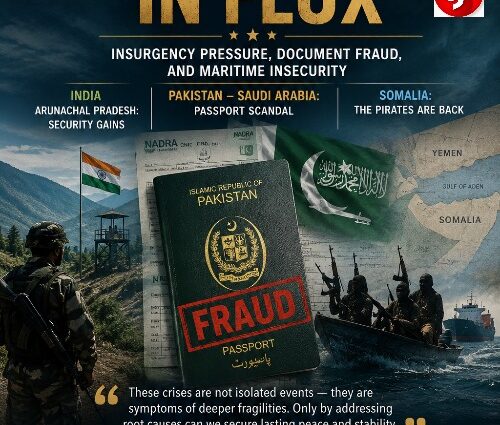
Across South Asia and the wider Indian Ocean region, a troubling security pattern is emerging: the old boundaries between terrorism, organised crime, document fraud, piracy and cross-border insurgency are becoming increasingly blurred.
From thousands of fraudulent Pakistani passports surfacing in Saudi Arabia, to Somali pirates returning to one of the world’s most important shipping corridors, and armed groups continuing to operate along India’s Myanmar border, the latest developments point to a common problem: weak governance creates openings that criminal and militant networks are quick to exploit.
Afsara Shaheen, Research Associate, Institute for Conflict Management observes that India faces a different but connected challenge along its northeastern frontier. Arunachal Pradesh has recorded a substantial increase in militant surrenders in 2026. According to partial SATP data, 23 militants surrendered in 16 incidents up to August 16, compared with 12 militants in eight incidents during 2025. The surrenders involve cadres from ULFA-I, NSCN-R, NSCN-IM and different NSCN-K factions, suggesting that sustained security operations and rehabilitation efforts are placing pressure across several insurgent networks.
Yet the improvement remains fragile. The strategically sensitive Tirap-Changlang-Longding region lies along the India-Myanmar border, where difficult terrain, porous boundaries and militant camps across the border continue to provide insurgents with room to manoeuvre. On August 14, NSCN-K-YA militants attacked an Assam Rifles camp in Changlang, while an earlier March attack killed three Assam Rifles personnel during construction of a border fence. Extortion also remains a source of financing for militant groups.
Afsara Shaheen highlights, “The real security victory is not simply making insurgents surrender; it is converting that surrender into durable peace. Arunachal Pradesh is showing that militant networks can be pushed into decline, but until extortion, cross-border sanctuaries and local vulnerabilities are dismantled, the insurgency has not truly been defeated.”
Ruchika Kakkar, Research Assistant, Institute for Conflict Management finds that in Pakistan, the exposure of a major passport and identity-document scandal has raised uncomfortable questions about the integrity of the country’s national identification system. On August 18, 2026, Minister of State for Interior Talal Chaudhry told Pakistan’s National Assembly that Afghan nationals had surrendered around 5,000 Pakistani passports in Saudi Arabia alone. Some Afghan nationals had allegedly obtained Pakistani Computerised National Identity Cards and were even inserted into the family trees of genuine Pakistani citizens, reportedly through collusion with citizens or officials of the National Database and Registration Authority (NADRA).
The scandal appears considerably larger than the latest figure. Parliamentary briefings covering previous years cited approximately 12,000 Pakistani passports recovered from or linked to Afghan nationals in Saudi Arabia, including cases involving photo-swapping, manipulated NADRA data and forged identity documents. Pakistani authorities have arrested officials and agents allegedly involved in producing fraudulent documents, with more than 100 agents reportedly arrested during recent operations.
The consequences extend well beyond Pakistan’s borders. When a person using a fraudulent Pakistani passport commits fraud, terrorism or another crime abroad, the document can cause that individual to be treated as a Pakistani national. Pakistan therefore faces not merely a domestic corruption problem but a potentially serious diplomatic and reputational one. For Saudi Arabia, which hosts large Pakistani and Afghan communities, fraudulent identity documents complicate immigration, labour regulation and security enforcement. Persistent abuse could ultimately result in greater scrutiny of genuine Pakistani workers, pilgrims and travellers.
The scandal also feeds directly into Pakistan’s increasingly hostile relationship with Afghanistan. Islamabad has returned nearly 2.7 million Afghans since late 2023 under its repatriation drive, citing illegal migration and security concerns, particularly the threat posed by the Tehreek-e-Taliban Pakistan. Kabul denies allowing Afghan territory to be used for attacks against Pakistan. Yet cross-border clashes, Pakistani strikes inside Afghanistan and retaliatory actions have pushed relations towards open confrontation. Identity fraud, in this environment, becomes more than bureaucratic corruption: it becomes another potential channel through which militant and criminal networks can operate.
Ruchika Kakkar explains: ““The fraudulent passports expose a deeper failure of state capacity, a state security system being undermined from within, threatening not only Pakistan’s security but its credibility with Saudi Arabia and the wider international community.”
At sea, another security threat is returning. On August 20, officials disclosed that two commercial vessels carrying a combined 22 Indian nationals had been hijacked in separate incidents involving the waters off Yemen and Somalia. The Eritrea-flagged tanker M.T. Sibu 1 was seized in the Gulf of Aden by armed pirates, while the Cameroon-flagged cargo vessel M/V LUTUF had been hijacked off Puntland several days earlier.
These attacks are part of a broader resurgence. Since April 2026, the French Navy’s Mica Centre has recorded 18 piracy incidents and hijackings, while maritime authorities have raised the threat level along the Somali coast. Earlier attacks and attempted hijackings have involved vessels carrying Indian nationals, including incidents successfully disrupted by the Indian Navy.
The return of Somali piracy is particularly significant because the phenomenon had been largely suppressed for more than a decade. Between 2005 and 2012, Somali pirates carried out more than 1,000 attacks and extracted hundreds of millions of dollars in ransom. International naval patrols, armed security teams and improved shipboard protection eventually brought successful hijackings close to a halt.
That fragile success has now been undermined by a combination of factors. Naval forces have been stretched by conflicts around the Red Sea and Strait of Hormuz, shipping routes have shifted, and instability along the Puntland coastline has allowed pirate networks to reactivate. The pirates are generally financially motivated coastal groups rather than a single terrorist organisation, drawing recruits from fishermen, former fighters, financiers and local networks. Their objective remains ransom, but their revival exposes how quickly security gains can disappear when state capacity and international attention weaken.
Ruchika sums it up, “The pirates may have returned to Somalia, but the real danger is larger than the pirates themselves: a weakened maritime security system, stretched naval forces and collapsing coastal livelihoods have reopened a corridor that the world had spent more than a decade securing.”
The three developments therefore reveal contrasting sides of the same regional security landscape. Pakistan is struggling with the exploitation of its identity infrastructure; Somalia is confronting the return of maritime predation; and India is demonstrating that sustained security pressure, intelligence operations and rehabilitation can weaken insurgent networks, even though the underlying threat has not disappeared.
The geography changes, but the vulnerability is remarkably familiar: wherever governance leaves a gap, someone eventually learns how to exploit it.
JANPATH NEWS NETWORK (JNN)
Independent. Fearless. On the People’s Path.