










Commodore DS Sodhi, NM (Retd.)
The Birth of Pakistan, carved out of India on 14 August 1947 as a result of the Two-Nation Theory, left behind wounds that have failed to heal.
Approximately one million people perished in the inter-communal violence that accompanied Partition. Innumerable accounts have since been written about those terrible days. Documentaries and films have revisited the tragedy, often bringing to life stories of suffering, displacement and loss.
Yet, within the vast and painful history of Partition, there remain chapters that have received far less attention.
One such chapter is the story of the Sikh community in Jammu and Kashmir during the Kabali invasion of 1947.
Following Partition, the princely State of Jammu and Kashmir chose to remain independent. The State, with its Muslim majority and significant Hindu and Sikh minorities, found itself in an increasingly precarious position. As the uprising by Muslims in Poonch began gaining momentum, Pakistan formulated a plan to invade and occupy Jammu and Kashmir through Pashtun armed raiders, known as Kabalis, under what came to be known as “Operation Gulmarg.”
Early indicators of Pakistani intentions were brought to the attention of the Maharaja by the British officer Maj Gen Scott. Pakistan also cut off supplies of fuel, sugar and salt to Kashmir, creating further unrest among the population.
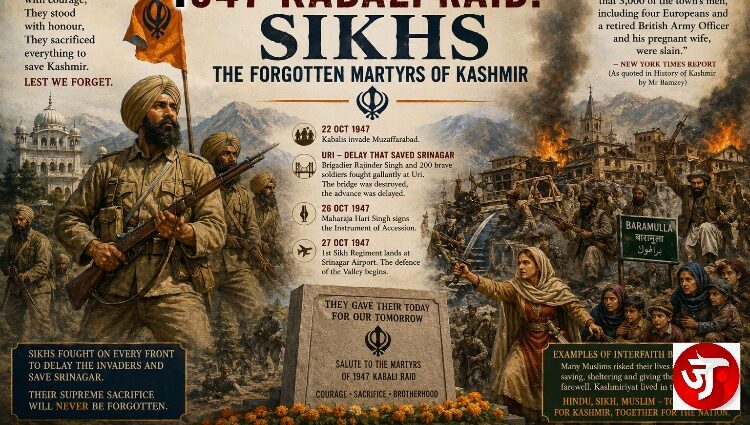
The Kabalis, supported by the Pakistan Army while operating in disguise, advanced along two principal axes, Poonch and Muzaffarabad. Organised into Lashkars numbering approximately 4,000 men, the invaders entered Muzaffarabad on 22 October 1947.
Their objective was clear: advance towards Baramulla, capture Srinagar Airport and seize control of the State.
In this desperate hour, the resistance offered by the State Forces at Uri became a pivotal delaying action.
Brigadier Rajinder Singh, Chief of Staff of the State Forces, accompanied by approximately 200 soldiers, fought the invaders gallantly at Saran Khowan De Bagh, Muzaffarabad. Vastly outnumbered, he was eventually forced to withdraw. During the retreat, the Uri bridge was destroyed, halting the invaders’ advance for a crucial period.
Brigadier Rajinder Singh was martyred on 27 October while fighting near Boniyar.
The resistance mounted by the State Forces bought precious time. That time enabled Maharaja Hari Singh to take the momentous decision to sign the Instrument of Accession on the evening of 26 October 1947.
The invaders had initially planned a five-day operation to capture Srinagar Airport. However, after overcoming resistance at Uri, they entered Baramulla. Instead of continuing immediately towards Srinagar, the Kabalis made a critical tactical error. They remained in Baramulla and the surrounding villages for two days, engaging in looting, arson, rape, killings and the plundering of property, much of it belonging to members of the minority communities.
Those two days would prove decisive.
Following the signing of the Instrument of Accession, the 1st Sikh Regiment landed at Srinagar Airport on the morning of 27 October and took up the defence of the Valley.
The Indian forces subsequently engaged the Kabalis at Khwaja Bagh in Baramulla, Pattan, Budgam and Shalteng, forcing the invaders into retreat. Col DK Rai was martyred at Khawaja Bagh, Baramulla, while Major Som Nath was martyred at Badgam.
The Kabalis were eventually pushed back and pursued by the Indian Army towards Uri. During their retreat, they once again killed innocent civilians, among them Muhammad Maqbool Sherwani of Baramulla, who had guided the Sikhs along a different route in an effort to save them from the Kabalis.
The Supreme Sacrifice of the Sikhs
This article seeks to bring to light some important events that exemplify not only supreme sacrifice but also the remarkable spirit of interfaith brotherhood that existed among ordinary Kashmiris during those dark days.
The complete chain of events cannot, of course, be covered within the limited space available in a publication. However, even these selected accounts reveal the extraordinary courage and sacrifice of the Sikh community.
In September 1947, as developments in Pakistan indicated an imminent attack on Jammu and Kashmir, Akali Kor Singh sent a message from Punjab to the Sikhs of Muzaffarabad, urging them to remain vigilant.
At this stage, Sant Gurbaksh Singh Danna, Jathedar Kapur Singh and Giani Ujagar Singh travelled through various villages, apprising the Sikh population of the prevailing situation. Jathedar Kapur Singh also convened a meeting of Shiromani Khalsa Dal at Gurdwara Amira Kadal in Srinagar.
Prior to the Kabali attack, Mr Vanchoo of the Public Works Department and S. Sadhu Singh of village Khadniyar had visited Muzaffarabad on official duty. When Muzaffarabad came under attack, they fled towards Baramulla and informed the Sikhs about the advancing Kabalis.
S. Kala Singh Raina, who had fled from Ghaddi Hateyan, met S. Tara Singh Musafir, S. Mohan Singh Bali and S. Nand Singh Kanlibagh. These Sikhs subsequently met the Deputy Commissioner, Mr Chaudhary Faiz Ullah, who informed them that he had received intelligence that the Kabalis would advance towards Srinagar.
He advised the Sikhs to move into the jungles. They moved to Singhpora, Dardpura and Ichama, among other places.
The Sikhs fought the Kabalis at every front with extraordinary courage and determination. Their resistance delayed the invaders’ movement towards Srinagar Airport. Many Sikhs, including women and children, attained martyrdom.
At Kanaspora, several Sikhs were killed. One of the village Muslims, Sultan Dar, carried their bodies to a house and set the house on fire so that the slain could receive a dignified funeral.
At Chandosa, two Muslims, Khalik Sheikh and Mohammad Sheikh, helped Sardarni Ghoni Kaur cremate the bodies of the martyred Sikhs.
These acts of humanity stand in stark contrast to the brutality surrounding them.
On 1 November 1947, the Kabalis attacked village Atna and began looting and arson. A courageous woman, Mata Ganga Kaur, came into the field with a sword in her hand to fight and inspire the Sikhs around her.
She was struck by a bullet and succumbed to her wounds.
Her courage became part of the larger story of ordinary men and women who refused to surrender in the face of overwhelming violence.
The Tragedy of Kamraz
Kamraz, on the other axis of the River Jhelum, contained numerous villages with significant Sikh populations.
As the situation deteriorated, the Sikhs abandoned their homes and property and assembled at a Gurdwara in village Satarna. A conscious decision was taken to move towards Srinagar.
S. Harnam Singh Ranger of Wampura recited the prayer, after which the Sikhs left Satarna.
Near Sopore, the group reached a marshy tract known as Nambli at Bulgam Choora. Here, Sikhs who were hiding were deceived by passing Kabalis who raised Sikh slogans. Believing them to be fellow Sikhs, the people emerged from hiding.
The deception ended in tragedy.
Approximately 450 to 500 Sikhs were killed at this location. Some managed to escape towards Srinagar, while others returned to their native villages.
The Sikhs who had travelled from Karnah to Chogal were advised by Kashmiri Pandits living there not to proceed towards Sopore.
Sardarni Salinder Kaur, wife of S. Sital Singh Raina, distinctly remembers the chain of events. She recalls how, at Sopore, Sikh women faced the horrifying prospect of captivity and attempted to take their own lives rather than lose their dignity. Some also jumped into the River Jhelum.
Sardarni Salinder Kaur herself suffered cuts and wounds on her limbs but managed to escape to her village, Patusa.
She also remembers the compassion shown by a local Muslim, Ghulam Mohd Mir, who provided them with food and shelter.
In the village of Mandna, kind-hearted Muslims including Sultan Tantarey, Gaffar Tantarey and Razzak Goria pleaded with the Kabalis not to harm the Sikhs.
In Khushipura, the bodies of Sikhs lay scattered across the village. Sardarni Makhan Kaur, daughter-in-law of S. Ganga Singh, pleaded with a Muslim for a respectful funeral for the dead.
He agreed, but on the condition that she marry him. She accepted.
However, after the bodies had been collected and a pyre was lit, Sardarni Makhan Kaur, along with her child, entered the fire and sacrificed her life to preserve her dignity and honour.
These are not merely stories of one community’s suffering. They are stories of extraordinary courage, terrible loss and, equally importantly, moments of humanity that survived even amid unimaginable violence.
Today, every house in Kashmir has a story to tell.
Baramulla: A Town of Death and Destruction
Mr Bamzey, in his book History of Kashmir, referring to a report in The New York Times, has written:
“Surviving residents estimate that 3,000 of the town’s men, including four Europeans and a retired British Army Officer and his pregnant wife, were slain.”
The scale of the tragedy at Baramulla demonstrates the devastation that accompanied the Kabali advance.
But within that devastation emerged another story, one that deserves to be remembered.
The Sikhs of Kashmir did not simply become victims of the invasion. After the forward defence of the State Forces was breached by the invading raiders, they formed the principal civilian line of determined resistance. Their resistance delayed the Kabalis and contributed to preventing their immediate advance towards Srinagar.
A Forgotten Chapter of Kashmir’s Defence
The basic purpose of this article, confined to Kashmir, is to draw the attention of the Government to the supreme sacrifice of the Sikhs who, after the breach of the State Forces’ forward defence, became a determined civilian line of resistance against the invading raiders.
The Kashmiris, in the spirit of indigenous secularism and brotherhood now commonly described as Kashmiriyat, fought together in the defence of the Valley and the Nation.
Yet it was the Sikhs of Baramulla, Kamraz, Karnah and Budgam who faced the brunt of the invasion.
Their story is not merely a Sikh story.
It is a Kashmiri story.
It is a story of courage in the face of overwhelming odds, of civilians who refused to abandon their homeland, and of ordinary people who made extraordinary sacrifices when the State itself stood in mortal danger.
It is also a story of interfaith brotherhood. Muslims who risked their own lives to shelter Sikhs, provide food, protect the dead and help families escape the violence demonstrated that humanity could survive even during one of the darkest chapters of the subcontinent’s history.
The role and sacrifices of the Sikh community during this defining chapter have been documented by locals, eyewitnesses and contemporary accounts.
Yet much of this history remains insufficiently recognised.
The supreme sacrifice of the Sikh martyrs deserves enduring public recognition through a dedicated memorial. An appeal has accordingly been made to the concerned authorities.
Such a memorial would not merely honour those who gave their lives, it would preserve for posterity an inspiring and painful chapter in the history of Jammu and Kashmir and the Nation. It would remind future generations that, in 1947, when the Valley stood on the brink of being overrun, ordinary men and women stood their ground.
They fought, resisted, sacrificed, and many of them never returned home.
Their sacrifice deserves to be remembered.
Lest we forget.
Commodore DS Sodhi, NM (Retd.)
The author is Former Deputy Assistant Chief of Headquarters Integrated Staff (IT), Author and Social Activist.